Stand on the east coast of England on a windy day and stare out across the North Sea. It looks permanent, moody and slightly annoyed, like a grey animal that has no interest in your weekend plans. Yet for thousands of years, that water was not water at all. It was land. Not a tiny strip, not a decorative island, not a polite geological footnote, but a broad, lived-in landscape of rivers, marshes, forests, animals and people. That vanished place now has a wonderfully blunt name: Doggerland.
The name comes from Dogger Bank, the shallow sandbank in the North Sea, which itself takes its name from old Dutch fishing boats called doggers. So yes, one of Europe’s most haunting lost landscapes sounds vaguely like a place where spaniels hold a committee meeting. History rarely cares about branding.
Doggerland once connected Britain to mainland Europe. During and after the last Ice Age, when sea levels sat much lower, people could move between what we now call Britain, the Netherlands, Germany and Denmark without needing a ferry, passport queue or overpriced airport sandwich. National Geographic describes it as a region of north-west Europe inhabited by Mesolithic people before rising seas drowned it and reshaped Europe into something closer to today’s map.
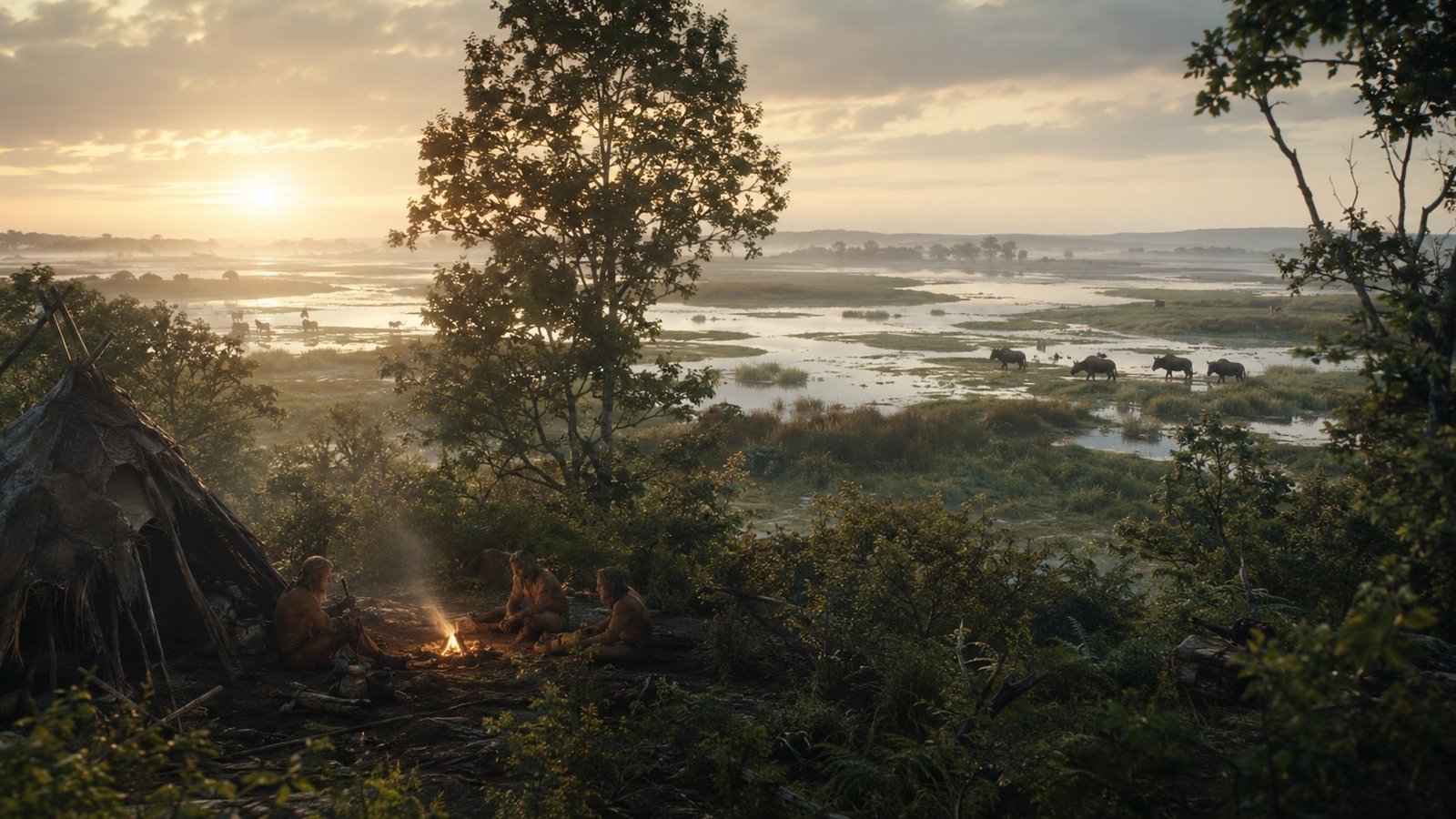
For a long time, people treated Doggerland as a land bridge, which sounds useful but rather dull. A land bridge is what you cross on the way to somewhere more interesting. Recent archaeology has made that view look lazy. Doggerland probably supported rich ecosystems and human communities. It had river valleys, lagoons, wetlands, wooded areas and animals worth following if you made your living by hunting, fishing and gathering. In other words, this was not a prehistoric motorway service station between Europe and Britain. It was home.
That matters because it changes how we imagine early Britain. Britain did not begin as an island sealed away from the continent by national temperament and damp weather. For much of human prehistory, it formed part of a wider European world. People, animals, tools, stories and genes moved across landscapes that now lie beneath shipping lanes, fishing grounds and offshore wind infrastructure. The sea did not simply separate Britain from Europe. It arrived late, with very wet paperwork.
The most recent research has made Doggerland even more intriguing. In 2026, the University of Bradford reported on a major sedimentary ancient DNA study led by the University of Warwick. Researchers analysed 252 samples from 41 marine cores and found evidence that temperate woodland species, including oak, elm and hazel, grew in parts of Doggerland more than 16,000 years ago. They also detected lime, a warmth-loving tree, earlier than expected in mainland British records, and even DNA from Pterocarya, a walnut relative thought to have vanished from north-western Europe hundreds of thousands of years earlier.
That is not a small tweak to the scenery. It suggests parts of Doggerland may have acted as a northern refuge for plants and animals during harsh climatic periods. Instead of picturing the place only as bleak tundra with heroic humans shivering beside a fire, we may need to imagine patches of woodland, animal movement, seasonal abundance and a landscape more hospitable than scholars once assumed. The same study suggested these environments could have supported early Mesolithic communities before flooding removed much of the evidence from easy archaeological reach.
Of course, Doggerland did not disappear overnight because the sea woke up in a bad mood. Its loss unfolded over millennia as ice sheets melted and sea levels rose. The story had stages. A broad plain became a shrinking territory. The shrinking territory became islands. The islands became memories, then seabed. The University of Bradford’s 2025 interactive simulation charts Doggerland from around 20,000 years ago to 5,000 years ago, showing it change from a vast landmass into an archipelago, then a final island, before the North Sea swallowed it.
That slow drowning makes Doggerland strangely modern. We often treat sea-level rise as an abstract line on a graph, because graphs make disaster look employable. Doggerland reminds us that rising water does not merely change coastlines. It changes where people sleep, hunt, remember, bury their dead and tell children where not to wander. A 2024 study on early Holocene inundation found that sea-level rise affected Mesolithic hunter-gatherer communities by flooding large areas of what is now the North Sea, with significant land loss around 10,500 to 10,000 years before present in parts of the southern North Sea.
Then came the Storegga tsunami, the dramatic celebrity cameo in the Doggerland story. Around 8,150 years ago, a huge submarine landslide off Norway triggered a tsunami across the North Atlantic. For years, popular retellings made it sound as though one giant wave finished Doggerland in a single cinematic gulp. Lovely drama, questionable simplicity. Research has complicated that picture. A modelling study argued that Doggerland’s abandonment probably resulted more from rapid sea-level rise before the tsunami than from the tsunami alone.
Still, what a scene it must have been. Imagine living in a landscape already losing ground to marsh, tide and salt water, then one day the sea comes in with entirely unnecessary enthusiasm. Even if the tsunami did not erase the whole place at once, it may have devastated vulnerable coastal zones and accelerated the end for communities already under pressure. Doggerland’s tragedy was not one disaster. It was a long retreat with a violent shove.
The evidence reaches us in odd ways. Fishermen have hauled up bones, antlers, tools and other traces from the seabed. Sand extraction and beach finds have added more clues. The University of Groningen’s FLOOD project notes that thousands of bones and artefacts recovered through fishing, sand extraction and beachcombing form an internationally important archive, while also pointing out a very archaeologist problem: many finds lack clear context, so dating them accurately can prove difficult.
That is one of the controversies around Doggerland. We know it existed. We know people used it. And we know the sea covered it. Yet much of the fine detail remains slippery, because underwater archaeology does not behave like a polite excavation trench in a field. Currents move things. Sediments bury things. Fishing gear disturbs things. Offshore industry sometimes reveals evidence while also complicating preservation. Doggerland sits beneath one of the busiest seas in the world, which is rather inconvenient for a lost Stone Age landscape trying to keep its secrets organised.
Then there is the Atlantis problem. People love a drowned land, and they love it even more when they can attach myth to it. Doggerland has inspired comparisons with Atlantis, flood legends and ancient memory. That does not mean Plato secretly described Norfolk with better weather. The sensible version says that real ancient floods may have left cultural echoes in oral traditions. The sillier version tries to turn every submerged landscape into a lost super-civilisation with crystals, temples and suspiciously advanced plumbing. Doggerland deserves better. Its real story already has enough wonder without giving everyone bronze-age Wi-Fi.
The practical lesson feels sharper because Doggerland sits so close to home. This was not some remote vanished continent beyond the edge of medieval maps. It lay between Britain and Europe, in waters crossed daily by ships and studied by energy companies. Modern scientists now use seismic data, marine cores, ancient DNA, modelling and artificial intelligence to reconstruct it. Bradford researchers have already mapped 188,000 square kilometres of seabed and plan to use AI to narrow the search for prehistoric settlement evidence.
That blend of ancient mud and modern computing feels almost comic. Mesolithic families left traces in a landscape that vanished beneath the waves, and now people with algorithms, marine surveys and lab coats try to find their campfires. It sounds like archaeology written by someone who owns both a trowel and a gaming laptop.