Dante and Hell as Medieval Social Media
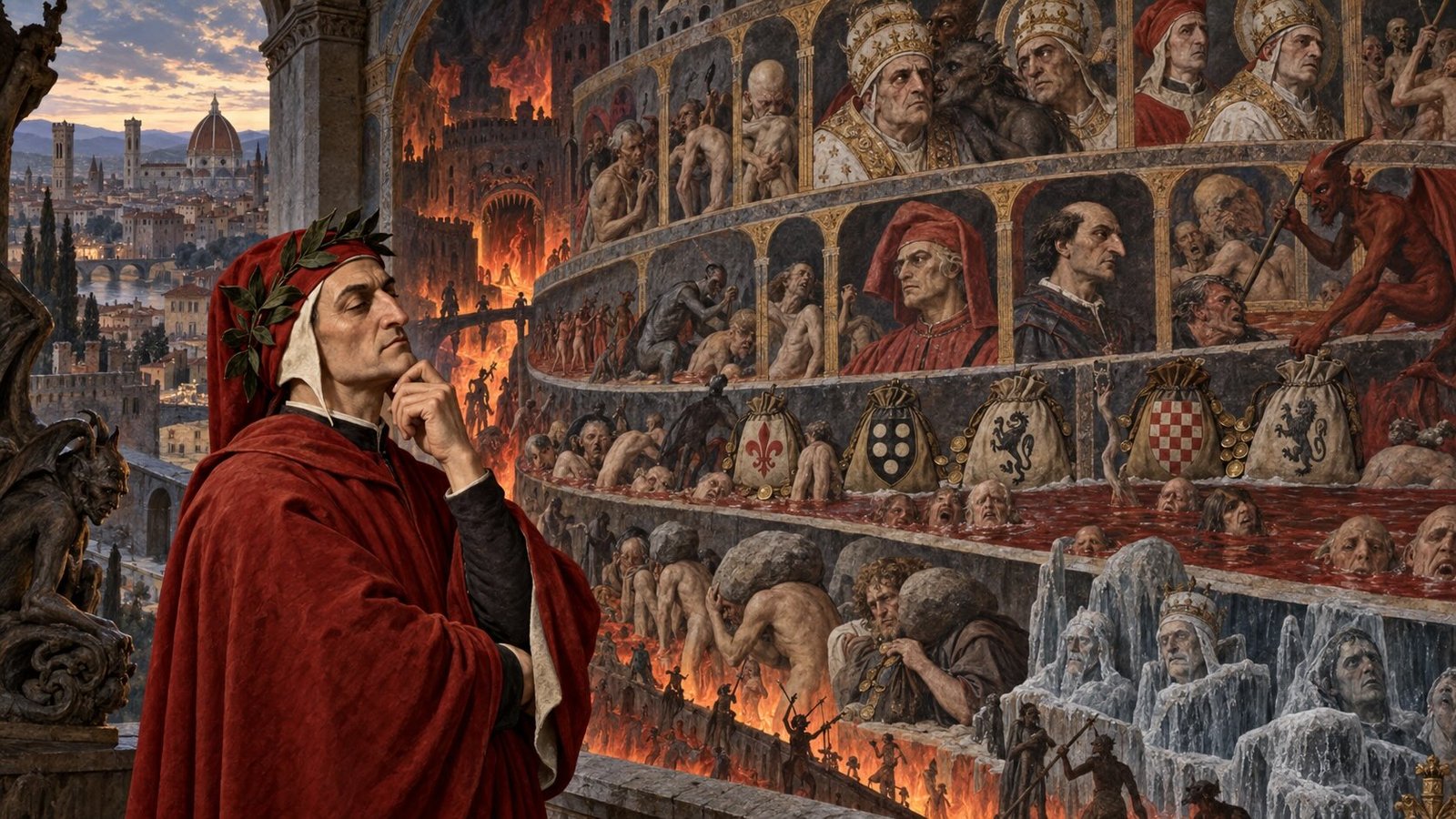
If social media had existed in medieval Florence, Dante Alighieri would have used it like a man with a grudge, a memory like a steel trap, and far too much talent for everybody else’s comfort. He would have posted names, hinted at scandals, ranked sinners, exposed hypocrisy, and then wrapped the whole thing in such brilliant language that people would still quote him seven hundred years later. In that sense, Inferno does not merely resemble a poem about Hell. It also feels uncannily like a permanent public feed of moral judgement, political commentary, and personal score-settling.
That comparison sounds cheeky, but it works better than one might expect. Dante filled his Hell with real people, many of them famous to his contemporaries. He did not hide behind vague abstractions. He named politicians, churchmen, military leaders, friends, rivals, and financiers, then placed them in carefully chosen circles of torment. Every punishment carried a message, and every message had an audience. This was not private irritation muttered into a cup of wine. This was public curation.
The timing mattered. Dante lived in a Florence that treated political peace as a charming but unrealistic fantasy. Factions fought factions, alliances shifted, and the papacy interfered in civic life with all the delicacy of a man kicking in a locked door. Dante himself took part in Florentine politics and ended up on the losing side. In 1302, his enemies exiled him from the city. He never returned. Exile gave him distance, bitterness, and a great deal of time to think about who had helped wreck his world. So he wrote a masterpiece and put many of them in Hell. That is not just literary genius. That is vengeance with archival quality.
One reason the social-media analogy feels so modern lies in the way Dante blends moral seriousness with recognisable human pettiness. Inferno certainly deals with sin, salvation, justice, and the soul. Yet it also contains flashes of something more familiar: “I know exactly what you did, and now everyone else will know as well.” He does not merely condemn corruption in general. He gives corruption a face, a family, and often a speaking role. Readers then watch the sinner explain himself, expose himself, or accidentally make matters worse. If that sounds like the medieval version of a disastrous public thread, well, that is because it often is.
Take Filippo Argenti, one of the more personal targets. He belonged to the Black Guelph faction, which opposed Dante’s side in Florence. When Dante meets him among the wrathful, the scene pulses with contempt. There is no lofty neutrality here. Dante clearly dislikes the man, and he writes him accordingly. The encounter feels less like serene moral philosophy and more like watching somebody who has finally found the perfect venue for an old quarrel.
Then there are the popes, and here Dante becomes truly fearless or gloriously reckless, depending on one’s taste. He places Pope Nicholas III in Hell for simony, which meant buying and selling church offices. Nicholas, in one of Inferno’s nastiest comic touches, mistakes Dante for Boniface VIII, because he assumes Boniface must already be on the way to the same punishment. Boniface was still alive in the poem’s fictional timeframe, which makes the whole scene wonderfully savage. Dante more or less reserves a future place in Hell for a living pope, as if posting, “Just preparing the list for when the next scandal finally becomes official.” That sort of confidence deserves respect, even if it also suggests that Dante would have been absolutely exhausting online.
His treatment of financiers and money men brings another layer to the comparison. In the circle of the usurers, Dante does something clever. He does not rely only on names. Instead, he identifies certain sinners by the heraldic purses hanging from their necks. Contemporary readers would have recognised the family symbols. In effect, he tags them visually. He manages the medieval equivalent of calling someone out without even needing to type the full username. Everybody in the know still understands who is being targeted, and that is all he needs.
This is what makes Inferno feel less like random insult and more like a highly structured reputational machine. Dante chooses not just whom to shame, but how to shame them. Some figures receive grotesque punishments. Others receive a cruelly fitting punishment that mirrors the nature of the sin. Others still gain a strange dignity, despite damnation. That last detail matters, because Dante is too intelligent to reduce the poem to a petty blacklist. He sometimes grants grandeur to people he opposes, and sometimes handles people he admires with sorrow rather than hatred.
Brunetto Latini is a fine example. Dante respected him deeply, yet still placed him among the sodomites. The meeting carries tenderness, grief, and reverence. This is no simple revenge fantasy. Dante has a moral architecture in mind, and he applies it even when it hurts. That gives the poem much of its authority. At the same time, one should not pretend that personal feeling disappears. It seeps through constantly, which makes the work both more human and more entertaining.
Modern social media loves outrage, but it also loves performance. Dante understood performance very well. He built scenes for maximum memorability. He gave us dramatic recognitions, emotional confrontations, prophetic warnings, and symbolic punishments so vivid that they still cling to the imagination. A man cannot just be corrupt. No, he must stand buried upside down with flames licking his feet. A flatterer cannot simply be criticised. He must wallow in filth. Dante knew that if one wants an audience, one should offer images people cannot forget.
He also understood something that every platform still runs on: public ranking. Hell in Inferno is not chaotic. It has order, hierarchy, categories, and gradations of blame. Some sins reflect weakness, others violence, others fraud. The deeper Dante goes, the more deliberate and destructive the offences become. In other words, he does not simply denounce people. He sorts them. If that does not sound like a medieval precursor to online tier lists and moral scoring, nothing does.
Yet there is an important difference, and it is worth keeping in view. Social media often produces instant judgement with very little reflection, whereas Dante’s judgements sit inside a vast theological, philosophical, and poetic structure. He does not post in haste after a bad lunch. He builds an entire cosmos of responsibility. Even when he behaves like a man settling scores, he does so with extraordinary intellectual ambition. That is why Inferno still matters. It is gossip raised to the level of civilisation.
The funniest part, perhaps, is that Dante achieved what countless online polemicists only dream about. Most digital outrage burns furiously for a few days and then vanishes beneath the next scandal. Dante’s call-outs did not vanish. They entered world literature. Imagine insulting a corrupt public figure so effectively that schoolchildren read it centuries later and tourists buy fridge magnets related to your afterlife system. That is not merely going viral. That is building an immortal brand around moral fury.
So yes, Dante’s Hell works beautifully as a medieval social network, though one with better writing and rather stronger enforcement policies. It gave readers scandal, tribal politics, moral theatre, celebrity damnation, and the thrill of seeing the mighty publicly classified. It also gave Europe one of its great works of art, which is not usually what happens when somebody decides to air grievances in public.
Seen that way, Inferno feels startlingly current. Dante understood that people hunger for stories in which power gets exposed, hypocrisy gets punished, and names get attached to bad behaviour. He also understood that once a judgement enters the public imagination, it can outlive courts, offices, factions, and fortunes. Social media did not invent public shaming. It simply made it faster, noisier, and far less poetic.
Post Comment
You must be logged in to post a comment.