
In the early 1960s, America built a passenger and cargo ship that could cross oceans without stopping for fuel. The NS Savannah had a swimming pool, an elegant dining room and a nuclear reactor. Its designers imagined a future in which merchant ships would travel the world powered by the atom. Unfortunately, the shipping industry had other ideas. Conventional vessels were cheaper to operate, and Savannah retired in 1970.
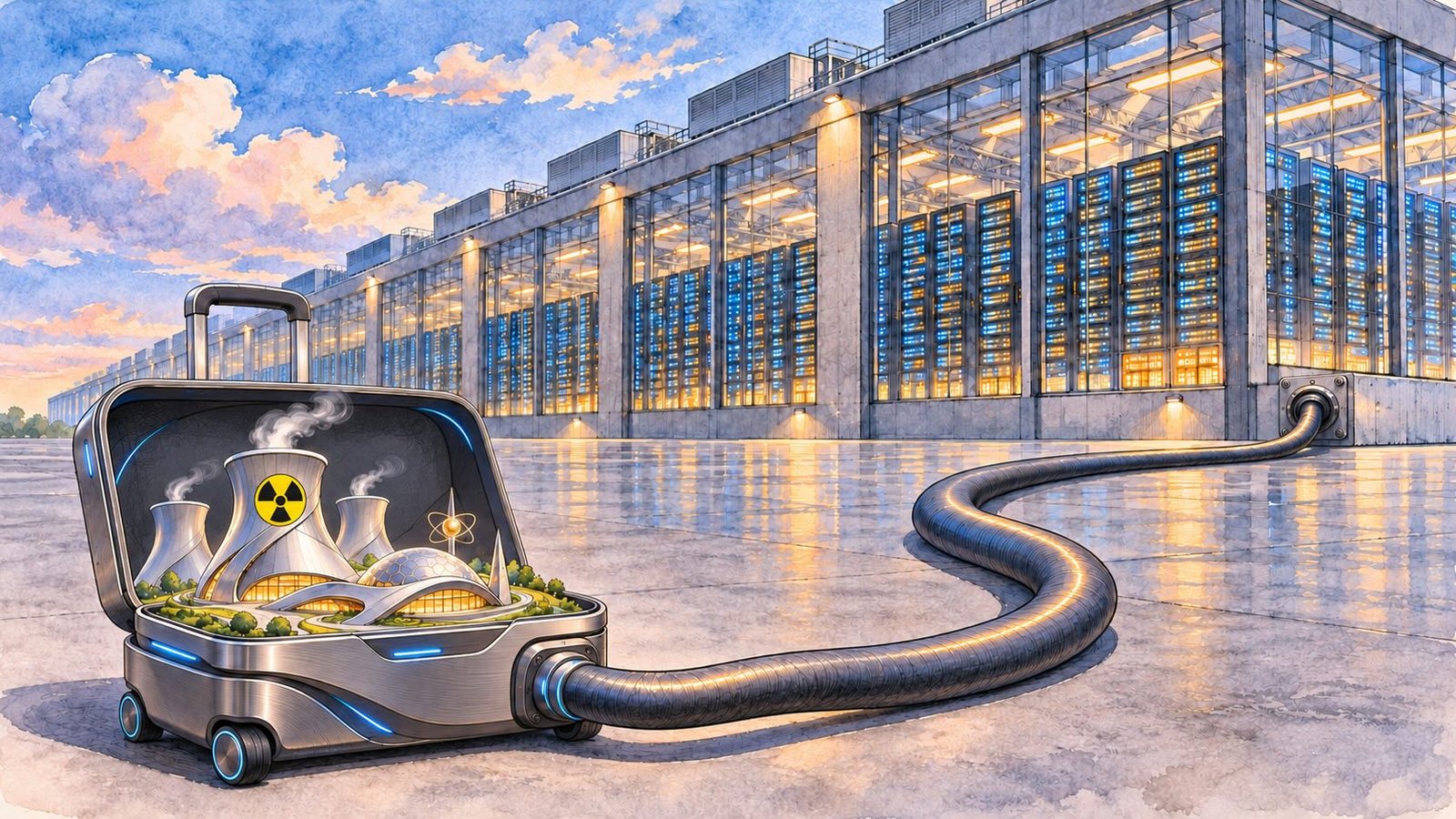
More than half a century later, a new generation of entrepreneurs is revisiting the same commercial puzzle: how to turn a small nuclear reactor into a profitable product. This time, their prospective customers are not shipping companies but the businesses behind artificial intelligence.
The idea of a compact nuclear reactor is almost as old as nuclear power itself. In January 1955, the USS Nautilus became the first submarine to travel under nuclear power. In 1959, the Soviet nuclear-powered icebreaker Lenin entered service. It subsequently spent three decades navigating Arctic waters, where operating for extended periods without refuelling offered an obvious advantage.
These vessels demonstrated that a reactor did not have to occupy an enormous building surrounded by cooling towers. Yet the economic considerations of operating a submarine or an Arctic icebreaker bear little resemblance to those of supplying electricity to ordinary households.
Civilian nuclear power went in the opposite direction. Engineers built progressively larger reactors because much of the cost of running a nuclear power station does not increase in proportion to its generating capacity. A bigger reactor could produce more electricity without requiring twice as many employees or twice the expenditure on security.
The trouble was that nuclear power stations also became enormously complicated construction projects. Britain offers a familiar example at Hinkley Point C, where construction schedules and projected costs have repeatedly undergone revision. Building a nuclear power station increasingly resembles building a medieval cathedral, complete with the possibility that those who commissioned it might retire before its completion.
Small modular reactors, commonly known as SMRs, propose a different economic model. Generally producing up to 300 megawatts of electricity per unit, they are designed around standardisation and factory manufacturing. Instead of maximising the output of each reactor, their developers hope to reduce costs through repetition.
Consider the difference between building a railway bridge and manufacturing a passenger train. Every bridge presents a different engineering challenge, whereas a factory can produce hundreds of almost identical trains. Nuclear entrepreneurs would like their industry to resemble the latter.
Unfortunately, the first attempts have hardly been reassuring. In November 2023, the American company NuScale and a group of municipal electricity providers abandoned an ambitious nuclear power project in Idaho. Rising projected electricity costs had made the proposition increasingly unattractive, and the project failed to secure enough customer commitments. Regulatory progress had not translated into commercial success.
Other countries have managed to get modular nuclear power stations into operation. Russia’s Akademik Lomonosov, a floating nuclear power station, began commercial operation in 2020. It supplies electricity and heating to Pevek, a remote Arctic town. In December 2023, China brought its HTR-PM modular nuclear power station into commercial service.
Both represent genuine engineering achievements. Neither, though, has demonstrated that factories can produce nuclear power stations in large quantities at consistently competitive prices. The distinction between a successful reactor and a successful manufacturing business remains rather substantial.
Then came artificial intelligence. Technology companies began encountering a problem that even the cleverest software could not solve: finding enough electricity. A data centre cannot simply suspend operations because the wind has stopped blowing or the sun has disappeared behind the horizon. For companies investing billions in computing infrastructure, reliable electricity has become a commercial priority.
Among those hoping to satisfy this demand is Aalo Atomics, an American start-up founded in 2023. Its name comes from the Bengali word for light, and its ambition is to bring something resembling assembly-line manufacturing to the nuclear industry. The company envisages standardised power installations designed particularly for large industrial customers and data centres.
Aalo reported an important milestone in 2026 when its experimental reactor achieved its first sustained nuclear reaction. For a company only three years old, this represents considerable progress. It has also announced plans to expand its manufacturing capacity. Nevertheless, an experimental reactor is not a commercial power station, and an impressive factory does not guarantee an attractive electricity price.
Aalo faces competition from some surprisingly familiar names. Bill Gates founded TerraPower in 2006, long before the current enthusiasm for artificial intelligence. Sam Altman became an early supporter and chairman of Oklo, stepping down from the latter role in April 2025. Amazon has invested in X-energy, while Google has signed an agreement to purchase future nuclear electricity from Kairos Power.
Established engineering companies have joined the competition. Rolls-Royce is pursuing modular nuclear power stations in Britain, while GE Hitachi and Westinghouse are developing their own offerings. Their approaches differ considerably, with some targeting national electricity grids and others concentrating on individual industrial customers.
One famous technology entrepreneur is conspicuously absent. Elon Musk has built businesses around electric vehicles, batteries, artificial intelligence and industrial manufacturing. He has also publicly defended nuclear energy, arguing against the premature closure of existing power stations. On paper, modular nuclear power looks remarkably compatible with his interests.
There is no confirmed explanation for Musk’s absence from the reactor manufacturing business. Tesla’s energy division already operates in a market where batteries can reach customers relatively quickly, whereas nuclear developers face years of regulatory scrutiny and substantial capital commitments before earning revenue. Musk might also find it perfectly sensible to buy nuclear-generated electricity for his AI businesses without taking on the responsibility of producing it.
The greatest obstacle for modular nuclear power, however, has little to do with famous billionaires. Manufacturers need substantial orders before mass production can bring down costs. Customers want evidence of lower costs before committing to substantial orders. Someone has to make the first expensive commitment, without knowing whether enough others will follow.
This is where technology companies could change the industry’s fortunes. Conventional electricity suppliers have strong incentives to minimise the price of power. For an AI company, the immediate availability of electricity may sometimes matter as much as its price. Delaying the opening of a multibillion-dollar data centre can be painfully expensive.
Seventy years after the Nautilus first sailed under nuclear power, the industry no longer needs to prove that reactors can be small. It needs to prove that small reactors can become ordinary commercial products. Perhaps the most encouraging announcement from Aalo or one of its competitors will eventually be that its hundredth power station looks exactly like the ninety-ninth, costs slightly less and opens without attracting much attention.