She arrived at King Solomon’s court carrying gold, precious stones, exotic spices and a collection of difficult questions. She left with her questions answered, her gifts exchanged and her reputation secured for nearly three thousand years. Yet there is one rather inconvenient detail about the Queen of Sheba: nobody knows whether she actually existed.
Few women from the ancient world have inspired such an impressive collection of stories while leaving so little reliable evidence of their own lives. The Bible presents her as a wealthy foreign monarch who tests Solomon’s wisdom. Islamic tradition calls her Bilqis and gives her a much more elaborate story involving a hoopoe bird, a mysterious throne and a diplomatic encounter with a prophet. Ethiopian tradition goes further, making her the mother of a royal dynasty that supposedly ruled until 1974. Three religious and cultural traditions, three rather different women, and not a single contemporary inscription that identifies her.
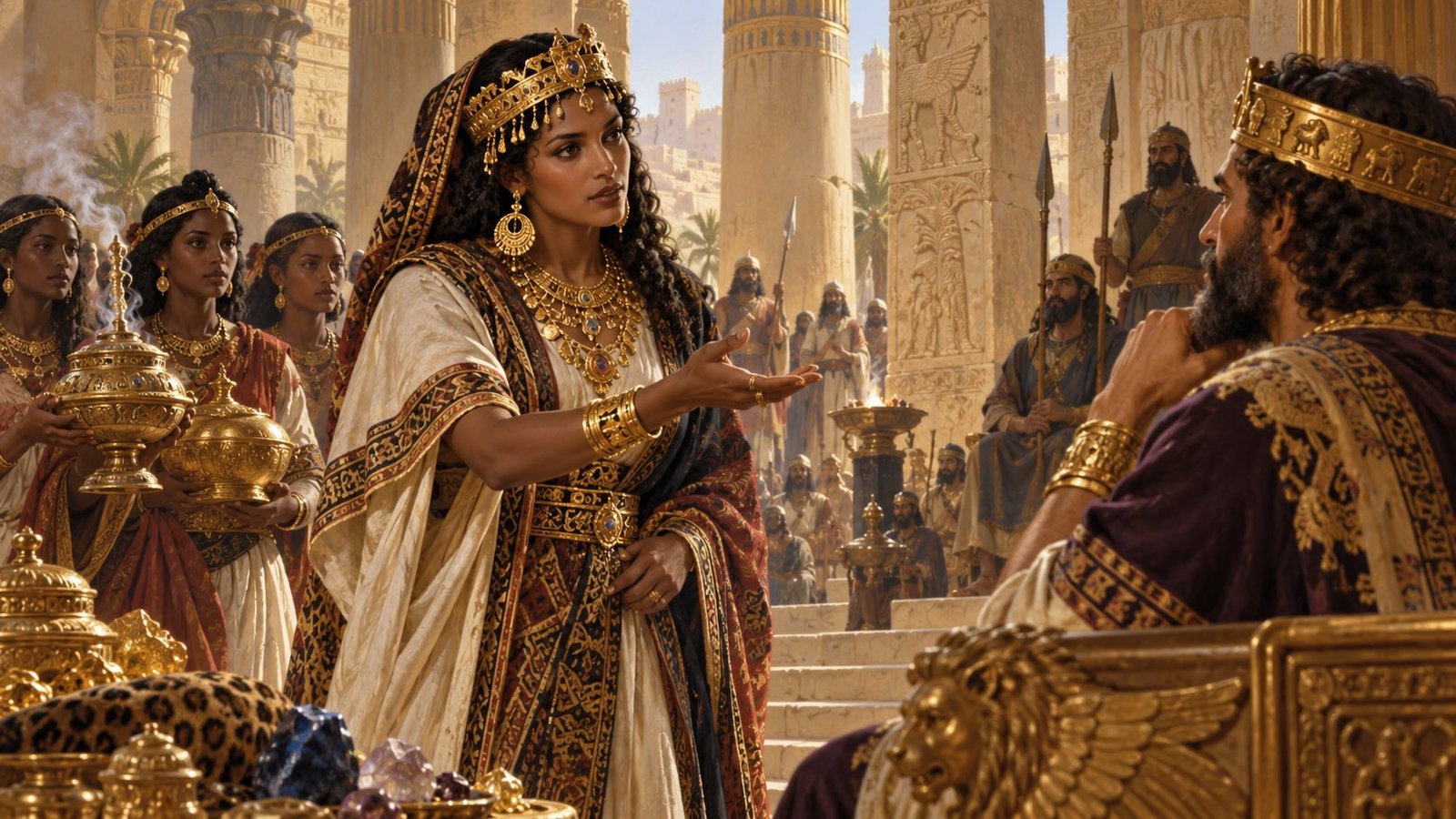
The earliest surviving account appears in the First Book of Kings, probably compiled centuries after Solomon’s traditional tenth-century BC reign. Hearing of his extraordinary wisdom, the Queen of Sheba travels to Jerusalem to test him with difficult questions. She arrives with a magnificent caravan, bringing camels loaded with spices, gold and precious stones. Solomon answers everything she asks. Suitably impressed, she praises his wisdom, his prosperity and the God who has placed him on the throne.
The biblical account is surprisingly restrained. There is no romance, no marriage and no suggestion of children. The queen gives Solomon 120 talents of gold, an enormous quantity whose precise modern equivalent depends on the weight standard used, and receives gifts in return. Then she goes home. For a woman who would eventually become one of history’s most celebrated mysterious beauties, her first literary appearance is essentially a high-level diplomatic visit with an unusually demanding examination. But the story raises an obvious geographical question. Where exactly was Sheba?
Most historians associate the biblical kingdom with Saba, an ancient civilisation centred in what is now Yemen. The Sabaeans prospered through agriculture and trade, particularly the lucrative exchange of aromatics such as frankincense and myrrh. These substances were essential to religious ceremonies, medicine and luxury consumption across the ancient Near East. Before modern perfume counters and pharmaceutical companies, aromatic resins were serious international business.
The Sabaean kingdom developed sophisticated irrigation systems, including the famous dam at Marib, and controlled important routes connecting southern Arabia with markets farther north. Its wealth was real, although the precise chronology of its earliest political development remains debated. The archaeological record has not established the existence of a queen who travelled to Jerusalem in Solomon’s lifetime. Nor does it demonstrate that Saba was already the powerful, organised kingdom described in later accounts during the tenth century BC.
There is another geographical complication. The ancient Red Sea connected southern Arabia with the Horn of Africa, and cultural and commercial contacts crossed those waters over many centuries. Sabaean inscriptions and material influences appear in parts of present-day Ethiopia and Eritrea. These connections help explain why both Yemen and Ethiopia have powerful traditions surrounding the Queen of Sheba, although they do not establish where a historical queen, if one existed, was born.
In the Quran, the queen’s story takes a distinctly different turn. Although the text does not name her, later Islamic literature generally calls her Bilqis. A hoopoe bird informs Solomon that it has found a woman ruling a prosperous kingdom whose people worship the sun. Solomon sends a message demanding that they submit to God. The queen consults her advisers and sends gifts, but Solomon refuses to be impressed by wealth. Eventually she visits his court, where her throne has mysteriously arrived before her.
The most memorable episode involves a palace floor made of glass. Mistaking the transparent surface for water, the queen lifts her clothing to avoid getting wet. Solomon explains that it is a polished floor, and she acknowledges her error and submits to God. The Quran presents a story about faith, judgement and political authority, not a love affair. Later storytellers, apparently unwilling to leave a perfectly good royal encounter without romantic complications, supplied those themselves.
Ethiopia developed the most politically consequential version of the story. In the Kebra Nagast, a medieval Ethiopian work whose title means The Glory of Kings, the queen is known as Makeda. She visits Solomon, becomes pregnant by him and gives birth to Menelik, traditionally regarded as the founder of Ethiopia’s Solomonic dynasty.
The narrative continues with an episode of astonishing ambition. Menelik travels to Jerusalem to meet his father and eventually returns to Ethiopia accompanied by the Ark of the Covenant, the sacred chest associated with the tablets of the Ten Commandments. Ethiopian Orthodox tradition holds that the Ark remains in Axum, guarded at the Church of Our Lady Mary of Zion. The claim is a matter of religious belief, not an archaeologically verified fact, and the object is not available for independent examination.
This story was no harmless royal fairy tale. It became a foundation of Ethiopian imperial legitimacy. The Solomonic dynasty claimed descent from Solomon and Makeda, a genealogy that linked Ethiopian monarchy directly to biblical sacred history. Emperor Haile Selassie, deposed in 1974, belonged to that tradition and presented himself as a descendant of their son Menelik. A woman whose historical existence remains unconfirmed had become an ancestor of emperors and a source of political authority.
The Queen of Sheba also acquired a romantic reputation that her earliest biblical appearance scarcely justifies. Later Jewish, Christian, Islamic and European traditions variously portrayed her as a beautiful foreign ruler, a convert, a lover and occasionally a dangerous seductress. Artists particularly enjoyed the encounter between the two monarchs, often dressing them in the fashions of their own periods. Renaissance and Baroque paintings transformed an ancient diplomatic exchange into a lavish royal spectacle.
Even her supposed appearance became a subject of speculation. Some later legends attributed unusual feet or hairy legs to the queen, while other traditions associated her with supernatural ancestry. Such details tell us considerably more about the imagination and anxieties of later storytellers than about an ancient Arabian or African monarch. A powerful foreign woman, it seems, was not allowed to remain merely intelligent, wealthy and politically independent. Something unusual had to be done about her feet.
The historical problem remains stubborn. We possess inscriptions, temples, irrigation works and other evidence for the civilisation of Saba. We have biblical and Islamic accounts of the queen, together with a substantial Ethiopian literary tradition. What we lack is direct contemporary evidence connecting a particular female ruler of Saba with Solomon. It is entirely possible that the biblical narrative preserves memories of early trade and diplomatic contacts between southern Arabia and the Levant. It is equally possible that its central encounter developed as a literary demonstration of Solomon’s wisdom and international prestige.
There is also an overlooked aspect of the story. In its earliest biblical form, the queen is not simply an admirer arriving to congratulate a famous king. She is a sovereign who investigates another ruler’s reputation for herself. She brings valuable goods, poses difficult questions, judges the answers and speaks with considerable authority. Solomon’s greatness is confirmed not by a submissive subject but by the independent assessment of a foreign monarch. That makes her essential to the story, even though the writer never bothers to record her name.
Perhaps this explains why the Queen of Sheba has survived so successfully in different cultures. The biblical writers needed a formidable visitor to demonstrate Solomon’s wisdom. Islamic tradition developed her into a ruler who recognises divine truth. Ethiopian kings needed an illustrious ancestor who connected their throne with Jerusalem. European painters wanted an exotic royal spectacle. Each tradition found something useful in the same mysterious woman.
The historical Queen of Sheba, if there was one, may have been a ruler, a diplomat or the inspiration for a character created from several older stories. We may never know. But the unnamed woman who supposedly travelled to Jerusalem to test the wisdom of a king has achieved something Solomon himself might have appreciated: nearly three millennia later, she is still making people think.