Volcanic Lightning Makes Eruptions Look Apocalyptic
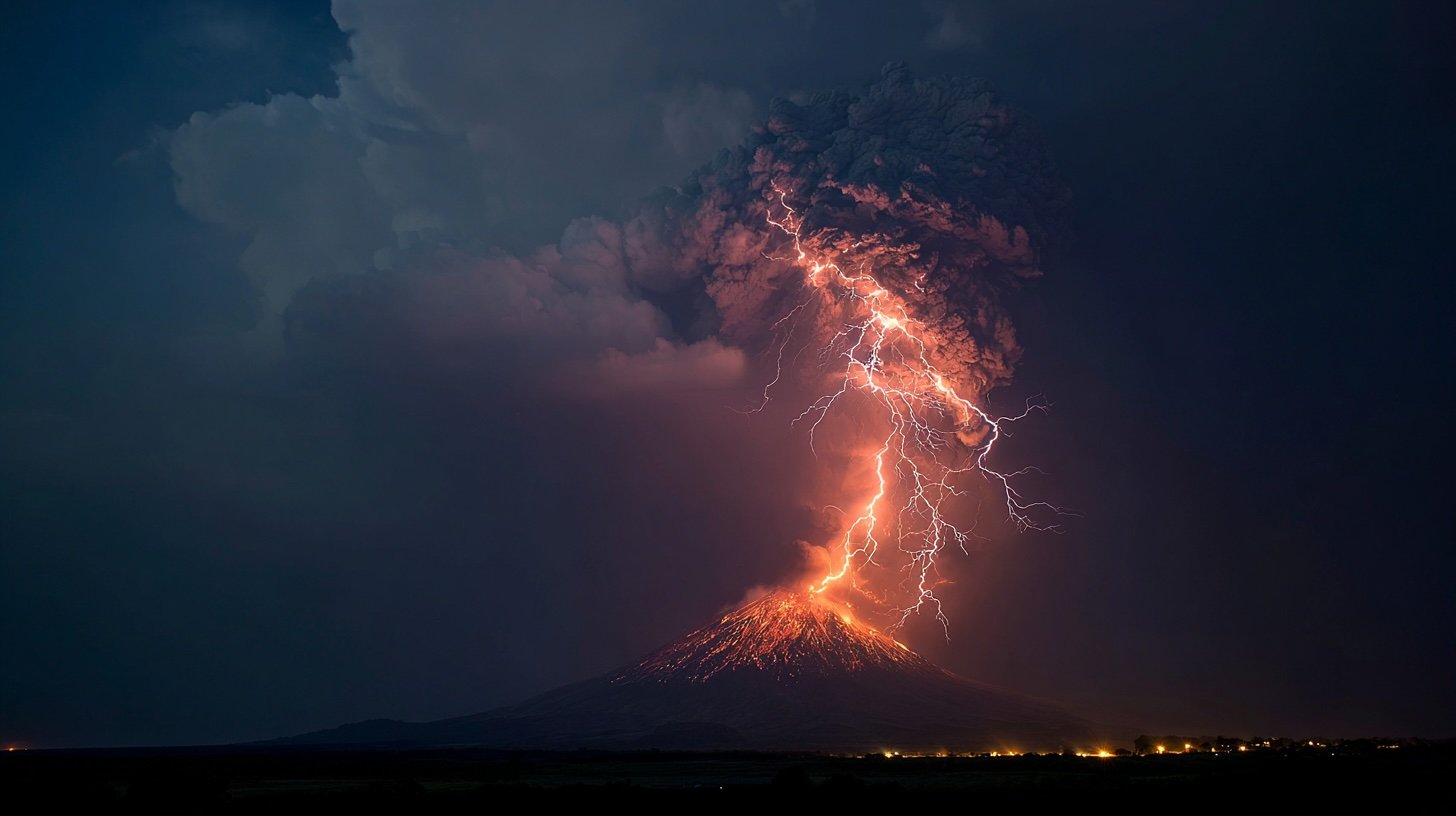
Volcanic lightning loves a dramatic entrance. One moment a mountain rumbles like it has opinions, the next a giant column of ash shoots into the sky and starts crackling with lightning as though someone plugged the volcano directly into the national grid. People call it a dirty thunderstorm, which sounds ruder than it is, but fits the mood perfectly. It’s thunder and lightning, except the clouds are made of ash, rock, and volcanic grumpiness.
The recipe starts the moment an eruption kicks off. Ash particles fire upwards at ridiculous speeds, banging into each other like commuters on the Central line. Each collision transfers tiny bits of electrical charge. Some particles grab electrons, others lose them, and soon there’s a crowd of positively and negatively charged grains swirling around in the plume. That separation of charges builds up tension in the atmosphere until it snaps, releasing bright flashes that turn the ash cloud into a strobe show.
The area near the volcanic vent forms the early battleground. The blast shatters rock into fragments, and that fracturing spits out additional electrical charge. This fracto-charging helps spark the earliest flashes even when the plume has only just started climbing. It’s the volcanic version of flicking a wool jumper in a dark room and getting a surprise spark, except the jumper is millions of tonnes of pulverised mountain.
Higher up, things get even more electrifying when water joins the party. When hot ash rises through moist air or glacial melt, the sudden cooling produces ice crystals. They bump into each other, swap charges, and create the same kind of electric separation that powers ordinary thunderstorms. A plume with a good supply of moisture and ice tends to be more dramatic, which is why eruptions in Iceland seem determined to put on the best lightning displays. The local glaciers contribute just enough water to make the whole thing extra spicy.
The most famous recent example still rings in everyone’s memory. Eyjafjallajökull erupted in 2010 and cheerfully reminded Europe that volcanology can have consequences. Flights grounded, airports jammed, business travellers pacing terminal floors with the tragic aura of people who just wanted to email from Düsseldorf. And above Iceland, the sky filled with a massive ash plume that began lighting itself up from within. Photographs from that eruption show lightning bolts slicing across the smoke column like nature had discovered industrial rave lighting.
The reason that eruption was so spectacular comes down to the volcano’s icy hat. Eyjafjallajökull is topped by a glacier, so when the eruption melted the ice, water vapour shot up alongside the ash. As it cooled, ice crystals formed and collided with the ash particles, creating an electrification playground. The plume climbed high into cold air, separated charges even more, and produced flashes that could be seen for kilometres. People who watched it in person described the experience as eerie, beautiful and slightly terrifying, which is about right for any volcanic event.
Scientists adore volcanic lightning because it reveals secrets about what the eruption is doing. By monitoring lightning frequency and patterns, researchers can tell how much ash the volcano is spitting out and how quickly the plume is rising. Lightning storms in the plume often correlate with high-energy ejections. These clues support rapid hazard assessment, especially in remote regions where no one stands close enough to check what’s happening directly. A spike in lightning can be the first sign that an eruption has shifted gear.
Modern networks pick up volcanic lightning at enormous distances. The Ruang eruption in Indonesia in 2024 delivered a phenomenal display. Over thirteen thousand lightning strikes were detected in just twenty-two hours. At peak moments, strikes hit at a rate of forty-two per second. That’s not weather misbehaving. That’s geology being theatrical. Such events give volcanologists incredible datasets to analyse, helping them understand which eruptions are capable of sending ash high enough to threaten aircraft or produce wide-scale ash fall.
The Tonga eruption of 2022 pushed things even further. It triggered the most intense lightning ever recorded. Observers counted hundreds of thousands of strikes in a matter of hours. The ash cloud rose so rapidly that it generated its own atmospheric chaos, creating a lightning field that wrapped around the plume like a luminous cage. It set records that may stand for years, unless another oceanic volcano decides to ruin everyone’s day.
The physics behind volcanic lightning remains a developing field. There’s broad agreement on the major players—ash collisions, fracturing, ice formation—but the exact balance between them changes from eruption to eruption. Some volcanoes generate lightning even without ice present, which suggests that ash-driven triboelectric charging can be remarkably efficient on its own. Other eruptions show far more lightning once the plume rises high enough to freeze water. The result is a puzzle that scientists enjoy piecing together with each new eruption.
Not all ash clouds produce lightning. The plume needs enough height, moisture or particle collision energy to generate meaningful charge separation. A slow, gentle eruption that oozes lava without much explosive force won’t build the conditions needed. But a strong, explosive blast usually does. That’s why the most dramatic lightning events occur during the most vigorous phases of an eruption.
For everyone watching safely from far away, volcanic lightning feels like the earth throwing its own firework show. The visuals tap into something primal: darkness, fire, smoke, thunder. It’s easy to see why ancient cultures interpreted eruptions as messages from the gods. Lightning crackling inside the ash cloud would have reinforced that impression. Even today, with all our science, the sight still looks mythological.
Nature also has a strange sense of timing. Lightning within the ash cloud tends to peak during the most chaotic parts of the eruption, right when the plume is climbing fastest and the ash density is highest. The cloud almost seems to pulse with energy as the volcano pushes material upwards. Observers often describe the scene as mesmerising in spite of the danger.
The ash itself plays a starring role. Volcanic ash isn’t like the soft grey dust in fireplaces. It’s tiny shards of volcanic glass, minerals and rock fragments. Each grain can carry charge and interact electrically with its neighbours. The sheer number of particles in a plume means countless collisions happen every second. Each collision is an opportunity to build charge. Add upward motion, turbulent air and enormous temperature differences, and the plume becomes a giant natural battery.
Some eruptions generate multiple layers of lightning. Near the vent, small flashes appear where rock fragments shatter. Higher up, intermediate flashes form where ash particles collide most violently. Even higher, ice-related lightning emerges once water freezes. These layers overlap, giving photographers those surreal images where lightning forks in several directions within the same column.
Historical accounts back up the idea that volcanic lightning has always captured human imagination. Reports from the 79 AD eruption of Vesuvius mention flashes illuminating the darkened sky. Medieval chroniclers watching eruptions in Iceland, Italy and Indonesia wrote about thunder-like noises and glowing clouds. Without an understanding of electricity, they explained what they saw with myth and theology. Even now, the term apocalyptic often sneaks into descriptions because the visuals feel like the world briefly forgot the rules.
For modern-day hazard planning, volcanic lightning offers practical benefits. Lightning detection systems can track eruptions even in the middle of the ocean where no one is around to see them. If lightning suddenly appears in an unexpected location, monitoring agencies know to check satellite data and look for fresh ash clouds. It’s one of the fastest clues available for identifying explosive activity.
Volcanic lightning also reminds everyone how interconnected earth systems are. A geological event triggers an atmospheric response. Rock meets air, water freezes in mid-flight, particles exchange charge, and suddenly the sky lights up. It’s a tidy example of how one natural process influences another, creating a chain reaction that spans several scientific disciplines. Geologists talk about magma movement. Meteorologists talk about charge separation. Atmospheric physicists talk about electric fields. Everyone meets in the middle of the ash cloud.
The most striking photos of volcanic lightning always show the same elements: a dark plume, flashes slicing horizontally or vertically, sometimes red glow from lava below and jagged mountains framing the scene. The contrast between the dark ash and bright lightning makes the effect look otherworldly. It’s the kind of scene that photographers risk everything to capture.
Eyjafjallajökull helped bring volcanic lightning into the public consciousness because so many travellers were stuck waiting for flights. The global attention made every image go viral. Most eruptions don’t force closed airports, so their lightning remains a spectacle for volcanologists and locals. But every few years a major eruption reminds the world that the planet still has a rebellious streak.
Anyone writing about natural wonders can count on volcanic lightning to capture attention. It combines danger, beauty and scientific intrigue in a single event. It’s also wonderfully photogenic. Even people who know nothing about geology instantly recognise that something extraordinary is happening.
Volcanic lightning shows no sign of retiring as a research topic. Each large eruption produces data that pushes the science forward. New satellite sensors, improved lightning detection arrays and high-speed photography all help unravel the phenomenon. In time, scientists may predict lightning intensity based on eruption style. For now, each event remains its own theatrical performance.
Whether the plume is rising above Iceland, Indonesia or the South Pacific, volcanic lightning always commands the sky. It crackles like a storm powered by stone. It turns ash clouds into lanterns. It reminds everyone that the earth occasionally chooses spectacle over subtlety. And every time it does, the result leaves people staring upwards, half awed, half uneasy, completely unable to look away.