The Kakapo: No Wings, No Fear
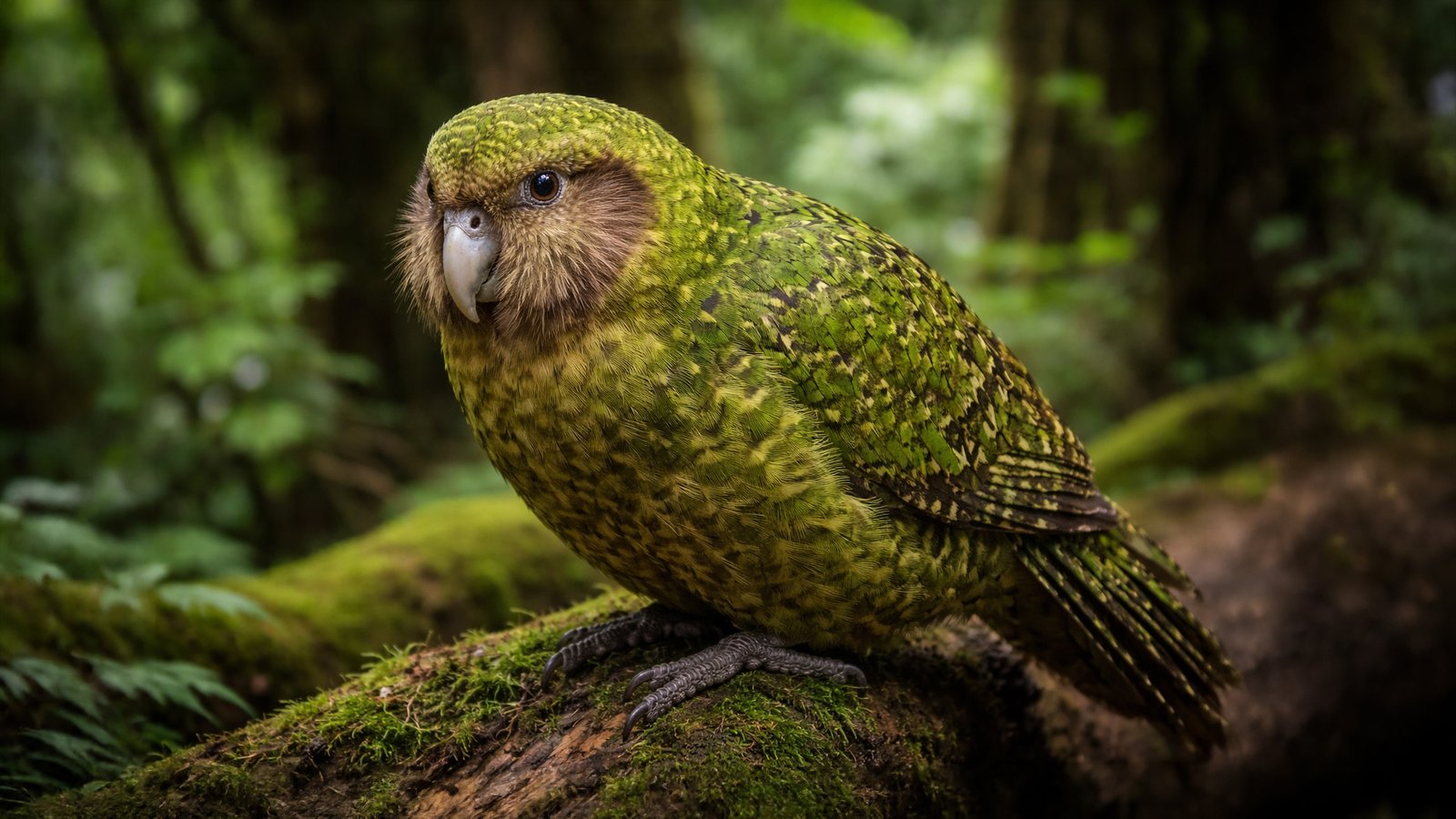
Some birds arrive in the world with drama. Eagles slice through air like sharpened ideas, while swans rehearse elegance on open water. Parrots, as a rule, favour spectacle and volume. The kakapo, however, looked at all that airborne ambition and quietly opted out.
It does not fly, and it does not rush. Nor does it panic when approached. Instead, it waddles through the undergrowth of New Zealand at night, smelling faintly sweet, like warm hay and honey. For millions of years, that strategy worked perfectly.
Long before humans appeared, the kakapo evolved in splendid isolation in New Zealand, a land without native land mammals. There were no foxes with sharp hunger and no cats with soft paws. Stoats did not thread through the ferns, because they did not yet exist there. Within that gentle ecological bubble, wings became less urgent, and flight slowly lost its advantage.
Over time, muscles once devoted to lift relaxed into sturdier uses. The body grew heavier, rounder, unapologetically grounded. Today the kakapo holds the title of the world’s heaviest parrot. Some males reach four kilograms, which is less “perch lightly” and more “test the branch first.”
Although it still has wings, they function more as parachutes than engines. When a bird climbs a tree, it uses its beak like a mountaineer’s ice axe. Eventually, it launches itself downward in a controlled, flapping descent. Technically, that counts as not crashing.
Its face explains part of the charm. A soft disc of fine feathers frames the eyes, creating an owl-like expression of mild astonishment. Around the beak sit whisker-like sensory feathers that amplify touch in the dark. Altogether, the effect suggests a Victorian naturalist redesigned a parrot after studying owls for too long.
Behaviour, however, pushes the species firmly into the realm of the improbable. Unlike most parrots, the kakapo lives by night. As darkness settles over New Zealand’s forests, it shuffles out to feed on leaves, shoots, bark and native fruits. It chews methodically and leaves behind distinctive fibrous pellets.
During daylight hours, it rests under dense vegetation. Camouflage and stillness serve as protection rather than speed. In ancient times, that stillness offered perfect defence. When danger appeared, it usually came from above in the form of giant eagles.
Freezing against the forest floor reduced visibility from the sky. Running made little sense in that context. Flying had never seemed necessary. Then humans arrived and rewrote the rules entirely.
Polynesian settlers reached New Zealand around the thirteenth century, bringing new pressures. They hunted kakapo for meat and feathers, and they introduced the Polynesian rat. Later, European settlers added cats, stoats and weasels to the mix. Forests fell for farms, while habitats fragmented.
Consequently, predators multiplied just as safe ground diminished. The kakapo responded as it always had: it froze. That strategy works beautifully against birds of prey. Against mammals that hunt by smell and persistence, it fails quickly.
By the twentieth century, the species had slipped towards oblivion. Sightings grew scarce, and reports felt almost mythical. Many observers assumed extinction had already occurred. However, small pockets survived in remote corners of the South Island and on Stewart Island.
In the 1970s, conservationists confirmed a bleak estimate of just over fifty individuals. Fifty birds remained in a country celebrated for biodiversity. At that point, the story could easily have ended. Instead, New Zealand chose stubborn intervention.
Scientists and rangers captured the remaining birds and relocated them to predator-free offshore islands. Each kakapo received a name and a radio transmitter. Rangers monitored movements, nesting attempts and health with meticulous care. Whenever females laid eggs, teams sometimes intervened to incubate fragile clutches.
Genetics experts analysed family lines with near-obsessive precision. Because the gene pool had shrunk so dramatically, preserving diversity became urgent. Therefore, breeding plans began to resemble intricate matchmaking charts. Rangers occasionally moved individuals between islands to balance lineage.
Breeding itself refuses tidy scheduling. The kakapo ties reproduction to the fruiting of the rimu tree, a towering native conifer. Rimu trees do not fruit every year. Instead, they produce heavy crops in irregular mast years, sometimes separated by long gaps.
Only when fruit appears in abundance do females gain enough energy reserves to lay eggs. Consequently, conservationists spend seasons waiting for forests to signal readiness. Once rimu fruits swell across the canopy, anticipation builds rapidly. Males then begin their extraordinary courtship ritual.
They dig shallow bowl-like depressions in the ground and connect them with cleared tracks. After that, they inflate a specialised air sac in the chest. Deep, resonant booms roll outward into the night. The sound travels for kilometres and pulses through valleys like distant bass.
Females follow those vibrations with pragmatic focus. They inspect potential mates and choose carefully. After mating, they depart to raise chicks alone. Meanwhile, the male returns to his bowl and resumes booming.
Because the population once fell so low, inbreeding remains a persistent concern. Low genetic diversity can reduce fertility and increase vulnerability to disease. For that reason, artificial insemination sometimes complements natural mating. Cutting-edge science now collaborates with a bird that never mastered flight.
Progress has come slowly but steadily. From roughly fifty individuals in the 1990s, numbers have climbed past two hundred and fifty. That figure still qualifies as critically endangered. Nevertheless, it represents a remarkable reversal of fortune.
Public affection has played an unexpected role. A kakapo named Sirocco became an unlikely ambassador after a documentary appearance turned unintentionally comic. Faced with a visiting presenter, he attempted to mate enthusiastically with the back of his head. The clip circulated widely and transformed an obscure parrot into a global talking point.
Rather than recoil, conservationists embraced the awkward fame. They recognised that charisma, even chaotic charisma, translates into funding and awareness. Behind the humour lies something more profound. The kakapo embodies the fragility of island ecosystems.
Islands amplify consequences dramatically. Introduce a single predator and the balance shifts. Remove one species and effects ripple outward. Protect one species, however, and entire habitats often benefit. Predator-free sanctuaries created for kakapo now shelter other native birds and reptiles.
Critics sometimes argue that such intensive conservation feels artificial. They suggest that nature should take its course. Yet nature’s course changed the moment ships arrived with stowaway mammals. Restoring balance now requires deliberate action rather than detachment.
Moreover, the kakapo challenges assumptions about evolutionary success. For millions of years, it thrived exactly as designed. Within its original environment, flightlessness made sense. Energy once spent on wings diverted to body mass and longevity.
With lifespans that may approach ninety years, these parrots invest in endurance. A slow metabolism supports that strategy. Measured movements conserve resources efficiently. Patience, not panic, once defined survival.
When circumstances shifted abruptly, those same traits became liabilities. Evolution does not anticipate cargo ships and domestic cats. It optimises for present conditions, not future invasions. As a result, human responsibility now fills the gap.
Walk through a New Zealand sanctuary at night and you might hear a distant boom rolling across the forest floor. You will not mistake it for birdsong. Instead, the sound feels almost geological, as if the earth itself cleared its throat. Follow it carefully and a moss-green shape may emerge from shadow.
It will not take flight, nor will it flee dramatically into treetops. Rather, it may pause and regard you with mild curiosity. That quiet confidence once defined an ecosystem free from mammalian pursuit. Today it depends on fences, biosecurity checks and relentless vigilance.
Hope, nonetheless, grows alongside that vigilance. Each breeding season brings fresh calculations and cautious optimism. Every fledgling that survives strengthens the population’s resilience. Advances in genetic analysis offer new tools for managing diversity.
National conversations about predator eradication gain momentum as well. Those ambitions aim not only to protect kakapo but also to restore broader ecological health across New Zealand. In that sense, this parrot functions as both symbol and catalyst.
The kakapo refuses tidy narratives. It is neither sleek nor conventionally majestic. It smells faintly sweet and booms instead of sings. Nevertheless, that refusal to conform endears it to those who learn its story.
Perhaps we recognise something of ourselves in its predicament. We too evolved for certain conditions and then altered them at speed. We too rely on cooperation and planning to navigate challenges of our own making. Saving the kakapo demands long-term thinking and scientific rigour.
In a world obsessed with efficiency, the species represents unapologetic eccentricity. It reminds us that biodiversity includes the odd and the impractical. Protecting it affirms that value does not rest solely in spectacle or utility.
Stand in a forest where rimu fruits hang heavy and the air carries that low, resonant boom. The story then feels less like a case study and more like a stubborn declaration. This grounded, improbable parrot continues to exist because enough people decided that weirdness deserved a future.
Flight never defined its strength. Endurance did. With careful stewardship, that endurance may yet carry it safely through a century it never anticipated.
Post Comment
You must be logged in to post a comment.