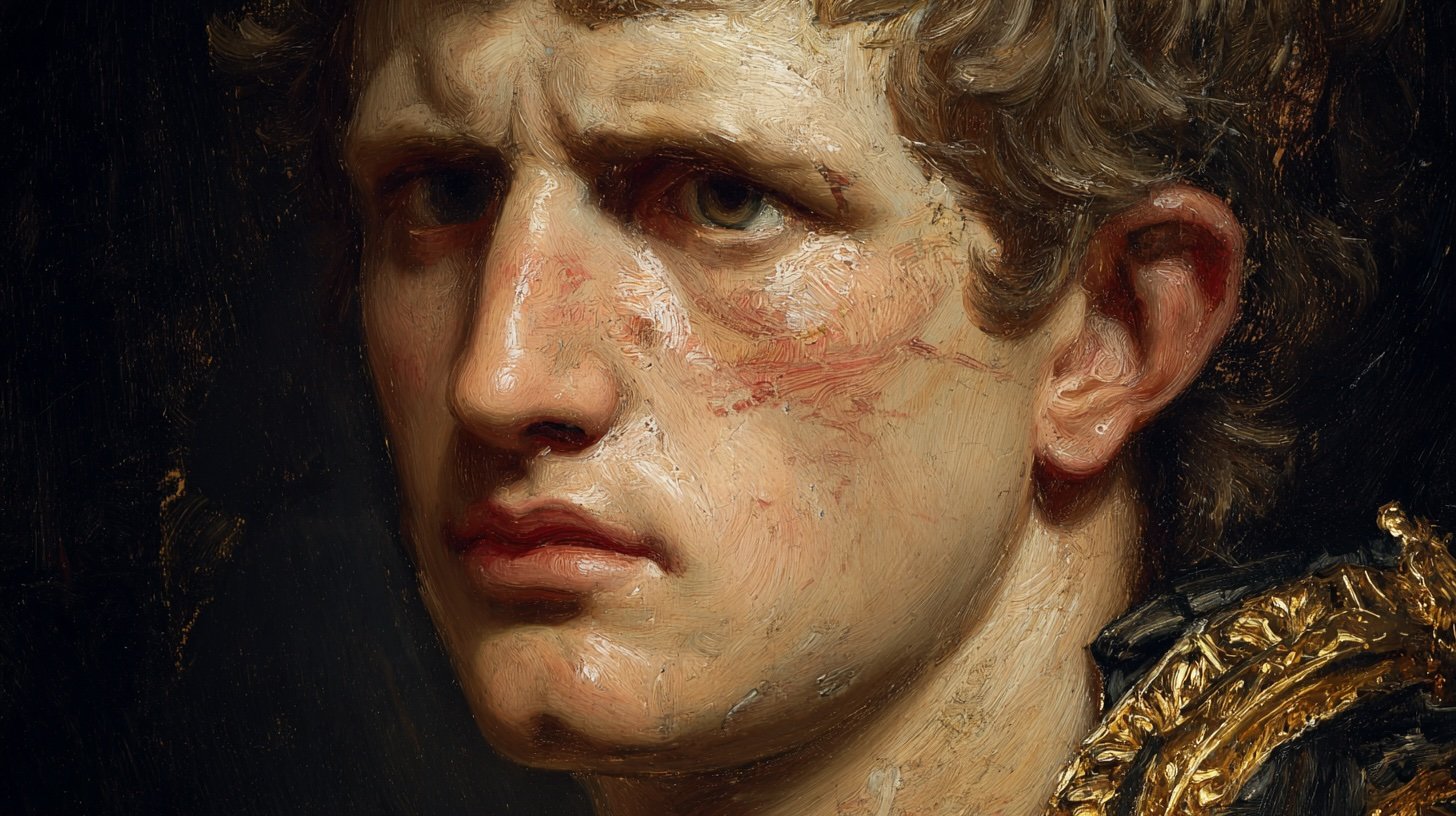
The wisest king in the Bible had 700 wives, 300 concubines, an enormous fortune and a magnificent temple. He also managed to leave his kingdom on the verge of collapse. According to the First Book of Kings, Solomon could settle disputes that defeated ordinary judges, impress foreign rulers with his intelligence and organise building projects on a formidable scale. Yet his own household and political arrangements proved considerably harder to manage. His son inherited a kingdom so deeply divided that it broke apart almost immediately. It is a curious portrait of wisdom: a man who apparently understood everything except the consequences of his own success.
The First Book of Kings, known as 1 Kings in most modern Bibles, occupies an unusual position between historical narrative, political commentary and religious teaching. It begins with the ageing King David struggling to maintain control over his succession and ends some 120 years later, in the middle of a bitter conflict between kings and prophets. In Jewish tradition, it belongs to the Former Prophets, while Christian Bibles generally place it among the historical books. Originally, First and Second Kings formed a single work. Their division developed through ancient Greek manuscript tradition and eventually became standard. The book’s author remains unknown, although scholars generally believe it took shape through successive stages of writing and editing, using older royal records and religious traditions.
The opening chapters resemble a particularly ruthless palace drama. David is old, and his son Adonijah has begun presenting himself as the next king. But Bathsheba, Solomon’s mother, and the prophet Nathan intervene, persuading David to declare Solomon his successor. The new king secures his position through a series of measures that include executions, exile and the removal of political opponents. Adonijah himself is eventually killed. The familiar picture of Solomon as a serene philosopher-king rather obscures this beginning. Before he becomes celebrated for wisdom, he has already demonstrated a practical understanding of power.
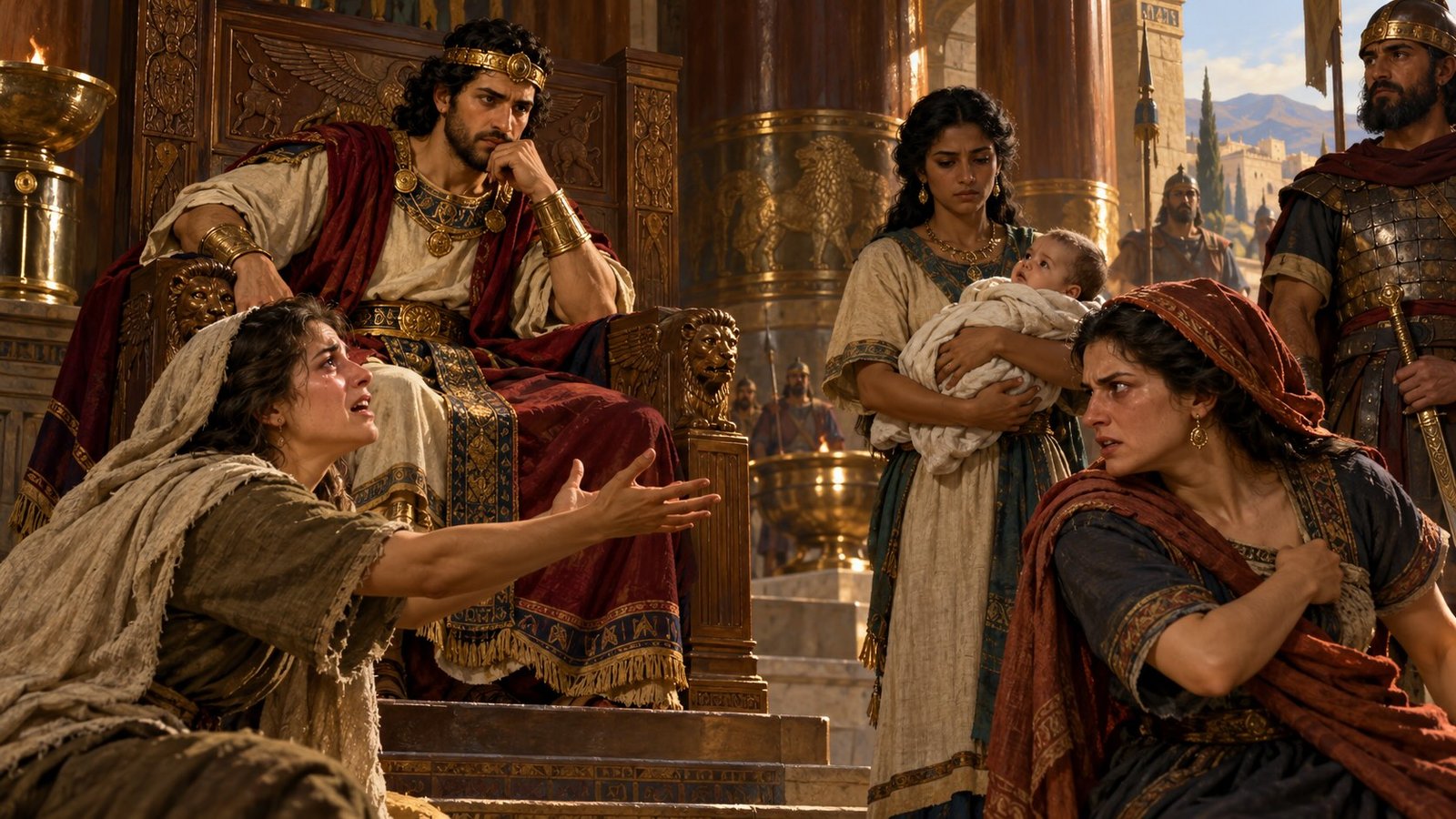
His most famous judgement involves two women who claim the same surviving baby. Unable to establish which woman is the mother, Solomon orders that the child be divided with a sword. One woman agrees; the other begs him to spare the baby and give it to her rival. Solomon identifies the second woman as the true mother. The account in chapter three has become a classic illustration of psychological insight. Rather than resolving the dispute through evidence, Solomon creates a situation in which the competing claimants reveal their priorities. Of course, the method depends upon the real mother reacting as expected. Fortunately for everyone, she does. It is an elegant story about judgement, although hardly a procedure one would recommend for modern family courts.
Solomon’s reign is presented as a period of prosperity, international trade and ambitious construction. The greatest project is the First Temple in Jerusalem, which the biblical account says took seven years to build. Its interior included cedar panelling, carved decorations, gold-covered surfaces and an inner sanctuary housing the Ark of the Covenant. Solomon also built a royal palace complex, which reportedly required thirteen years. The contrast is intriguing: the king devoted considerably longer to his own residence than to God’s house. The text does not explicitly criticise this imbalance, but its authors were perfectly capable of allowing details to speak for themselves.
The Temple became central to Jewish religious memory, yet its original architecture remains difficult to reconstruct. No archaeological remains have been securely identified as Solomon’s Temple, and the scale of his kingdom is still debated. Some archaeologists argue that the biblical account substantially exaggerates the wealth and administrative sophistication of tenth-century BCE Jerusalem. Others find evidence for a developing monarchy that could have supported elements of the traditional narrative. Later inscriptions, including the ninth-century BCE Tel Dan Stele, support the historical existence of a dynasty known as the House of David. They do not, however, establish that Solomon possessed the immense empire described in the Bible. The distinction between evidence for a dynasty and evidence for its legendary splendour matters.
One of the book’s most memorable visitors is the Queen of Sheba. Having heard of Solomon’s reputation, she travels to Jerusalem with precious gifts, including gold, spices and gemstones, and challenges him with difficult questions. Solomon answers them all, impressing his visitor with both his intelligence and the organisation of his court. The biblical text never gives her a personal name or describes a romantic relationship. Later Jewish, Islamic and Ethiopian traditions greatly expanded the episode. Ethiopian tradition calls her Makeda and connects her with the ancestry of the country’s ancient monarchy, while Islamic literature knows her as Bilqis. Historians commonly associate ancient Sheba with the kingdom of Saba in southern Arabia, although the precise historical background of the visit remains uncertain. A relatively brief diplomatic encounter eventually generated centuries of stories.
The account of Solomon’s decline is less flattering. The king acquires foreign wives, adopts religious practices that the biblical writers condemn and imposes substantial burdens upon his subjects. His building programme requires organised labour, taxation and administrative control. Behind the gold and cedar lies a less glamorous question: who actually paid for all this magnificence? When Solomon dies, his son Rehoboam faces demands to lighten the burden. Instead, he threatens to make it heavier. The northern tribes rebel, establishing a separate kingdom under Jeroboam, while Rehoboam retains the southern kingdom of Judah. The political message is remarkably recognisable. A ruler inherits public dissatisfaction, mistakes intimidation for authority and discovers that loyalty has limits.
From this point, First Kings follows two rival monarchies: Israel in the north and Judah in the south. Their rulers compete for territory, legitimacy and religious influence. Jerusalem remains the religious centre favoured by the biblical authors, while Jeroboam establishes alternative sanctuaries at Bethel and Dan. The writers repeatedly judge kings according to their faithfulness to the worship of Israel’s God. Military success, administrative skill and prosperity do not necessarily earn approval. A monarch can be politically effective and still receive a thoroughly unfavourable assessment. Kings, in other words, is not neutral court history. It is an attempt to explain national events through religious principles.
The second half of the book increasingly belongs to Elijah, one of the Hebrew Bible’s most memorable prophets. During the reign of Ahab, king of Israel, Elijah challenges the royal promotion of Baal worship, associated especially with Ahab’s Phoenician wife Jezebel. The confrontation reaches its dramatic peak on Mount Carmel, where Elijah contests the prophets of Baal. According to the narrative, their appeals produce no divine response, while Elijah’s prayer brings fire upon his sacrifice. The episode ends violently with the killing of the rival prophets. It reflects the intense religious conflict represented in the text, but it should not be mistaken for a documented account independently established by historical evidence.
A quieter episode follows. Fleeing danger, Elijah retreats into the wilderness and eventually reaches Mount Horeb. There he encounters a powerful wind, an earthquake and fire, yet the divine presence is associated instead with what some English translations famously call a still, small voice. Other translations render the Hebrew expression as a soft murmuring sound or profound silence. After the spectacle of Mount Carmel, the change of atmosphere is striking. The prophet who called down fire must now pay attention to something almost imperceptible. Few passages better illustrate the book’s ability to move between public drama and private uncertainty.
First Kings also contains the disturbing story of Naboth, whose vineyard lies close to Ahab’s palace. When Naboth refuses to surrender his inherited land, Jezebel arranges false accusations that lead to his execution. Ahab then takes possession of the property. Elijah confronts him over the injustice. The episode exposes a problem that has troubled societies under very different systems of government: the ease with which rulers can turn legal procedures into instruments of personal convenience. The crime is not committed outside the law but through its deliberate manipulation.
For historians, the First Book of Kings demands careful reading. Its accounts draw upon traditions about real kingdoms and rulers, but they also reflect the theological concerns of writers who lived after many of the events described. The book even mentions earlier records, including the Acts of Solomon and the annals of the kings, which have not survived as independent works. Its historical value therefore varies from episode to episode. Yet its literary insight is difficult to overlook. Kings rise through family manoeuvring, accumulate wealth, demand obedience, face criticism and discover that impressive buildings cannot guarantee political stability.
Perhaps the most revealing contrast is between Solomon’s celebrated judgement over a single child and his inability to preserve the unity of an entire kingdom. In the first case, he understands that power must be restrained to protect what matters. In the second, the royal system he leaves behind has apparently forgotten the lesson. Three thousand years later, that difference between knowing what is wise and governing wisely remains surprisingly familiar.