The Tasmanian tiger received legal protection just 59 days before the last known captive animal died. For decades, authorities had paid people to kill it. In July 1936, they finally decided it should stay alive. By September, the animal at Hobart’s Beaumaris Zoo was dead. Few wildlife stories contain such a compact demonstration of administrative timing.
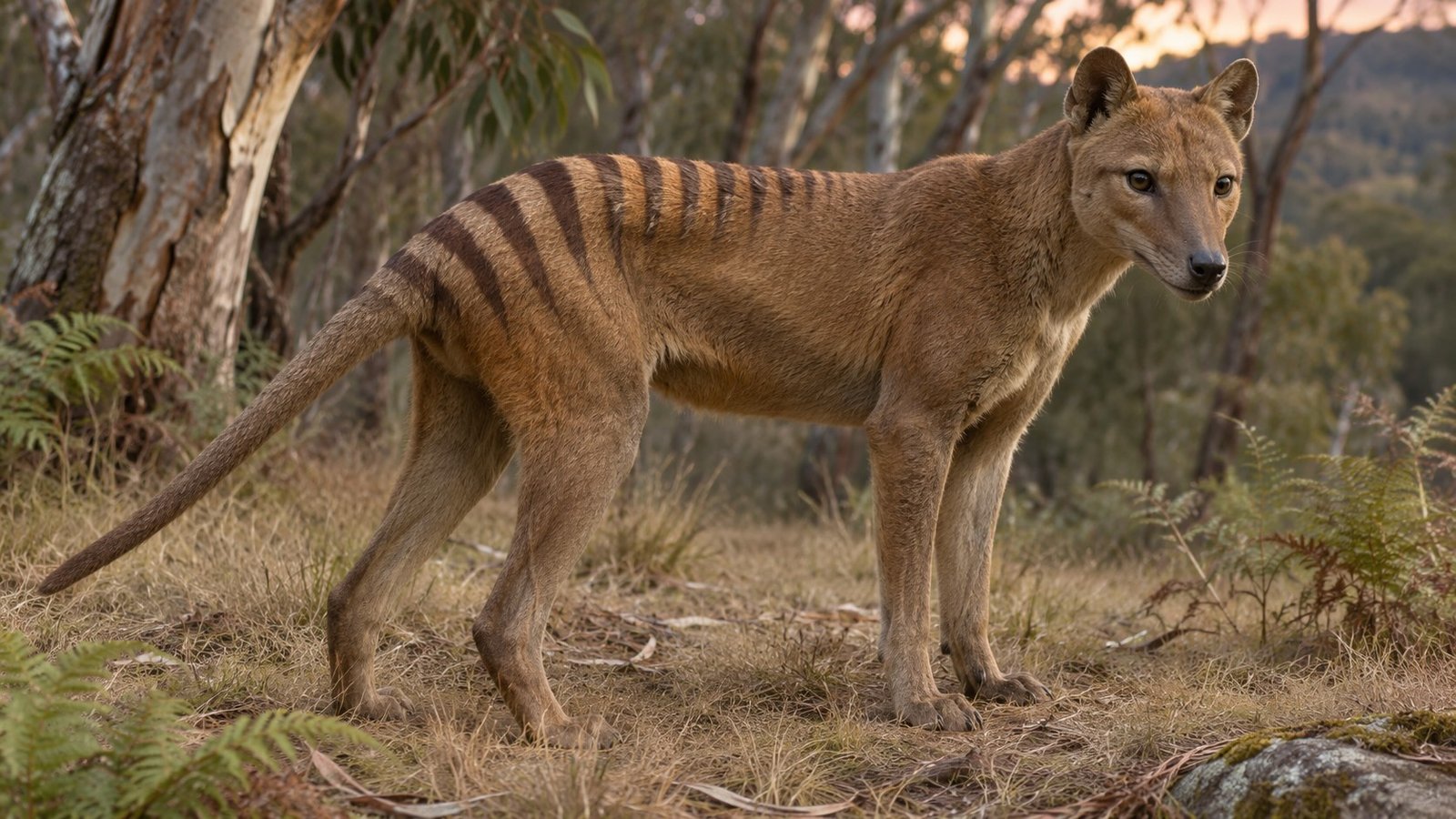
Even its name encouraged misunderstanding. The Tasmanian tiger was neither a tiger nor a member of the cat family. Its other nickname, Tasmanian wolf, was equally misleading. The thylacine, Thylacinus cynocephalus, was a carnivorous marsupial, more closely related to Tasmanian devils than to either animal. Dark stripes crossed its lower back and the base of its tail. From a distance, it looked rather like a dog that had borrowed the wrong coat.
Closer inspection made the resemblance less convincing. A heavy, relatively stiff tail extended behind the body, while rounded ears framed a long muzzle. Females carried their young in a pouch that opened towards the rear. They could raise up to four young, which remained dependent on their mother well beyond their earliest development. Males possessed a partial pouch too. Beneath the vaguely familiar exterior sat a body built along a quite different evolutionary route.
That misleading familiarity has made the thylacine a favourite example of convergent evolution. Its ancestors and those of wolves followed separate paths for roughly 160 million years, yet produced strikingly similar skulls. Comparable demands can push unrelated animals towards comparable shapes. But resemblance has limits. A wolf-shaped head does not automatically come with wolf behaviour, wolf hunting methods or a wolf-sized appetite. Some of the thylacine’s reputation appears to have filled precisely those gaps in the evidence.
In 2020, researchers substantially reduced its estimated average weight. Using measurements and three-dimensional analysis of museum specimens representing 93 individuals, they calculated a population average of about 17 kilograms. Males averaged roughly 20 kilograms and females about 14. A frequently used earlier estimate had placed the average near 30 kilograms. The supposed heavyweight predator suddenly looked considerably less imposing. This was a substantial biological correction, rather than a minor adjustment to a museum label.
Size matters because predators must balance the energy gained from a meal against the danger and effort of obtaining it. The revised estimates supported the view that thylacines generally specialised in prey smaller than themselves. That does not prove they never killed sheep or poultry. It does weaken the picture of a formidable livestock destroyer routinely tackling large animals. Unfortunately, nobody can now spend several seasons following wild thylacines to settle the matter. Their reputation survived; opportunities to test it did not.
Nor was this originally an animal confined to Tasmania. Fossils and Aboriginal rock art record a much wider presence across mainland Australia and into New Guinea. It disappeared from the Australian mainland at least 2,000 years ago. Competition with dingoes and hunting by people may have contributed, although the precise balance remains uncertain. Tasmania, separated by Bass Strait and without dingoes, preserved the surviving population. The island was its final refuge, rather than its entire ancestral home.
European settlement brought a new set of pressures. Sheep farming created both conflict and a convenient suspect whenever animals went missing. Thylacines acquired a damaging reputation as stock killers, although dogs and poor livestock management also caused losses. Farmers did not need a complete understanding of marsupial ecology to demand action. They needed something identifiable to blame, and a striped predator supplied a more satisfying explanation than several overlapping problems.
Private bounties began in the nineteenth century. From 1888, the Tasmanian government offered £1 for an adult thylacine and ten shillings for a juvenile. The scheme continued until 1909 and paid more than 2,180 bounties. Hunting operated alongside habitat clearance and other pressures; disease has also been proposed as a contributor to the decline. Uncertainty about their relative effects should not obscure the most straightforward fact: people deliberately killed large numbers of an animal whose population could not sustain it.
The habitat itself complicates the familiar picture. Thylacines occupied combinations of open woodland, grassland and wetland, rather than simply inhabiting inaccessible mountain forest. In Tasmania, historical records particularly associate them with northern and eastern districts and the midland plains. Those were places where farming could bring predators and livestock into contact. The modern image of a secretive survivor deep in remote wilderness fits our hopes rather neatly, but only part of the animal’s known ecology.
By the time protection came, the remaining population had become desperately difficult to find. The last known captive thylacine died on 7 September 1936, possibly through exposure and neglect. That date marks the end of the confirmed captive record; it cannot establish the precise night on which the final wild animal died. An extinction rarely provides such tidy paperwork. Somewhere beyond the zoo, a few animals may have persisted without leaving evidence strong enough to resolve their fate.
Reports of sightings have continued ever since. Some witnesses have been sincere and experienced observers, but confidence and confirmation are different things. No conclusive evidence has established that thylacines still survive. Equally, the absence of a known final carcass leaves room for endless argument about how long they lasted. It is an unusually durable mystery because every uncertain shape offers another possibility, while an empty forest cannot provide a final answer.
Now genetic research offers another possible future. Scientists working on thylacine de-extinction aim to use preserved genetic information and living marsupial relatives to produce an animal resembling the lost species. Sequencing a genome, though, is several difficult steps away from producing a healthy animal, let alone a breeding population. Even success would leave questions about behaviour and ecological function. A sequence cannot tell researchers everything that young thylacines once learnt from their mothers.
The oddest part is how much remains uncertain about an animal that survived into the age of cinema. We have photographs, film, skins and skeletons, yet still debate its weight, prey and hunting behaviour. People once knew enough about the Tasmanian tiger to put a price on its head. Almost a century after its disappearance, we are still working out what sort of head it was.