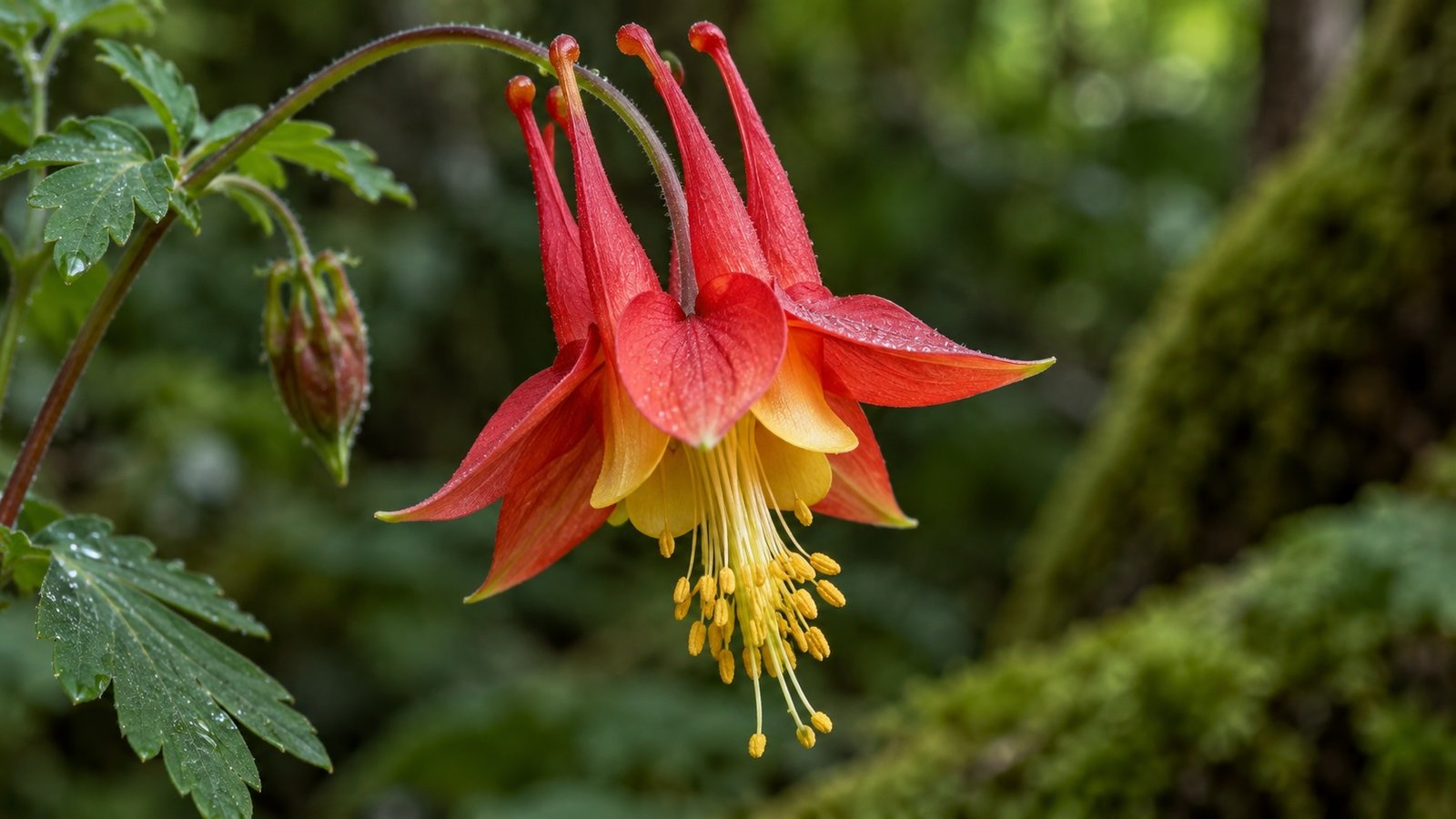
The Western Columbine looks as though someone assembled a flower upside down, added five miniature trumpets and painted everything scarlet and yellow. Its blossoms hang from slender stems like elaborate Chinese lanterns. Long red spurs point skywards, while golden stamens dangle below. Yet this improbable arrangement is no botanical accident. Every curve, colour and projection serves a purpose. Much of the explanation involves one of nature’s most demanding customers: the hummingbird.
Known scientifically as Aquilegia formosa, the Western Columbine is native to western North America. It grows from Alaska and British Columbia southwards to California, with populations extending into the inland mountains. It belongs to the buttercup family, Ranunculaceae, although its flowers hardly resemble the familiar yellow buttercups of British meadows. The plant favours moist woodland, stream banks, forest clearings and mountain slopes. In suitable conditions, its delicate stems rise to around 60–90 centimetres. They carry flowers that seem almost too elaborate for such a modest plant.
Its botanical name offers the first clue to its unusual appearance. Aquilegia comes from the Latin word for eagle. The name traditionally refers to the resemblance between the flower’s curved spurs and an eagle’s talons. The species name formosa means beautiful or finely formed. Botanists, apparently, were not immune to a little admiration. The same genus includes the familiar garden columbines cultivated across Britain. Yet the Western Columbine’s fiery colouring makes it particularly distinctive.
What appears to be a complicated collection of petals is actually a remarkably organised structure. The flower has five red sepals, which spread outwards like pointed wings. Five petals have yellow blades and long, backward-projecting red spurs. These spurs contain nectar near their tips. Beneath the flower hangs a prominent bundle of yellow stamens, the pollen-producing organs. These surround the female reproductive structures. Viewed from the side, the arrangement resembles a tiny chandelier designed by someone fond of medieval weaponry.
The shape becomes easier to understand when a hummingbird approaches. Unlike most birds, hummingbirds can hover almost motionlessly while feeding. Their long, slender bills and extendable tongues allow them to reach nectar hidden inside flowers. Western Columbine provides precisely this sort of arrangement. The bird approaches the downward-facing blossom and reaches into the flower to collect its reward. During the visit, its head or bill may brush against the reproductive structures. This contact helps transfer pollen between flowers.
The red colouring is no coincidence either. Hummingbirds possess excellent colour vision and frequently visit red and orange flowers. Many bee-pollinated flowers use rather different visual signals. Colour alone does not determine which animal visits a flower. Yet combined with nectar production, spur length and floral orientation, it helps create an effective relationship. The Western Columbine has, in effect, developed a feeding station suited to airborne customers.
There is a further complication. The flower’s nectar is not always collected by visitors willing to perform the intended pollination service. Some insects bypass the entrance and reach the nectar through holes in the spurs. Botanists call this practice nectar robbing. Research has found that legitimate visitors and nectar robbers can affect the bacterial communities living in Western Columbine nectar differently. Even the microscopic inhabitants of a flower’s sugary refreshments depend partly on who has been drinking from them. A peaceful mountain wildflower turns out to operate a surprisingly complicated hospitality business.
Columbines have also attracted scientific attention because of how their flowers evolve. Across the Aquilegia genus, species display striking differences in colour, spur length and floral orientation. Some are associated primarily with bees, others with hummingbirds, and certain long-spurred species with hawkmoths. Changes in pollinators have helped shape this diversity. The Western Columbine offers a particularly attractive example of this evolutionary relationship. Interactions between plants and animals can influence the appearance of flowers over countless generations.
Another unusual feature concerns the timing of reproduction. Western Columbine flowers generally enter a male phase first, when they present pollen. They then move towards a female phase, when the stigma becomes receptive. Botanists call this protandry. By separating these phases in time, the plant can reduce some opportunities for self-pollination. It also encourages pollen movement between flowers. Evidently, even a wildflower has developed strategies to avoid keeping everything in the family.
For Indigenous communities of western North America, Western Columbine has had uses beyond attracting wildlife or decorating woodland. Traditional medicinal applications included preparations of leaves and roots for various ailments. Some communities also employed parts of the plant externally. Such uses reflect generations of botanical knowledge. They should not, however, be mistaken for evidence that the plant is safe to consume. Columbines contain potentially harmful compounds, particularly in their foliage, roots and seeds. Their ornamental appeal is best appreciated without culinary experimentation.
Despite its extravagant flowers, Western Columbine is a relatively undemanding perennial in suitable conditions. It prefers moisture-retentive but well-drained soil and generally appreciates partial shade. It can tolerate more sunshine where the ground remains cool and damp. Its finely divided, blue-green foliage provides an attractive contrast to the flowers. These appear from late spring into summer, depending on climate and elevation. Unlike some heavily cultivated ornamental plants, Western Columbine retains a loose, natural character. This makes it particularly suitable for informal woodland gardens.
British gardeners can grow Western Columbine successfully, especially in cool, moderately sheltered positions. Its main difficulty is not winter cold but unsuitable growing conditions. Prolonged waterlogging and excessively dry summer soil can both cause problems. Seeds can be sown outdoors in autumn, allowing winter cold to assist germination. Established plants may also self-seed. However, seedlings growing near other columbines may not reproduce their parents’ exact appearance. Gardeners seeking the characteristic red-and-yellow flowers should therefore obtain reliably identified plants or seeds.
There is, of course, one small disappointment for anyone cultivating Western Columbine in Britain. Its most celebrated pollinators are unlikely to appear. Hummingbirds are native to the Americas, and even the finest British garden cannot reasonably expect a visiting one. Bees and other insects may still investigate the flowers. Yet the elaborate relationship between plant and bird belongs primarily to its native environment. A British gardener can provide the flower, the nectar and the scenery. Unfortunately, the principal guest remains unavailable.
Perhaps that is what makes Western Columbine particularly appealing. In a garden, it is an elegant ornamental flower with an almost theatrical appearance. In a North American mountain meadow, the same flower becomes something rather different. A hummingbird hovering beside its nodding blossoms reveals a piece of living engineering. Its form has developed through countless generations of interaction between plants and their pollinators.
Its five red spurs are not decorative extravagances, and its downward-facing flowers are not mistakes of construction. They are part of a relationship between two organisms whose lives have become closely connected. Somewhere in a damp woodland in the American West, a hummingbird is performing its daily aerial acrobatics. A Western Columbine is offering exactly what it came for. Neither has any interest in aesthetics, which may explain why the result is so beautiful.