The Wild Giant of Yellowstone
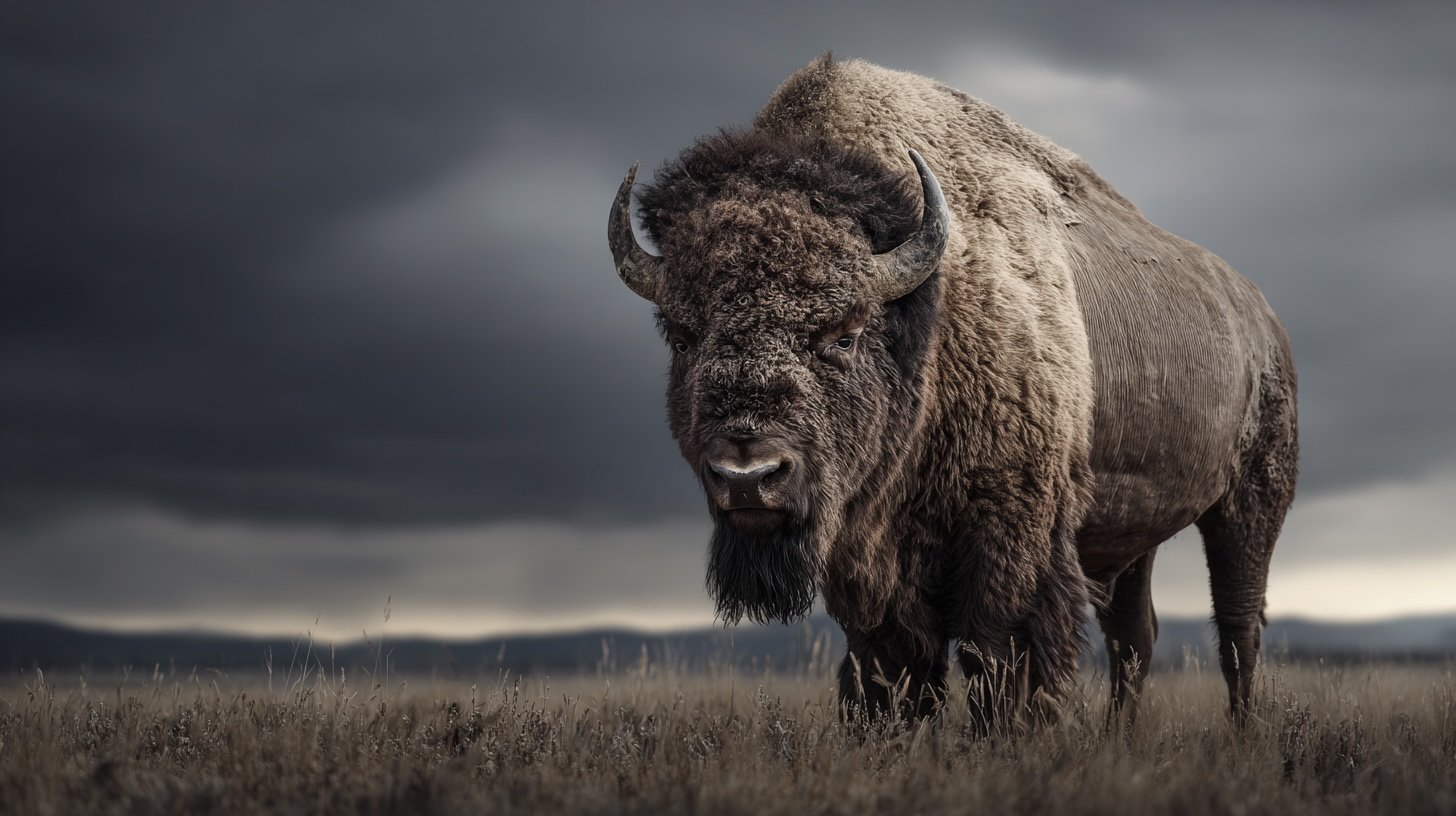
They look as if they have wandered out of a cave painting and decided to ignore the last ten thousand years. Massive shoulders carry a hump like a misplaced mountain. Frost clings to their beards in winter. Their eyes suggest both calm and calculation. In Yellowstone, the American bison does not pose for postcards. Instead, it grazes, snorts, clashes, and occasionally blocks traffic with the unhurried confidence of an animal that survived the Ice Age and sees no reason to rush for a rental car.
Once, their kind covered the continent in numbers that still sound exaggerated. Historians suggest thirty million, perhaps even sixty. No census taker stood on the prairie with a clipboard. Even so, early travellers described the plains as a moving continent of muscle. Herds rolled across grasslands like weather fronts. The earth trembled beneath hooves. The horizon darkened with living shadow. Moreover, entire ecosystems organised themselves around that movement.
Then the 19th century arrived with rifles, railways, and markets. Hide hunters shot bison from train windows for sport. Industrial tanneries demanded leather belts for factory machines. At the same time, the US military recognised a brutal fact: if the bison vanished, Plains nations would struggle to survive. Consequently, slaughter became strategy. Within a few decades, abundance collapsed into near absence.
Against that backdrop, the story of Yellowstone feels improbable. Established in 1872 as the world’s first national park, Yellowstone did not set out to become the final refuge of truly wild bison. The early years looked chaotic. Poachers operated with ease. Protection often meant little more than ink on paper. Yet in remote valleys, a small group endured.
Those survivors matter more than their numbers suggest. They were never fully domesticated. Ranchers did not systematically fence them in and reshape them for beef production. They were not redesigned to suit agricultural ambition. Instead, they carried on as bison always had, moving with the seasons and enduring winter without scheduled feed deliveries. As a result, behaviour remained anchored in ecology rather than husbandry.
However, survival did not mean isolation from human interference. By the early 1900s, Yellowstone’s wild herd had dwindled to only a few dozen animals. Alarmed officials supplemented the population with bison from captive conservation herds. That decision prevented extinction. Nevertheless, it complicated the genetic picture for future scientists. Even so, Yellowstone preserved something no other place quite managed: continuity of wild behaviour across generations.
Today, when researchers describe the Yellowstone herd as genetically unique, they are not indulging romance. During the late 1800s and early 1900s, many private breeders crossbred bison with domestic cattle. They hoped to produce hardier livestock. The result, often called cattalo, blurred species boundaries. Therefore, most modern bison herds in North America carry traces of cattle DNA.
Yellowstone stands apart in relative terms. Genetic studies indicate that its animals show little to no detectable cattle introgression compared with other populations. Scientists continue to debate fine details. Nevertheless, the herd ranks among the most genetically intact on the continent. That distinction turns it into a living archive of evolutionary history rather than a reconstructed approximation.
Genetics, though, tell only part of the tale. Culture, in animal terms, shapes the rest. Bison do not consult devices when snow deepens. Older cows remember migration routes. Calves learn where to cross rivers and where early grass appears. Bulls test each other during the rut, establishing hierarchies through ritualised combat. Over time, these patterns form behavioural inheritance passed between generations.
In Yellowstone, those traditions unfold without perimeter fencing. The herd divides broadly into northern and central groups, roaming landscapes such as the Lamar and Hayden valleys. Yet boundaries remain porous. Animals drift, mingle, and reshape social ties according to forage and season. Consequently, gene flow persists in largely natural rhythms.
Predators reinforce that authenticity. When grey wolves returned in 1995, they entered an ecosystem that still remembered large herbivores. Elk adjusted quickly and often nervously. Bison reacted differently. Adult bison frequently stand firm. They form defensive circles around calves, horns angled outward, eyes fixed on movement. Wolves rarely take healthy adults. Instead, they test the young, the old, or the injured.
These confrontations ripple outward across the landscape. Because bison graze intensively and move frequently, they influence plant communities. Their hooves churn soil. Their dung fertilises meadows. Birds follow them. Insects flourish around them. Even riverbanks respond to shifting pressure. Thus the Yellowstone herd functions not as a museum display but as an active ecological engineer.
Still, romance fades at the park boundary. Bison ignore legal lines drawn by surveyors. In harsh winters, snow deepens across the plateau. Grass becomes scarce. Instinct drives herds toward lower elevations in Montana. There, they encounter fences, ranches, and political anxiety.
That anxiety centres on brucellosis, a bacterial disease that can cause cattle to abort calves. Yellowstone bison carry the pathogen, likely inherited from contact with domestic livestock more than a century ago. No confirmed case documents wild bison transmitting brucellosis directly to cattle under natural regional conditions. Even so, fear shapes policy. Ranchers worry about economic loss. State agencies aim to minimise perceived risk. Federal authorities attempt to balance wildlife preservation with agricultural realities.
As a result, winter often brings controversy. Officials haze bison back toward the park with helicopters or mounted riders. Some animals enter quarantine programmes. Others face slaughter when numbers exceed negotiated limits. Conservationists argue that the last continuously wild herd deserves broader roaming rights. Meanwhile, local communities defend their livelihoods. Consequently, the debate repeats each season.
History deepens the emotional charge. Long before Yellowstone became a tourist icon, bison anchored the lives of numerous Indigenous nations. They provided food, clothing, tools, shelter, and spiritual meaning. The near-eradication of bison in the 19th century coincided with campaigns to dispossess Plains tribes of land and autonomy. In that context, the survival of a wild herd carries symbolic weight far beyond biology.
In recent decades, tribal nations have participated more actively in bison management and restoration. Some animals transferred from Yellowstone through quarantine programmes now graze on tribal lands. That movement reconnects ecology with culture. It also reframes conservation as collaboration rather than unilateral control. Gradually, stewardship expands beyond federal boundaries.
None of this, however, prepares a first-time visitor for the animals’ physical presence. A mature bull can weigh nearly a tonne. His head appears sculpted from dark rock. In winter, frost gathers along his beard while steam curls from nearby geothermal vents. Tourists step out of cars to photograph him. Occasionally, he steps toward them. Rangers then remind everyone that bison can run faster than most humans and pivot with alarming speed.
Every year, bison injure more visitors than bears do in Yellowstone. The reason rarely involves aggression in the human sense. Instead, people mistake tolerance for tameness. A bison standing by the roadside does so because the road slices through its territory. It has not agreed to share space politely. Therefore, distance remains the wisest form of respect.
Seasonal rhythms anchor life here. In spring, reddish calves wobble beside attentive cows. Their small size contrasts sharply with adult bulk, which makes them photogenic and fiercely defended. Summer brings long grazing days under expansive skies. Meanwhile, insects swarm and rivers shrink. Autumn intensifies everything. Bulls clash during the rut, their bellows echoing across valleys. Dust rises and rivalries escalate. Then winter returns, quiet and heavy.
Climate change complicates this cycle. Snowpack patterns shift unpredictably. Drought pressures grasslands. Fire seasons lengthen. Bison have survived dramatic climate swings before; their lineage stretches back to glacial epochs. However, modern constraints differ from ancient ones. Ice sheets never negotiated land-use agreements. Today, highways, fences, and property lines restrict movement that once spanned a continent.
Consequently, conservation increasingly focuses on connectivity. Ecologists argue that the Greater Yellowstone Ecosystem must function as more than a scenic enclave. Wildlife corridors, cooperative agreements with neighbouring states, and expanded tolerance for migration could allow bison to respond to environmental change as they evolved to do. Without sufficient space, resilience becomes theory rather than lived reality.
Despite political friction, the Yellowstone herd has rebounded numerically. Population estimates fluctuate between roughly four and six thousand animals, depending on winter severity and management decisions. Such variability reflects ecological dynamics. Harsh winters reduce numbers. Mild seasons support growth. Unlike livestock herds managed to precise quotas, these bison live within a shifting system.
That dynamism defines their uniqueness. Many parks display bison behind fences. Ranches raise them for meat marketed as heritage protein. Conservation herds across North America contribute meaningfully to species recovery. Yet only in Yellowstone does one find an unbroken chain of wild behaviour linking the present to the late 19th century. Nowhere else does a herd maintain that continuity without full domestication.
The phrase continuously wild sounds technical. In practice, it means that for more than a century these animals have made their own decisions about where to graze, when to migrate, and how to respond to predators. Humans intervene, certainly. Policies shape outcomes. Nonetheless, daily life for a Yellowstone bison unfolds according to ecological logic rather than agricultural routine.
Stand in the Lamar Valley at dawn and the point becomes tangible. Light spills over ridges. Steam lifts from the river. Dark shapes move steadily across pale grass. For a moment, modern America feels thin, almost translucent. Beneath it lies a deeper layer of time in which hooves drum against frozen ground and survival depends on memory, muscle, and herd cohesion.
This explains why the Yellowstone bison matter beyond statistics. They remind us that extinction does not always erase every thread. Occasionally, a fragment persists long enough to anchor recovery. At the same time, their story resists tidy optimism. Saving a species requires negotiation, compromise, and persistent argument. It demands humility about land ownership and courage about coexistence.
Ultimately, the herd embodies paradox. It survives within a national park created by a government that once oversaw its near destruction. It thrives as both wilderness symbol and participant in heated policy debates. It draws tourists armed with smartphones while carrying genetic echoes of the Pleistocene.
Perhaps that tension suits the bison. After all, this animal has outlasted mammoths, empires, and market frenzies. It endured rifles and railways. It adapted to wolves, winter, and, reluctantly, to helicopters. In Yellowstone, the species continues not as nostalgia but as presence.
As long as bison move across geothermal valleys and snowbound plateaus under their own power, a piece of prehistoric North America remains active rather than archived. The herd does not ask for admiration. It requires space, tolerance, and respect. Offer those conditions, and it will keep doing what it has done for thousands of years: walking steadily through time, indifferent to headlines and entirely at home in a landscape older than the nation that surrounds it.