
Imagine an Italian town square in the late sixteenth century. Merchants argue over prices, servants carry baskets, young couples exchange suspiciously dramatic glances, and someone boasts loudly about military victories that probably never happened. Then a temporary stage appears, actors put on leather masks, and ordinary life returns to the audience in a distorted but instantly recognisable form.
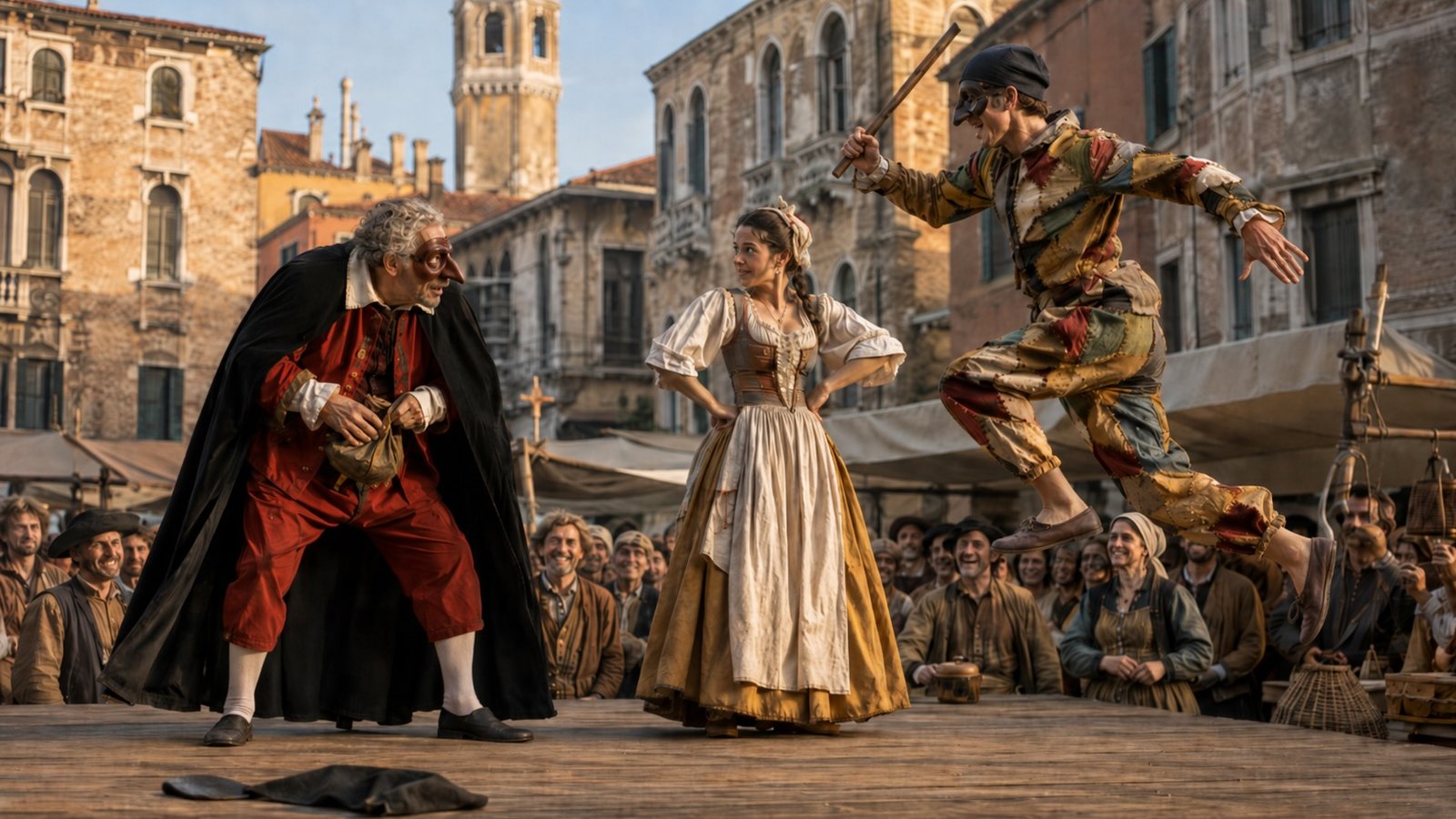
This was the world of commedia dell’arte, a theatrical tradition that emerged in Italy during the Renaissance and spread across Europe. The name sounds grand, yet its meaning remains practical. Here, arte refers to skill, craft and profession. Commedia dell’arte was comedy performed by professional actors rather than enthusiastic aristocrats who had found an afternoon free.
Its performers did not usually memorise a complete script. Instead, they worked from a scenario that outlined the situation, characters, entrances, misunderstandings and probable ending. Within that framework, actors improvised dialogue, physical comedy and topical jokes. However, the popular idea that they simply walked onstage and invented everything from nothing gives improvisation rather too much romance. Successful performers trained for years, developed specialised characters and stored jokes, speeches, gestures and comic routines in their professional toolkits.
Among its crowded population of foolish masters, scheming servants, boastful soldiers and lovesick young people, three characters achieved particular fame: Pantalone, Arlecchino and Colombina. Together, they formed something close to a dysfunctional Renaissance household. Pantalone controlled the money, Arlecchino tried to avoid work, and Colombina usually understood what everyone else should have done several scenes earlier.
Pantalone came from Venice, which made perfect sense. Venice was a wealthy commercial republic filled with merchants, bankers and international deals. Naturally, its representative on the comic stage became an elderly businessman who loved money more reliably than he loved human beings.
He usually wore tight red trousers, a red jacket, a long black cloak and a close-fitting cap. His mask featured a hooked nose, heavy eyebrows and an ageing face. A purse hung prominently from his belt because Pantalone never allowed anyone to forget who controlled the finances. He bent forward when he walked, partly because he was old and partly because centuries of counting coins had apparently reshaped his spine.
Pantalone could be miserly, suspicious and absurdly possessive. He often tried to prevent his daughter from marrying the young man she loved, particularly when the match threatened his fortune. At other times, he pursued much younger women with the confidence of a man who had mistaken his bank balance for personal charm. Audiences laughed because they recognised the type: a powerful older man who believed every relationship involved ownership, payment or negotiation.
Still, Pantalone was more than a joke about old age. He represented money itself: necessary, influential and permanently nervous that someone might take it away. His schemes usually failed because he tried to control emotions as if they were entries in an account book. Love, unfortunately for him, refused to follow Venetian bookkeeping.
Arlecchino occupied the opposite end of the social ladder. He was a zanni, or comic servant, traditionally associated with Bergamo in northern Italy. Poor, hungry and endlessly energetic, he wanted food, affection and an easier working day, preferably in that order.
His costume originally consisted of rough clothing covered with irregular patches. Over time, those patches developed into the colourful diamond pattern now associated with Harlequin. The transformation neatly mirrors the character’s journey from hungry Italian servant to elegant international clown. France polished him, ballet refined him, artists romanticised him, and modern decorative culture placed him on porcelain figurines looking far more thoughtful than he ever behaved onstage.
Arlecchino wore a dark half-mask with a low forehead, small eyes and sometimes a bump suggesting a horn. His movements combined acrobatics, animal energy and sudden changes of direction. One moment he might leap like a cat; the next he might freeze because someone had mentioned dinner. He often carried a wooden bat called a batacchio, made from two pieces designed to produce a loud noise without causing equivalent injury. From this theatrical object came the English word “slapstick”.
He was not exactly stupid. Rather, his intelligence arrived in flashes and often disappeared before completing the job. Arlecchino could devise an ingenious plan, misunderstand his own instructions and then survive the resulting disaster through speed, luck or shameless invention. He was the employee who created half the office problems but remained strangely difficult to dismiss because he also solved the other half.
His hunger supplied many jokes, although it carried a sharper social meaning. Pantalone worried about losing wealth; Arlecchino worried about finding lunch. Their conflict transformed inequality into physical comedy. The master guarded his purse, while the servant stole a sausage. Somehow, four centuries later, the basic workplace tension has not become entirely unfamiliar.
Then came Colombina, the clever maid who often served the young female lover. Her name means “little dove”, although anyone expecting a delicate, fluttering innocent soon discovered that this particular dove had excellent survival instincts.
Unlike Pantalone and Arlecchino, Colombina often appeared without a mask. That mattered. Her uncovered face allowed the actress to communicate directly with the audience, using expressions unavailable to the masked men around her. She could observe their foolishness, share a knowing glance with spectators and continue arranging the plot while everyone else congratulated himself on being clever.
Colombina usually became Arlecchino’s sweetheart, though she treated him with affection tempered by realism. She knew he was charming, unreliable and easily distracted by food. Rather than waiting helplessly for rescue, she delivered messages, arranged meetings, exposed lies and helped the young lovers escape parental control. In many scenarios, she functioned as the practical intelligence of the entire play.
Her role also points to one of commedia dell’arte’s most important features. Women performed female parts at a time when many European theatrical traditions excluded them from professional stages. Italian actresses appear in surviving records from the 1560s, and several achieved international fame. They did not merely decorate productions; they wrote, managed troupes, improvised and created influential stage personalities.
Naturally, this freedom had limits. Colombina remained a servant in a society structured by class and male authority. Plots sometimes treated unwanted pursuit by older masters as routine comedy. Pantalone’s interest in a young maid could generate laughter rather than moral outrage, and modern performers must decide how to handle material shaped by very different assumptions about power, gender and consent.
That debate forms part of a wider controversy around commedia today. Its stock characters can expose arrogance, greed and inequality, but they can also reduce people to regional accents, physical features or social stereotypes. Historical performers mocked scholars, foreigners, soldiers, peasants, old men and women with impressive democratic enthusiasm. Modern productions therefore face a choice: reproduce the old conventions unquestioningly or use them to challenge the same structures they once reinforced.
Another myth concerns the masks. People often imagine every commedia performer wearing one, yet the young lovers usually appeared unmasked, as did Colombina in many traditions. Masks identified social types rather than hiding every face. Pantalone did not represent one particular miserly merchant. He represented every miserly merchant unfortunate enough to sit near the stage.
The form eventually declined as literary playwrights demanded tighter control over dialogue and character. Carlo Goldoni helped reform Italian comedy during the eighteenth century, replacing improvisational types with more fully written personalities. Ironically, he also helped popularise the term commedia dell’arte while moving theatre away from many of its conventions.
Yet the tradition never truly vanished. Its fingerprints appear in pantomime, circus, opera, ballet, puppetry, silent cinema, television sitcoms and animated comedy. The greedy authority figure, chaotic junior employee and sharp-witted woman who keeps the household functioning still appear everywhere. Their costumes have changed, but their arguments remain remarkably stable.
That explains why Pantalone, Arlecchino and Colombina continue to feel alive. They do not behave like distant museum exhibits. They resemble people from the office, the family gathering or the restaurant table nearby. One controls the bill, another tries to escape it, and the third already knows exactly how the evening will end.
Commedia dell’arte offers no flattering portrait of humanity. We chase money, misunderstand instructions, fall in love unwisely and exaggerate our importance. Fortunately, we also improvise. Sometimes we even recover before the final curtain.