Morning Glory Clouds: Australia’s Strangest Dawn Spectacle
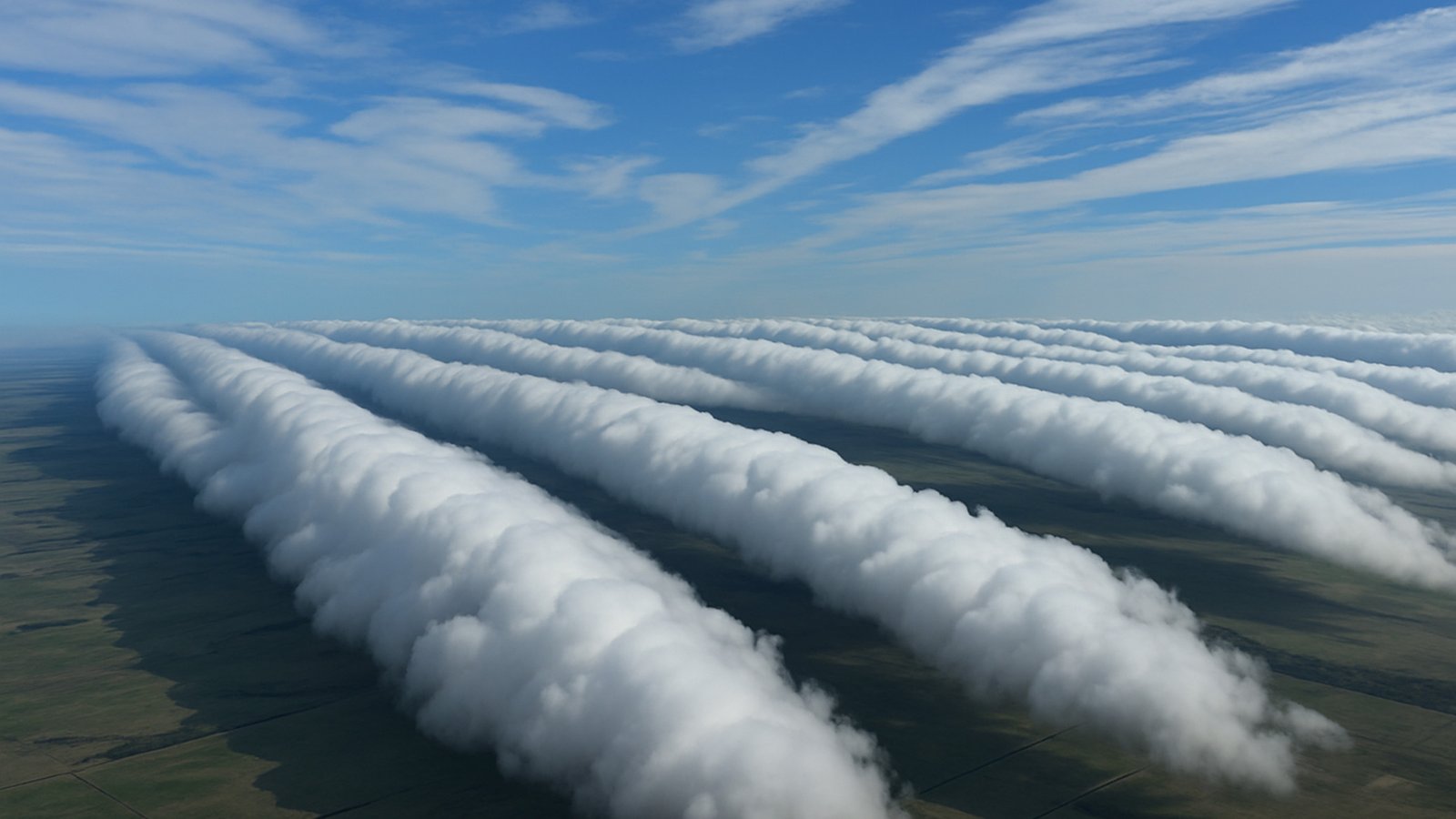
The sky over northern Australia sometimes behaves as if it’s auditioning for a science‑fiction film. Dawn creeps in, and the horizon suddenly grows a perfectly straight, perfectly tubular cloud, stretching so far you start wondering whether someone, somewhere, has laid out an atmospheric conveyor belt overnight. It rolls towards you with the confidence of a creature that knows it’s spectacular. Locals nod knowingly, tourists forget to blink, and pilots begin calculating how quickly they can get airborne. Meteorologists, meanwhile, reach for tea and resignation in equal measure. This is the Morning Glory cloud, one of the most bewildering atmospheric shows on Earth.
The name sounds poetic, but the behaviour is anything but subtle. Imagine a single cloud shaped like a colossal cylinder, tidy enough to satisfy even the most tyrannical geometry teacher. Now picture it stretching for hundreds of kilometres — sometimes close to a thousand — while maintaining a shockingly consistent form. The cloud doesn’t just float; it rolls. Air rises at the front, dips at the back, and the whole structure behaves like a slow‑moving wheel made of vapour.
Occasionally you get just one. Other mornings deliver a whole fleet — parallel tubes sweeping across the Gulf of Carpentaria like airborne runways that forgot their aircraft. Even seasoned Australians, who long ago adapted to living alongside crocodiles, spiders the size of dinner plates and heat that could roast a potato on a car bonnet, still stop to marvel at this one. Try explaining to someone who has never seen it that the sky is currently running several kilometres of neatly rolled cloud carpet. Their eyebrows always do interesting things.
Pilots adore the Morning Glory with the kind of fondness usually reserved for vintage cars or particularly obedient dogs. The cloud’s leading edge provides steady, reliable lift. Get your glider into the right position and you can surf it for dozens of kilometres without so much as tapping the instruments. Those who have flown along its curve talk about it in tones that sit somewhere between exhilaration and obsession. They’ll say it felt like riding the perfect wave, only with less saltwater and significantly more altitude. They’ll also insist it’s addictive. Take that with whatever quantity of salt you prefer.
Meteorologists approach the phenomenon with slightly less enthusiasm and slightly more dread. Their problem is simple: the Morning Glory requires a precise cocktail of atmospheric conditions, most of which refuse to behave. Two sea breezes — one from the Coral Sea to the east and one from the Gulf to the west — march inland during the day. They meet over the Cape York Peninsula, lift air upwards, and form a neat cloud line. When night arrives, the land cools. A temperature inversion settles over the Gulf: cooler air below, warmer air above. That’s when the whole system transforms.
The air that accumulated over the peninsula begins sliding down beneath the inversion, creating a solitary wave — essentially an atmospheric ripple with a stubborn sense of self‑importance. Air rises along the front edge of this wave and sinks along the rear, triggering condensation on one side and evaporation on the other. The result: a rolling cloud that replenishes itself as long as the wave remains stable and the humidity cooperates. It’s like nature accidentally built a self‑cleaning, self‑sustaining atmospheric machine.
Observers on the ground see beauty. Pilots feel lift. Meteorologists see chaos. Even a tiny change in wind shear, humidity or temperature can ruin the whole setup. Perhaps the wave forms but the air is too dry, and the cloud never appears. Perhaps the inversion isn’t strong enough, and the wave collapses before dawn. Forecasting the Morning Glory is like trying to predict whether a soufflé will rise when someone keeps slamming the oven door.
The best place to witness the spectacle is the Gulf of Carpentaria, particularly near the small town of Burketown. Here, the geography conspires in favour of drama: a peninsula flanked by two seas, generous humidity, dependable inversions and long, flat terrain. From September to November the chances of seeing the Morning Glory rise increase significantly, and Burketown quietly turns into a temporary base camp for glider pilots, photographers and weather romantics. Locals have embraced it with good humour. You can buy mugs and t‑shirts featuring a cloud tube, and no one seems remotely surprised.
Stand near the water at first light and the effect is surreal. The world feels paused, as if waiting for the sky to begin a performance. The air cools slightly, birds become restless, and then — a line appears. At first just a smudge, then a pale streak, then the unmistakable face of a vast rolling cylinder drifting with calm conviction. It moves at roughly the pace of an unhurried cyclist, which leaves far too much time to stare at it and question your understanding of the laws of nature.
Sometimes the cloud dips low enough to feel close, almost physical. People swear the air tastes different as it passes. The landscape changes character; the long horizon becomes a frame for this single impossible form. There’s no clutter, no complications — just one line drawn across the sky with improbable accuracy. It’s minimalism on the scale of continents.
As the sun climbs higher, the enchantment begins to dissipate. Warm air breaks the inversion, moisture slips away, and the once‑mighty cylinder dissolves into uneven patches, then into nothing at all. Five minutes later the sky looks deceptively innocent, as if it hadn’t been performing atmospheric acrobatics since dawn. Anyone arriving late might assume the whole thing was exaggerated by enthusiastic locals.
Those who have witnessed the Morning Glory tend to talk about it compulsively. They sound like people recalling an odd dream, except with more hand gestures. They’ll insist it’s simple physics, just airflow and moisture and inversions — but their eyes say otherwise. The phenomenon makes even the rational feel briefly conspiratorial. A cloud isn’t supposed to behave that well. A cloud isn’t supposed to be that long. A cloud isn’t supposed to roll.
The rare combination of predictability and unpredictability is part of its charm. You know the season. You know the region. You have absolutely no guarantee you’ll see anything at all. People return year after year, chasing the perfect cylinder. They wake before sunrise, sit by the water with flasks of tea and heroic levels of patience, waiting for the faintest sign of a line forming where the sea meets the sky. Sometimes the clouds oblige. Sometimes they don’t. The atmosphere is not especially bothered.
In a world full of increasingly erratic weather, the Morning Glory offers a comforting paradox. It refuses to follow easy rules, yet it appears often enough to feel almost traditional. It’s familiar yet astonishing, orderly yet wild. It arrives early, leaves quickly, mesmerises absolutely and explains nothing. No wonder it has become a quiet legend.
Those who chase storms find thrills in lightning. Those who chase clouds find magic in the Morning Glory. It’s one of those rare phenomena that reminds you the atmosphere still has a sense of humour — one that involves enormous rolling tubes drifting over the outback while everyone stares up in delighted confusion.