Madagascar Fossa: Mischievous Elegance with Claws
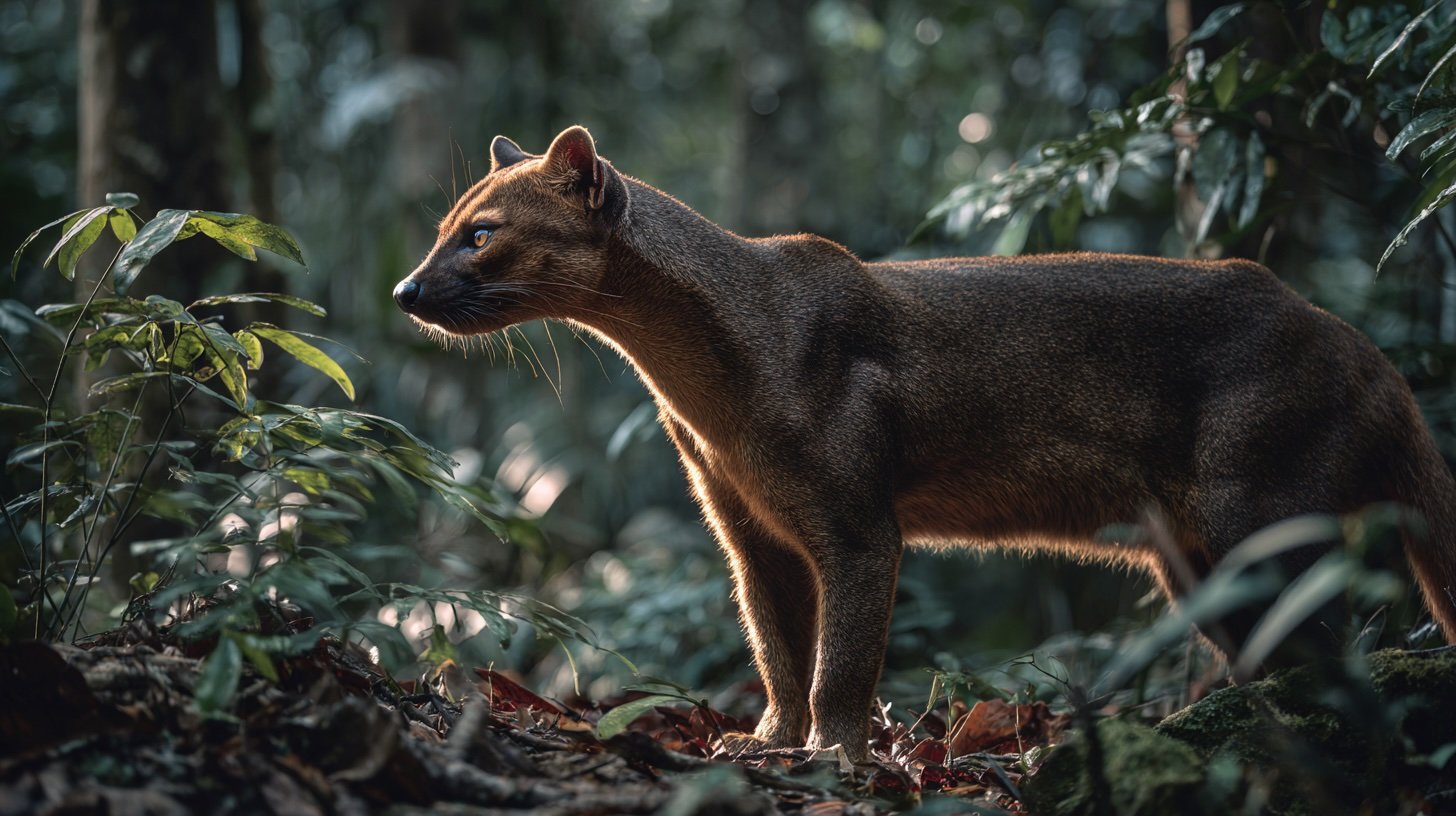
Fossa lives where logic goes on holiday. Madagascar likes to reinvent nature, and the fossa is its most confusing invention. People see it for the first time and whisper, very politely, that it looks a bit like a stretched cat with the manners of a mongoose. Naturalists, unable to resist a good puzzle, nod along and admit that even after decades of trying, they still can’t decide which familiar creature the fossa resembles most. It moves with the confidence of something that has never cared about the opinions of mainland biology.
This predator rules Madagascar’s forests with a quiet swagger. Every muscle seems designed for shortcuts: bounding up trunks, slipping along branches, diving down tree trunks as if gravity clearly doesn’t apply in this part of the world. Most island predators evolve into something slightly odd, but the fossa embraced the island brief and went full bespoke. It ended up as a long, coppery, muscular shadow with golden eyes and a tail almost as long as its body. When you wander through the forest at dusk, it watches you first. It always does.
Island evolution enjoys a dramatic flourish, and the fossa’s backstory delivers. Millions of years ago, Madagascar welcomed an ancestor that resembled a mongoose. With no large carnivores around, it took the opportunity to become the island’s apex predator. It stretched, strengthened and refined itself until it could outrun lemurs, outmanoeuvre birds and leave scientists shrugging. The result is a creature that sits within its own subfamily, a sort of evolutionary inside joke. You couldn’t mistake it for anything else once you’ve seen it sprint through a canopy like a reddish-brown lightning bolt.
Forest life forces creativity, and the fossa learned early on that the trees offer better routes than the undergrowth. It moves through branches as if they belong to it. Its ankles rotate almost fully backwards, giving it the enviable skill of climbing down trees headfirst, something even the world’s most self-assured domestic cat would envy. Lemurs certainly do not appreciate this feature. They start their day with a chirp, a stretch and a deep existential dread of being ambushed by a predator that hunts with both stealth and style.
Lemurs form the core of the fossa’s menu, though it happily expands its diet when the opportunity arises. Birds, reptiles, rodents, even the occasional tenrec — the fossa doesn’t discriminate. Evolution built it for efficiency rather than decorum. Farmers sometimes discover that it has taken a particular interest in their chickens, which never improves its public image. Stories travel quickly in small communities, especially when they involve a mysterious animal slipping in and out of the night like a rumour with teeth.
The fossa’s reputation has always hovered in that peculiar space between admiration and suspicion. In villages near forest edges, people speak of it with a mix of respect and irritation. Some describe it as a spirit of the forest, something ancient and entitled. Others mutter about its uncanny talent for making poultry disappear. Myths grew, as they always do where observation and scarcity collide. One tale insists the fossa can hypnotise chickens. Another claims it sneaks into houses to steal babies, a story with absolutely no factual basis but enormous staying power. You can almost imagine the fossa raising an eyebrow at humanity’s tendency for melodrama.
Scientists, who prefer data to folklore, still find the fossa enchanting to study. Tracking collared individuals through dense forest reveals home ranges far larger than anyone expected. These predators wander across tens of square kilometres, marking territories with deliberate precision. Solitary for most of the year, they tolerate company only during an annual ritual that seems designed by a committee of dramatists. When the season arrives, females occupy a special tree — yes, a specific tree — which becomes the stage for several days of courtship. Males gather, queue in a display of surprisingly orderly chaos, and wait for their chance. The entire affair takes place in the canopy, a sort of treetop opera featuring growls, yowls and the occasional undignified scuffle.
The young, born after around three months, arrive blind and helpless. For the first weeks they resemble small, stubborn kittens, though they grow into lanky teenagers remarkably quickly. By the time they reach adulthood, they carry the full set of arboreal superpowers. The forests need them, even if humans sometimes forget that they are there for balance rather than mischief.
Madagascar’s ecosystems depend heavily on the fossa. Without it, lemur populations would surge, forests would shift and entire networks of species would feel the impact. Apex predators act as the quiet regulators of their landscapes, and the fossa is no exception. Yet its presence on the island becomes increasingly precarious. Deforestation continues to chip away at its habitat, slicing forests into smaller pieces and isolating populations. When the forest shrinks, the fossa shrinks with it — not in size, but in number.
Attempts to protect the species face all the usual challenges. Habitat restoration takes decades. Community education must compete with folklore older than many villages. Conservationists try to bridge the gap between scientific urgency and local experience, explaining that the fossa isn’t a villain plotting poultry heists but a creature trying to survive in a landscape transformed by human hands. Some success stories emerge, especially around large protected areas where forest corridors still allow individuals to travel and find mates. Even so, population numbers remain low and vulnerable.
Watching a fossa in the wild feels strangely grounding. It reminds you how much of the world still runs on quiet rules that existed long before humans arrived. A single flash of movement, a soft rustle, and suddenly the forest becomes a theatre. The animal steps into view with the confidence of something that knows it doesn’t need an audience. It never hurries, even when it’s hunting. Every step follows internal choreography.
Visitors often expect something more dramatic. They imagine a snarling beast leaping through branches. The reality is more elegant. A fossa pads along a branch, pauses, listens and watches everything half a second before it happens. Its tail sways like a counterweight that understands physics better than you do. Then it slips away, leaving you feeling as though you saw something faintly mythical by accident.
The world has not fully decided how to classify the fossa. Is it cat-like? Mongoose-like? Something entirely separate? The lack of a neat label only adds to its charm. Madagascar produces creatures that refuse to fit into tidy categories, and the fossa leads this troupe with a certain pride. Its entire existence asks a subtle question: why settle for one evolutionary path when you can borrow the best bits of several?
Modern depictions often do it no favours. Animated films turned it into a wide-eyed caricature, a slightly manic villain chased away by lemurs with improbable social skills. Anyone who has observed a real fossa knows that it would never accept such indignity. Real ones operate like seasoned hunters who have learned to waste neither movement nor emotion. They do not shriek or skitter. They choose silence and shadows, because both suit them.
Spend long enough reading field notes and you discover a pattern in scientists’ descriptions. They begin with technical detail but end with something closer to admiration. Even the most stoic biologist can’t hide a spark of fondness for the fossa’s unapologetic independence. It doesn’t fear humans, yet it keeps its distance with exquisite manners. It seldom threatens, preferring to watch and melt into the undergrowth the moment you blink.
The forests of Madagascar echo with many sounds — lemur calls, rustling palms, the thump of falling fruit — but the fossa moves quietly, a soft pulse in the background. Its future rests on our willingness to protect the landscapes it threads through. Without continuous forest, the species will struggle. Without understanding, it will continue to be blamed for problems that lie elsewhere.
For now, the fossa endures. It darts across branches in Masoala’s rainforests, patrols Kirindy’s dry woods and slips through the shadows of Ankarafantsika’s lakeside paths. Every sighting adds a fragment to our understanding, yet the animal manages to keep most of its secrets. Perhaps that is part of the appeal. Not everything in nature wants to be solved.
Madagascar’s most enigmatic predator carries on with its quiet dominion, unimpressed by human attempts to label, organise or tidy up its story. It lives exactly as it chooses, which might be the truest form of island wisdom.