Tenochtitlan began with water. Not the cinematic kind with slow motion and violins. More the steady, practical sound of canoes brushing past reed edges, water nudging stone steps, market goods moving through canals, and someone probably swearing because a basket of chillies had just tipped over.
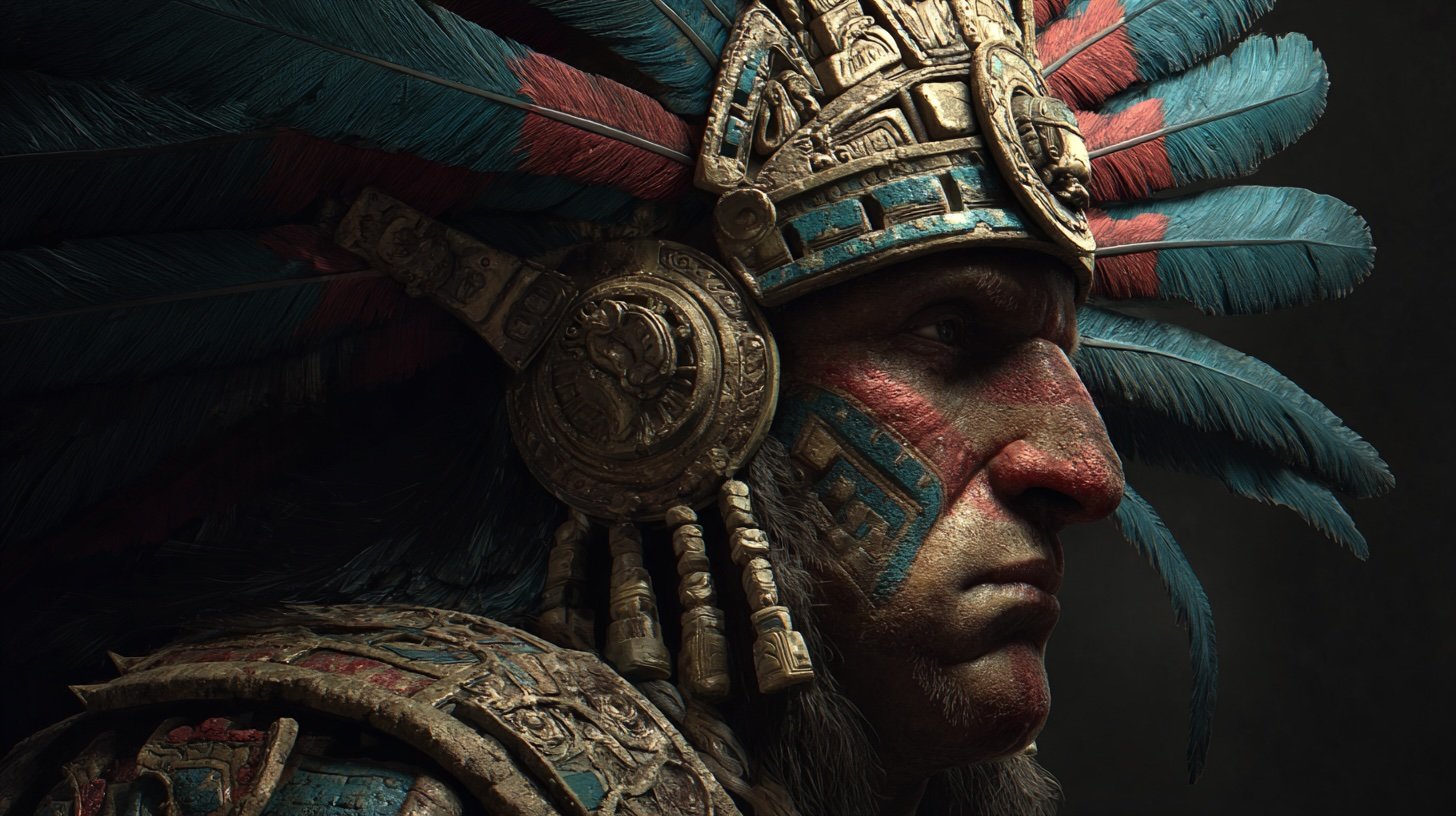
This was the capital of the Mexica people, built on an island in Lake Texcoco and somehow determined not to behave like a modest lakeside settlement. By the early sixteenth century, Tenochtitlan had become one of the most remarkable cities in the world: engineered on water, fed by intensive agriculture, organised through markets and tribute, and framed by rituals that still unsettle modern readers.
We usually call its rulers the Aztecs. That is useful shorthand, but it hides some nuance. The people at the centre of this story called themselves the Mexica. Their empire was not a neat, centralised state in the Roman style. It grew from the Triple Alliance of Tenochtitlan, Texcoco and Tlacopan, formed in 1428 after the defeat of the Tepanec power centred on Azcapotzalco. From there, the alliance expanded its influence across much of central Mexico through war, tribute and political pressure.
The awkwardly short lifespan of that empire often surprises people. The Triple Alliance emerged in 1428. Tenochtitlan fell to Spanish-led forces in August 1521. That is less than a century of imperial dominance. The Aztec Empire did not rise, flourish and fade over millennia. It sprinted.
Its origin story begins with movement. Mexica tradition spoke of Aztlan, a northern homeland that sits somewhere between memory, migration myth and political identity. Whether Aztlan was a precise physical place matters less than what the story did. It explained why the Mexica arrived relatively late in the Valley of Mexico, why they initially lacked the prestige of older powers, and why divine favour became so central to their self-image. Even the word “Aztec” points back to Aztlan, though “Mexica” is often the more precise term for the people who built and ruled Tenochtitlan. Britannica notes that Aztlan may be legendary and that the Aztecs were also known as Mexica and Tenochca.
When the Mexica reached the valley, they entered a crowded political world. Lakes, city-states, alliances and rival dynasties already shaped the region. They settled on a marshy island that did not look especially promising. Then they engineered it into something extraordinary.
Building a capital on a lake sounds like a terrible idea until you realise how seriously the Mexica took infrastructure. Causeways connected the island to the mainland. Canals carried people and goods through neighbourhoods. Aqueducts brought fresh water. This was not a soggy improvisation but a planned urban system where movement, food supply, trade and ritual were tightly connected.
The chinampa system is still often misunderstood because people like calling them “floating gardens”. They did not float. Farmers created rectangular plots in shallow lake beds by building up layers of mud, vegetation and organic material, then stabilising them with trees. Canals ran between the plots, giving farmers irrigation, transport and access. Maize, beans, squash, chillies, flowers and herbs could be grown intensively close to the city that consumed them. National Geographic identifies chinampas as a key feature of the agricultural system that helped feed Tenochtitlan’s population.
That matters because population estimates for Tenochtitlan are famously tricky. Older and popular accounts often present the city as having hundreds of thousands of inhabitants, and it was certainly a major urban centre. But exact numbers are contested. Some scholars have questioned very high estimates derived from Spanish descriptions, arguing that without reliable census data, population size has to be reconstructed cautiously from urban area, household structure and density. A sensible article should therefore avoid pretending that one neat figure has been settled. Tenochtitlan was large, sophisticated and densely organised; the precise number remains debated.
Its markets impressed even its enemies. The market at Tlatelolco, Tenochtitlan’s sister city, became famous in Spanish accounts for its scale, variety and regulation. Traders sold food, textiles, tools, feathers, cacao, pottery and many other goods. Officials monitored disputes and standards. A city that can organise commerce at that level does not run on chaos or superstition. It runs on rules, trust, enforcement and habits learned over generations.
The empire itself expanded through pressure rather than simple annexation. Conquered or dependent provinces often kept local rulers, but they owed tribute. Goods flowed towards the imperial centre: foodstuffs from nearby areas, and high-value items such as textiles, feathers, cacao and precious materials from more distant regions.
The Codex Mendoza, created after the Spanish conquest, preserves valuable pictorial records of tribute obligations, conquests and aspects of daily life. It is not a neutral window into the pre-conquest world — no colonial-era source is — but it remains one of the most important records for understanding how tribute helped sustain imperial power.
This is where the Aztec Empire starts to look less like a mysterious “lost civilisation” and more like a hard-headed political economy. Empire meant moving goods, maintaining fear, rewarding allies, punishing rebels and making sure the centre remained visibly powerful.
Trade networks reached beyond imperial borders. Obsidian, the volcanic glass used for blades, tools and weapons, moved across central Mexico through exchange and tribute networks. In a world without steel weapons, obsidian mattered enormously. It shaped daily labour, warfare and ritual practice.
Aztec warfare also followed a logic that can look strange from the outside. Wars secured tribute, punished defiance and captured prisoners. Some conflicts, often described as “flower wars”, appear to have had ritualised dimensions, though scholars continue to debate exactly how they functioned. They may have helped maintain military readiness and supplied captives for sacrifice, but they also preserved enemies who would later have every reason to turn against Tenochtitlan.
That resentment matters. The Spanish did not conquer the Aztec Empire alone.
When Hernán Cortés arrived in 1519, he entered an existing world of rivalries, grievances and strategic calculations. Tlaxcala, a long-standing enemy of the Mexica, became one of the most important allies of the Spanish. Other groups joined for their own reasons. The fall of Tenochtitlan was not a simple duel between Europe and the Americas. It was a coalition war in which Indigenous enemies of the Mexica played a decisive role.
Disease made everything worse. Epidemics devastated populations with no prior exposure to Old World pathogens, weakening resistance and deepening social crisis. But disease alone did not conquer Tenochtitlan. It interacted with politics, siege warfare, hunger, alliance-building and violence.
At the centre of Mexica religious and political life stood the Templo Mayor. Its twin shrines were dedicated to Huitzilopochtli, associated with war and the sun, and Tlaloc, associated with rain and fertility. That pairing matters. Conquest and crops were not separate concerns. The survival of the city depended on both.
Human sacrifice remains the most controversial and uncomfortable part of Aztec history. It should be neither sensationalised nor softened beyond recognition. Mexica religion linked cosmic order to ritual action. Gods required nourishment. Human life, blood and hearts could be understood as offerings that helped sustain the world.
Colonial sources describe sacrifices on a vast scale, including the infamous claim that more than 80,000 victims were killed over four days during the reconsecration of the Templo Mayor in 1487. That figure should be treated with caution. It is logistically difficult, politically useful for Spanish writers, and far too neat as an image of absolute horror. Questioning the number, however, does not mean denying the practice.
Archaeology confirms ritual killing. Excavations around the Huei Tzompantli, the great skull rack associated with Tenochtitlan’s sacred precinct, have identified hundreds of skulls. INAH reported 655 identified skulls in the altar, including male, female and infant remains. That finding complicates the older assumption that sacrificial victims were only captured male warriors. It also shows why the subject needs care: the evidence is real, but the interpretation is not simple.
Everyday life, meanwhile, did not consist only of temples, warfare and sacrifice. Most people lived through farming, craft production, trade, family duties and local obligations. Social class shaped expectations. Nobles trained for leadership, war and ritual roles. Commoners farmed, traded, made goods and served in armies. Slavery existed, though it differed from later Atlantic slavery; enslaved people could retain some rights and in some cases regain freedom.
Education mattered. Boys and girls received formal instruction, though their training differed by gender and social status. Schools taught history, religion, discipline, moral conduct and practical skills. The system could be harsh, but its existence tells us something important. The Mexica were not merely building monuments. They were reproducing a society.
Women played essential roles in household production, textile work, trade and ritual life. Midwives held respected positions. Markets depended on female labour as well as male. Daily survival rested less on spectacular violence than on food preparation, weaving, child-rearing, exchange and relentless work.
Several myths still cling to the Aztecs.
One is the idea that Moctezuma believed Cortés was the returning god Quetzalcoatl. Modern historians are deeply sceptical of that story. It appears most clearly in post-conquest Spanish narratives, where it conveniently makes the fall of Tenochtitlan look like destiny rather than a messy combination of coercion, calculation, misunderstanding and betrayal. Moctezuma may have hesitated. He may have tried diplomacy. He did not simply mistake armed strangers for gods strolling out of prophecy.
Another myth casts the Aztecs as uniquely cruel. Human sacrifice shocks modern readers, and it should. But ritual violence did not exist in a moral vacuum. Early modern Europe also practised public executions, religious persecution, torture and brutal war. That comparison does not excuse sacrifice. It prevents lazy superiority.
The opposite myth is just as misleading: the romantic claim that the Aztecs were peaceful victims of European treachery alone. The Mexica built an empire. Subject peoples paid tribute, faced punishment and sometimes had powerful reasons to hate Tenochtitlan. Ignoring that reality erases the political world into which the Spanish inserted themselves.
The Aztec Empire thrived because it combined engineering, agriculture, markets, military pressure, religious theatre and political alliance into a single powerful system. It fell because that system faced invasion at a moment of epidemic shock, internal strain and regional hostility.
When Tenochtitlan fell on 13 August 1521, it did not simply disappear. Temples were dismantled. Stones were reused. Mexico City rose over the ruins. Lake Texcoco gradually shrank and was drained. Yet the old city keeps resurfacing whenever modern Mexico City digs deep enough.
That may be the best way to understand the Aztecs: not as a vanished people frozen in sacrifice scenes or conquest paintings, but as a complex imperial society whose remains still disturb easy stories.
They built fast. They ruled hard. They believed deeply. They fed a huge city from a lake. They terrified their enemies, impressed their conquerors and left behind a legacy that refuses to fit neatly into hero or villain categories.
History does not ask us to be comfortable. It asks us to pay attention.