In 1817, an American newspaper described a man named William Irving as a “lobby member” of the New York legislature. It sounded almost like an elected office, although the important distinction was that Irving had no seat. The following year, another writer helpfully explained what a lobby member did. He was someone engaged to use outside influence on behalf of people whose petitions were before the legislature. The explanation suggests the expression still needed a gloss. The job itself was easy enough to grasp. Someone had a case to make, someone else had a vote, and there was a place where their paths might cross.
The building had supplied the vocabulary long before the occupation acquired a name. In 1640, an English record referred to the outer room of the House of Commons as the lobby. The word belonged to architecture. It named a place just outside the room where the business happened, a useful distinction in a building where crossing a threshold could change what you were allowed to do. A lobby might be a hall, an antechamber or a passage. Its political usefulness came from where it led. A perfectly comfortable room at the other end of the building would have been considerably less useful.
Eighteenth-century London offered a rehearsal of sorts. Theatres had lobbies outside their boxes, and the “box-lobby lounger” was a recognisable figure. A man could spend a perfectly satisfactory evening there talking to well-connected people and pay very little attention to the play. American theatres had their own lobby loungers, and historians at the US House of Representatives suggest that the theatrical habit helped furnish the political vocabulary. It is a plausible connection, though the surviving examples give us firmer dates for the words than for the route they took. The theatre and the legislature did share one convenience. Both gave people a reason to turn up at an appointed hour and pass through the same few doors.
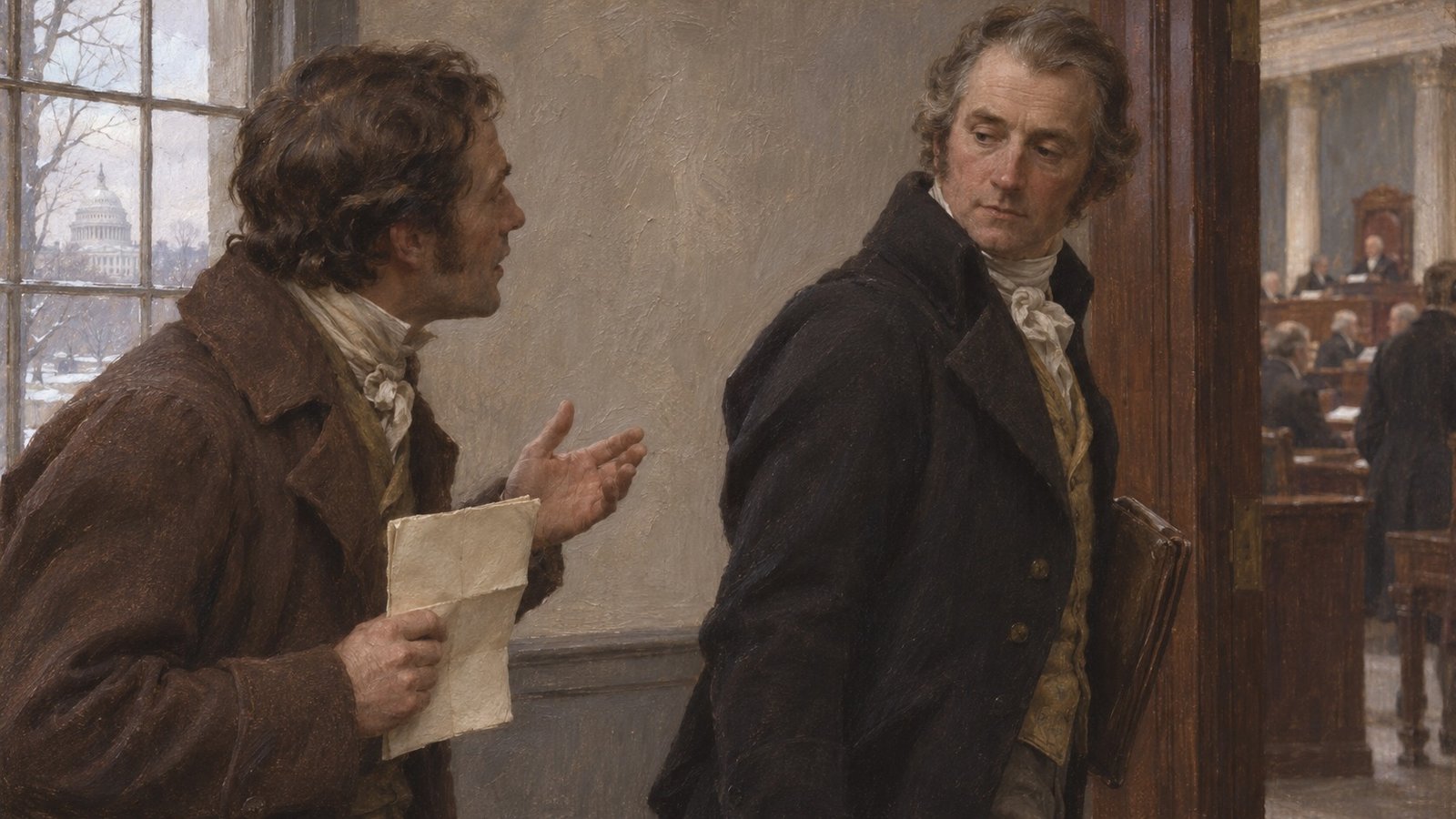
The early US Capitol made particularly good use of this arrangement. Representatives had no offices there, so the lobby outside the House chamber was often the only place in the building to catch one. Spectators, vendors and diplomats all made use of it. In 1801, the noise became so tiresome that the Speaker threatened to clear the space altogether. The threat went unfulfilled, and the lobby remained a convenient spot to intercept a member on his way to or from the chamber. The modern expression “to get a meeting” sounds oddly formal beside this arrangement. Sometimes getting a meeting meant being in the way.
By 1820, the verb was already doing political work. That April, the New Hampshire Sentinel reported allegations that senators had been “lobbying about the Representatives’ Chamber” during the struggle over the Missouri Compromise. The dispute concerned the expansion of slavery, and the report accused senators of trying to intimidate wavering representatives with threats that the Union would break up. The wording catches the term halfway between a place and a practice. The senators were physically about the chamber, and their presence was purposeful. It also complicates the picture of lobbying as something outsiders do to politicians. Here, one set of legislators was accused of doing it to another.
That newspaper also makes life difficult for the most entertaining origin story. According to Washington lore, President Ulysses S. Grant found himself besieged by people seeking favours in the lobby of the Willard Hotel. The story credits him with giving the petitioners their name. A president trying to spend a quiet evening while strangers look for an opening is an appealing image, and the hotel gives the tale an address. The dates are less accommodating. Grant took office in 1869, nearly half a century after the New Hampshire newspaper used “lobbying”. The Willard may have supplied a fine setting for the practice. The word was already in circulation.
Westminster has an equally persuasive setting. After fire destroyed much of the old Palace in 1834, Charles Barry designed the new Central Lobby as a meeting place where MPs could see their constituents. It is a lofty stone octagon at the point where corridors from the Commons, the Lords and Westminster Hall meet. A visitor can still ask at the desk for their MP without having made an appointment, and staff will try to contact the member. This gives the place a practical function beyond its mosaics and stone kings. The ordinary business of asking an elected representative to hear a complaint has a room of its own.
Westminster also uses the word for the two corridors on either side of the Commons chamber where MPs record their votes in a division. Members walk through the Aye Lobby or the No Lobby, depending on how they intend to vote. The building thus contains one lobby where a constituent can ask an MP to take a position and two others where that MP can formally do so. It is an unusually literal piece of political architecture. Between the place where someone makes a case and the place where a vote counts lies a short walk through the same building.
The word has since left the building altogether. A residents’ group can lobby a council by email, a charity can lobby for a change in the law, and a trade association can lobby through a meeting arranged months in advance. All can use the same verb, though they have very different chances of getting a hearing. The old physical lobby made that difference easier to see. There was the person with the vote, the person waiting to speak, and the short distance between them. In the early Capitol, even a vendor could stand in the right spot. The trick was getting the man on his way to the chamber to stop walking.