
In Haiti, a smoked herring can end up flaked into a sharp little salad with onion, peppers and vinegar. In Britain, a fish from the same North Atlantic waters might reach the breakfast table split open, its skin bronze from the smokehouse. The British version comes with toast. The Haitian one might come with cassava bread and enough chilli to make a second helping a considered decision. Put the dishes side by side and you can see what made herring such a successful traveller. Salt and smoke helped it survive the voyage. Each kitchen decided what to do with the salt and smoke when it got there.
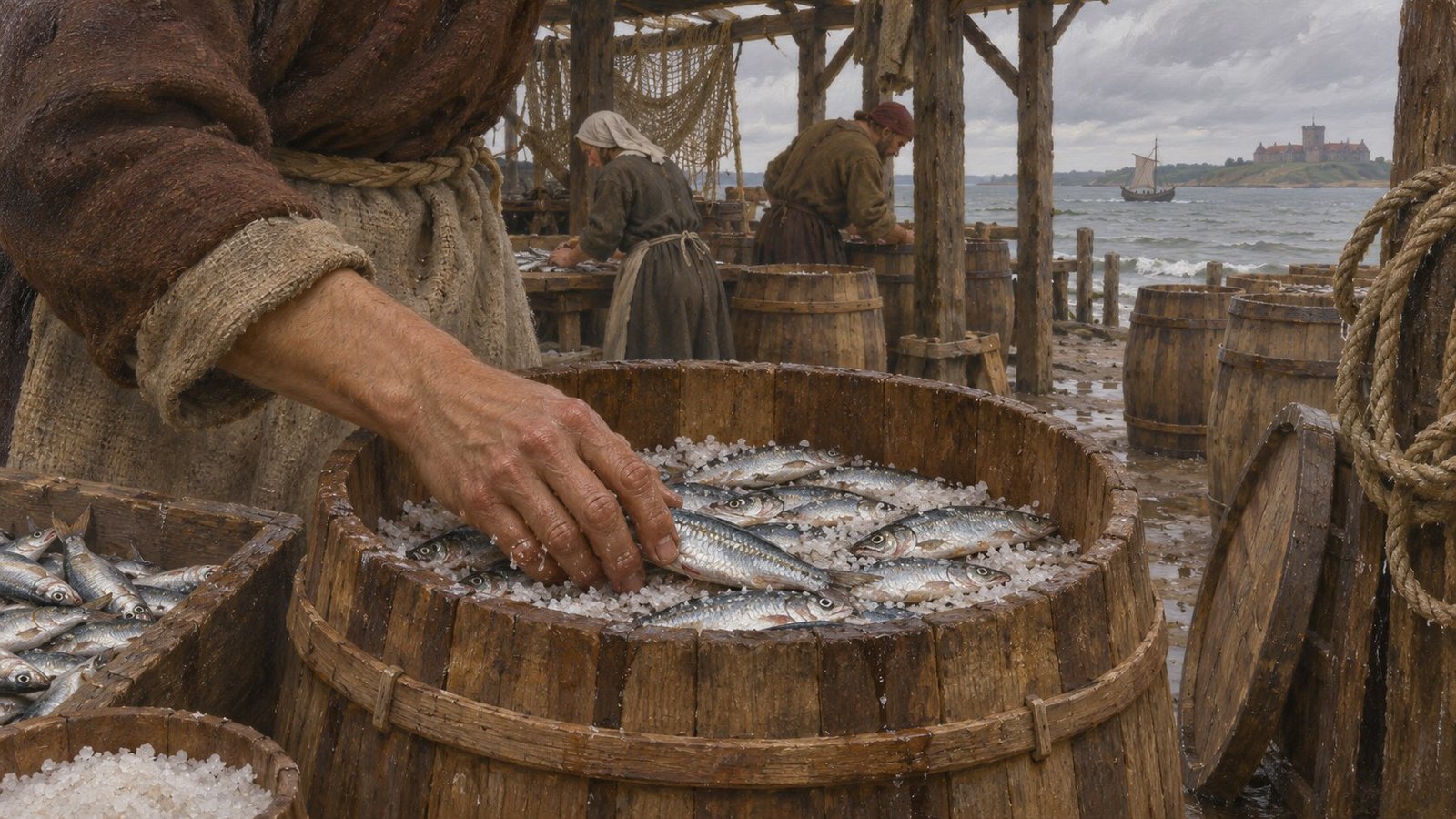
Medieval fishers had a problem that anyone who has bought fresh fish on a warm day can appreciate, although theirs came by the boatload. Herring gathered in immense shoals, so a good catch could land far more fish than a port could eat or sell fresh. By the thirteenth century, fisheries off Great Yarmouth and along the coast of Scania, then part of Denmark and now in southern Sweden, were supplying markets well inland. By the early fourteenth century, some of that catch was going into barrels of salt brine. The timing suited Christian Europe, where days of abstinence from meat created a regular market for fish. A merchant could sell herring to people who had never seen the sea.
The Dutch turned North Sea herring into a major export and developed a cure that shows how much flavour depends on what happens before a fish reaches the kitchen. For Hollandse Nieuwe, processors select herring before spawning, when the fish are fatty. In the traditional method, they remove much of the gut but leave the pancreas, whose enzymes help the flesh mature during the salt cure. The result is soft and rich, with a gentler saltiness than the old barrel fish that needed soaking. At a Dutch fish stall, it may come cut into pieces with chopped raw onion. The familiar pose of holding the fish by its tail and lowering it into the mouth remains available to anyone who trusts their shirt.
Smoke sends the fish in a different direction. For a British kipper, the fish is split along the back, opened flat, brined and cold-smoked. The two sides stay joined, which gives a whole kipper its distinctive shape on the plate. A German rollmop puts the fillet to quite another use. The cook wraps it around a piece of pickled cucumber or onion, pins it with a small stick and packs it in a vinegar marinade. A kipper gives you warm smoke and oily flesh. A cold rollmop delivers a mouthful of acid and crunch, with a wooden pin to account for before the second bite.
Sweden’s surströmming takes a third approach. Producers lightly salt Baltic herring and let it ferment. Fermentation continues in the tin, and opening one outdoors is a courtesy familiar to neighbours of enthusiasts. The fish once formed part of the everyday diet of poorer households along Sweden’s northern coast. Its reputation now travels chiefly through its smell, which tells you rather little about how people actually eat it. On thin flatbread with boiled potatoes and chopped onion, a few pieces of fish season the whole thing. Watching someone attempt a forkful straight from the tin gives about as fair an impression of the dish as watching them eat a spoonful of mustard.
Haiti’s chiktay aransò works on a similar principle, although the flavour comes from salted, smoked herring. Cooks first take some of the salt out, often with a brief boil and soak, then remove the bones and pull the fish into flakes. One version tosses it with onion, sweet pepper, carrot, garlic, vinegar and oil. Hot pepper can give the mixture a second kind of heat. Bread or cassava makes it easy to scoop up the juices. Canadian smoked herring still goes to Haiti and other Caribbean markets, so this particular example of a northern fish finding a southern kitchen is a living trade as well as a culinary habit.
Across the Pacific, herring had its own commercial history. From the late Edo period into the Meiji era, shoals came close to the Hokkaido coast to spawn, sometimes turning the water milky white. A portion of the catch went into migaki nishin, gutted herring dried for storage and shipment. Merchant vessels carried it down the Sea of Japan coast, and it found its way into dishes well beyond the fishing grounds. In nishin soba, associated with both Kyoto and Hokkaido, cooks simmer dried herring with sweet and savoury seasonings until it softens, then lay it across a bowl of buckwheat noodles. Kyoto typically favours a lighter broth seasoned with kombu and light soy sauce. Hokkaido versions can taste stronger and sweeter.
Japanese cooking also gives the eggs their own place at the table. Kazunoko, herring roe, appears in New Year meals as a wish for many descendants, a meaning easy to grasp when the little eggs are still packed together. It has a delicate crunch quite unlike the yielding flesh of a Dutch cured herring or the soft, simmered fillet on soba. In a traditional Hokkaido preparation called Matsumae-zuke, cooks combine the roe with dried squid and kelp, giving the mixture several textures before they have even started on the seasoning.
There is one more thing drying does for the herring in a bowl of soba. As the fish simmers and softens, some of its sweet cooking liquor goes with it into the broth. A few bites in, the noodles and the fish begin to taste of one another. A merchant loading dried herring aboard a ship needed it to give up its water. The cook at the other end of the voyage had a very good reason to put it back.