Hitchcock, His Blondes and the Obsession That Went Too Far
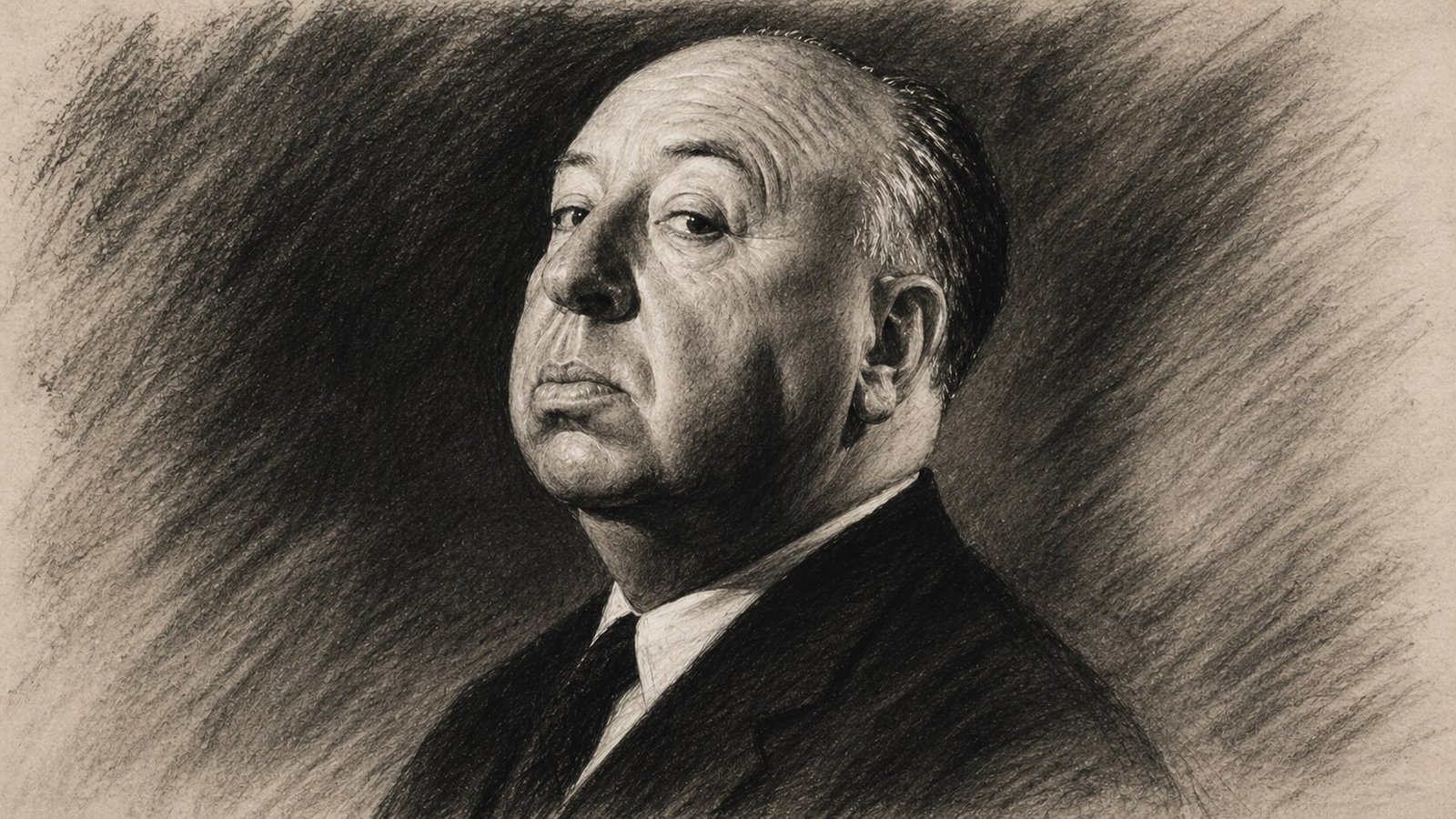
Alfred Hitchcock loved blondes. Not in the charming, casually-appreciative way a person might prefer a particular flavour of ice cream. No, the Master of Suspense loved blondes the way a collector loves rare objects — obsessively, possessively, and with a disturbing desire to own them completely. And yes, that distinction matters enormously.
All of his most acclaimed films feature a blonde in a pivotal role. From Madeleine Carroll in the 1930s through to Grace Kelly and eventually Tippi Hedren, Hitchcock constructed a very specific type of woman and placed her at the centre of his greatest work. Cool, calm, sophisticated, icy and untouchable — that is what a Hitchcock blonde was supposed to be. A woman whose locks were never out of place, with blue eyes clear and appraising. Perfectly poised. Devastatingly elegant. And, crucially, not entirely to be trusted. Which, when you think about it, says rather a lot about how Hitchcock viewed women in general.
He was quite candid about his reasoning. Hitchcock said blondes made the best victims — they were like virgin snow that shows up the bloody footprints. Romantic. When pressed further on his preference, he told François Truffaut he was after the drawing-room type, and elaborated in terms so colourfully crude that we’ll leave them to your imagination. The point was the contrast: a refined exterior concealing something altogether less controlled underneath. That tension, that gap between surface and depth, was what he was after. Artistically, it was genuinely brilliant. Personally, it was where things got complicated.
In many of Hitchcock’s films, the main female character tends to fit a certain model of appearance — attractive, with blonde hair. Critics have noted this preoccupation as representing women not as they are, but as Hitchcock wished them to be. Film theorist Laura Mulvey put the whole thing under a microscope in her 1975 essay on the male gaze, using Hitchcock as her chief exhibit. She noted how, in Rear Window, James Stewart’s character spends much of the film secretly looking through his camera lens into other people’s apartments. In Vertigo, Stewart’s detective voyeuristically follows Kim Novak’s Madeleine, watching and falling in love with a perfect image of female mystery and beauty — with Hitchcock’s shot selection making the viewer complicit in that voyeurism. So you are not just watching a film about obsession. You are, rather uncomfortably, participating in one.
Vertigo is where the whole thing plays out most explicitly on screen. Scottie becomes so fixated that when he meets Judy, he begins to transform her into an exact visual replica of Madeleine in a quest to create the ideal woman. He picks her clothes, redesigns her hair, remakes her entirely. It is both the most technically dazzling and the most psychologically unsettling thing Hitchcock ever committed to film. The character mirrors the director with uncomfortable precision. Life imitating art, or art confessing to life — depending on how generous you feel.
Grace Kelly starred in three of his films and was a major fixation for Hitchcock, who was crushed when she left Hollywood to marry the Prince of Monaco. He then sought a replacement through a series of strikingly beautiful blonde actresses — Kim Novak, Janet Leigh, Eva Marie Saint, and eventually Tippi Hedren. Each one, to varying degrees, became subject to his controlling tendencies. Novak famously found a plucked chicken hanging upside down in her dressing room and still, to this day, has no idea what it meant. Leigh famously had to negotiate the terms of the Psycho shower scene in considerable detail. Nobody walked away from a Hitchcock production without a story.
With Hedren, however, things went far beyond on-set eccentricity. After casting her in The Birds, Hitchcock developed what Hedren described as an unhealthy obsession. He was extremely possessive of her, warning castmates not to touch her, and if she was seen talking to another man, she would receive an expressionless, unwavering stare from across the soundstage. He sent her jewellery and notes. He had his driver pass by her home. He had a door installed between his office and her dressing room on the set of Marnie. None of this was subtle.
According to Hedren, after she refused his advances, he began a programme of psychological torture on set, culminating in the filming of a bird attack in which live birds were thrown at her face for five days in a row, leading to a breakdown. There had been studio-engineered mechanical birds built for the film’s climactic attack sequence. They had spent a fortune on them, but they looked like mechanical birds, and the decision was made to use live ones instead. Live birds were tied to Hedren’s arms. Hundreds were thrown at her as she opened a door. She later said she believed it was punishment for rejecting him. Her description of the whole experience was damning: “It was sexual, perverse, and ugly.”
When Hedren turned down his advances on Marnie, Hitchcock threatened to ruin her career. After filming ended, he kept her under contract while declining to offer her any significant projects — a particularly cruel form of professional limbo that effectively froze her out of the industry for years. He also once sent her daughter, Melanie Griffith, a Hedren-shaped doll in a small coffin-like box as a gift. Just casually, as one does.
The standard defence of Hitchcock — and there is always a defence — is that the films themselves are more complex than a simple reading allows. His women are frequently the most intelligent people in the room. Lisa Fremont in Rear Window ultimately solves the case. Grace Kelly’s character was essentially the masculine figure in that film, as Stewart’s Jeff was immobilised in a wheelchair. The blondes drive the narratives even as the camera ostensibly objectifies them. The counter-argument is that this complexity on screen made what happened off screen even more calculated. He understood exactly what he was doing. He built his obsessions into the work and then, on set, acted them out in real life. A recurring motif throughout his films is of a man possessing a woman, going to any lengths to gain that possession. In Hitchcock’s case, fiction was not so much an escape from reality as a blueprint for it.
None of this makes the films less magnificent, which is the genuinely uncomfortable part. Vertigo consistently tops polls of the greatest films ever made. The Birds is still terrifying. Rear Window remains a masterclass in tension. You can hold two things at once: the work is extraordinary, and the behaviour behind it was not. What Hitchcock did was build a cinema of desire and control so persuasive that generations of audiences watched it and called it genius. They were not wrong. But the women who lived through it deserved considerably better than to be cast as supporting characters in someone else’s obsession — and then blamed for not playing the role he had written for them.
Hedren never feared speaking up. She told many colleagues privately about what happened and eventually gave her account to Hitchcock’s biographer Donald Spoto, before writing about it fully in her own memoir decades later. At 96, she is still here. Hitchcock, meanwhile, remains on the syllabi of every film studies course in the world. And the conversation about what we choose to admire, and what we choose to overlook in the name of art, carries on — rather like his camera, lingering on something just a moment longer than is entirely comfortable.