The Last Friend of Gilgamesh
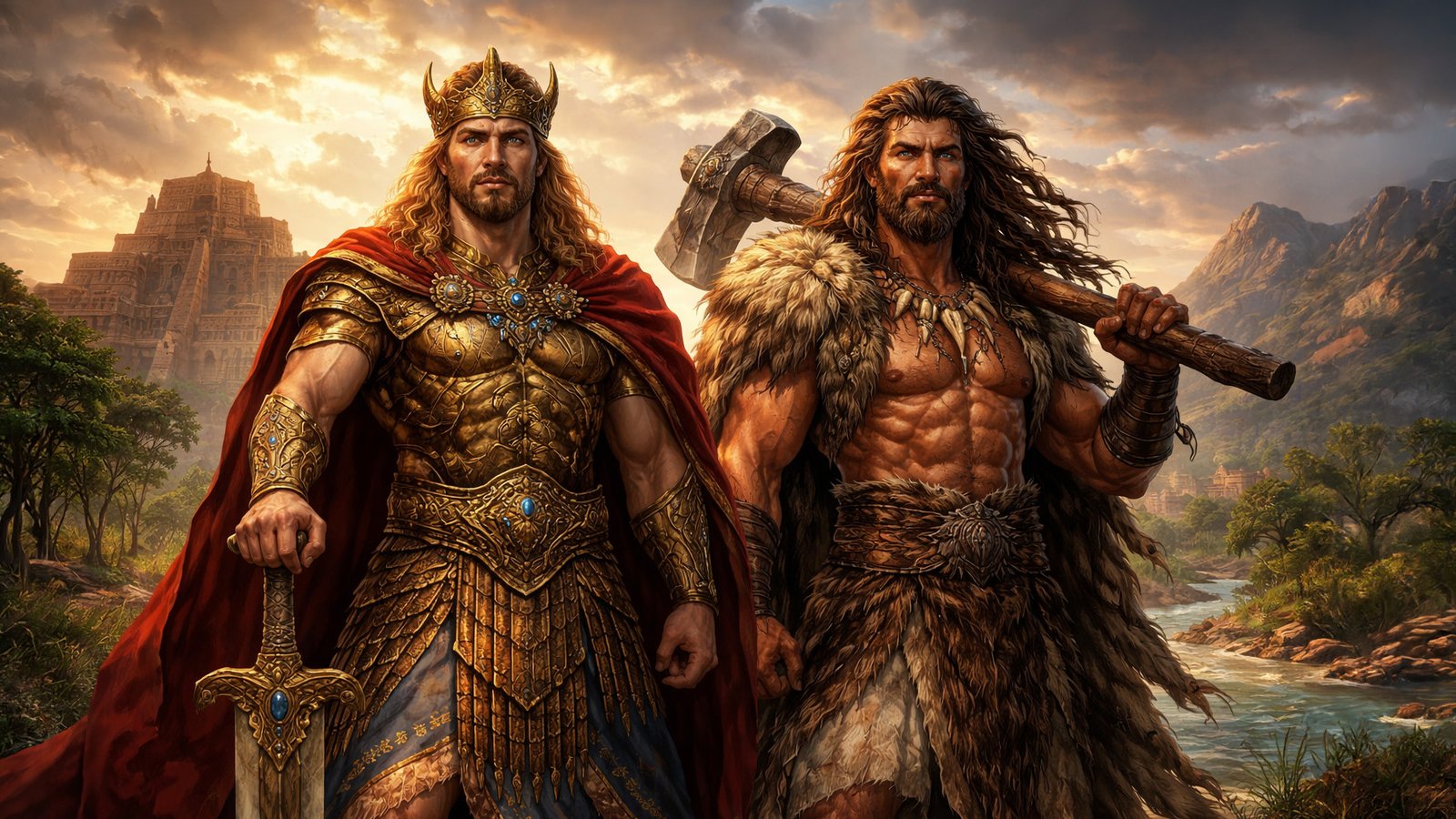
On the world’s oldest story of male friendship — and what it tells us about a very modern kind of loneliness
There is a moment, somewhere in your thirties, when you realise that the last time you made a close male friend you cannot quite remember. The friendships exist, of course — accumulated over years, carried gently forward like furniture from a previous flat. But the making of them, the particular alchemy that turns a colleague or a neighbour into someone you would ring at midnight: that, for many men, has quietly stopped. Life gets full. Work expands. The weekends compact. And one day you find yourself sitting across from a man you genuinely like, sharing a drink you’ve been meaning to have for six months, and realising, with a faint unease you can’t quite name, that you don’t really know each other at all.
It is, researchers now tell us, a crisis. The proportion of men who report having no close friends at all has risen fivefold since the early 1990s — from three per cent in 1990 to fifteen per cent today, with the number of men with six or more close friends having fallen from fifty-five per cent to twenty-seven per cent in the same period. The US Surgeon General has issued advisories. Academics have coined the phrase “friendship recession.” A small industry of opinion pieces has appeared, many of them performing a kind of theatre of concern while doing very little about it. The phrase “male loneliness epidemic” has been repeated so often that it has acquired the faint absurdity of all health-crisis language — the word “epidemic” pressed into service far beyond its natural range.
But before any of this was a talking point, before the surveys and the podcasts and the Men’s Sheds charities, there was a story. It was written in a dead language on clay tablets that crumbled, were buried beneath a burning city, and lay undiscovered for two and a half millennia. It is the oldest work of literature in human history. And at its centre is a man who has lost his closest friend, and cannot find his way back to the world.
The Epic of Gilgamesh began as a series of Sumerian poems, probably composed around 2100 BCE, concerning a semi-divine king of the city of Uruk in what is now southern Iraq. The version most commonly read today — the Standard Babylonian version, compiled by the scribe-priest Sin-leqi-unninni sometime between 1300 and 1000 BCE — was discovered in 1853, when the Assyrian archaeologist Hormuzd Rassam excavated the ruins of the great library of King Ashurbanipal at Nineveh. That library, now considered one of the greatest archaeological finds in history, contained more than thirty thousand clay tablets and fragments; most were transported to England and can today be found in the British Museum.
The breakthrough in understanding what those tablets contained came in 1872, when George Smith, a self-taught Assyriologist working at the British Museum, deciphered Tablet XI and recognised its flood narrative’s striking parallels with the story of Noah in Genesis. Smith was so excited by his discovery that he reportedly jumped up from his desk and began undressing, overcome by the realisation of what he had found. One imagines the other scholars in the room — Victorians, presumably, with pocket squares and measured opinions about everything — doing their best to look elsewhere.
What Smith had found, and what subsequent generations of translators have slowly reconstructed from fragments, is a poem of extraordinary sophistication: a meditation on friendship, mortality, the nature of civilisation, and the terrible loneliness of the powerful. It predates Homer by more than a millennium. It predates the Bible’s oldest texts. And it is, to a remarkable degree, about men who do not know what to do with their feelings — which is perhaps why it has felt so prescient to so many readers in the early twenty-first century.
At the story’s beginning, Gilgamesh is a tyrant. Two-thirds god, one-third man, possessed of extraordinary strength and beauty, he rules Uruk without restraint — conscripting young men into his army, taking brides on their wedding nights. Despite his superhuman abilities and dominion over thousands, he is essentially alone in the world. Striving for ever more wealth, power, and sex has left him without human connections. The gods, responding to the citizens’ prayers, create a figure to balance him: Enkidu, a wild man of the steppes, hairy and vast, who runs with animals and knows nothing of cities or politics or the particular loneliness of kings.
The two men meet, fight, and immediately become inseparable. Their friendship is the motor of the epic: it is through Enkidu that Gilgamesh first learns what it is to be responsible for someone else, to have someone who tells you the truth, to feel not invincible but accompanied. Before he meets Enkidu, Gilgamesh is an arrogant leader, oblivious to his own limitations and mortality. But his friendship with Enkidu leads Gilgamesh on a quest for everlasting life, and then to accept his own mortality — the happiness and fulfilment he finds in that friendship ultimately allows him to find meaning even in his finite existence.
This is not a friendship of convenience or circumstance. It is not the passive proximity that passes for male friendship in so many modern lives — the group chat that has replaced the pub, the football scores that have replaced the conversation. What Enkidu represents to Gilgamesh is something the ancient Mesopotamians understood clearly and which we have spent several centuries systematically dismantling: the idea that a man might be incomplete without a friend.
Enkidu is, in a sense, the rational part of the friendship; once he is gone, it is not simply his death but his absence and inability to counsel Gilgamesh that leads the king to go off on such an irrational quest. The two are each other’s ground. Gilgamesh provides courage and ambition; Enkidu provides wisdom and restraint. When one falters on their journey to the Cedar Forest, the other steadies him. Their conversations on the road to fight the demon Humbaba — Gilgamesh’s bravado, Enkidu’s quiet warnings, the oscillation between terror and resolve — read, even in translation, with the grain of something true. This is what it sounds like when two people know each other well.
And then Enkidu dies.
The gods, affronted by the heroes’ arrogance in slaying the sacred Bull of Heaven, decree that one of the pair must die. It is Enkidu who sickens first, slowly, agonisingly, across twelve days. He rages at the door he fashioned for a temple, at the trapper who first discovered him, at the world that drew him from the wilderness into the company of men — and therefore into the orbit of death. Gilgamesh watches, helpless, as the friend who was his complement and counterweight wastes away.
In Tablet VIII, Gilgamesh addresses the elders of Uruk: “I weep for my friend Enkidu; like a grief-stricken woman, I howl in despair. The shaft at my side, the bedrock of my strength, the sword at my belt, the shield before me, the clothing for my festivals, the sash on my pleasure: a fiendish force sprang up to snatch him from me.” He covers Enkidu’s face as a bride’s is covered. He circles the body like an eagle. He paces back and forth like a lioness robbed of her cubs. He tears his curly hair and strips off his finery. He summons the finest craftsmen in Uruk to build a statue of his friend from lapis lazuli and gold. Then he remains by the body, in denial, watching, until a worm crawls from Enkidu’s nose — and the fact of death can no longer be refused.
What strikes a modern reader about this lament is not its strangeness but its familiarity. The images are four thousand years old, the language translated twice over from a dead script, and yet something in the shape of the grief — the inventory of what has been lost, the refusal to bury, the way bereavement strips a man back to something animal and raw — feels entirely recognisable. Grief does not update itself. It has the same geography in every century.
Gilgamesh refuses to bury Enkidu for seven days, openly weeping and lamenting for him. He remains in complete denial of Enkidu’s death, fuelled by anger, refusing to bury Enkidu in the belief that he can bring him back to life through the sheer power of his grief. He then does what the bereft have always done: he sets off walking. He wanders the wilderness wearing animal skins, seeking Utnapishtim, the one mortal ever granted immortality by the gods. He wants the secret of eternal life — not, one suspects, for himself, but to find a way back to Enkidu. The quest for immortality is a displacement activity for grief so profound it has no other outlet.
He fails, of course. The gods do not negotiate with grief. He returns to Uruk, older and emptier, and finds what peace he can in the contemplation of the city walls. The story ends not in triumph but in acceptance — which is the kind of ending that separates literature from entertainment.
The friendship between Gilgamesh and Enkidu is, in literary terms, the archetype that generated all subsequent epics of male companionship: Achilles and Patroclus, Frodo and Sam, all those novels in which one man’s recklessness is held in check by another man’s wisdom, until it is not. But it is also, in a more immediate sense, a portrait of something that has become genuinely rare.
Richard Reeves, author of Of Boys and Men, has argued that we have “underestimated the extent to which the institutions of the workplace and the family, maybe even some religious institutions, have actually provided spaces where male friendships were formed almost automatically.” The male loneliness crisis is, in his view, a reflection of a broader institutional crisis. “As that’s becoming less and less true,” Reeves says, “that has exposed the fact that maybe many men lack the skills or the institutions or the habits that are required to sustain those friendships.”
This rings true, though it does not tell the whole story. The problem is not only structural but cultural — a long, slow suppression of the kind of emotional expressiveness that the Epic of Gilgamesh, startlingly, takes entirely for granted. Gilgamesh weeps in public. He howls. He compares himself to a grieving woman and appears to mean it as a measure of depth rather than a source of shame. It is only by the nineteenth century, as cultural fears about homosexuality hardened and gender roles became more rigidly policed, that emotional intimacy between men began to feel risky, even shameful. The ancient world had no such problem. In Ur and Uruk, apparently, men cried.
What the epic also understands, with a precision that most contemporary discourse on male loneliness tends to skirt around, is that the friendship between Gilgamesh and Enkidu is not incidental to who Gilgamesh becomes — it is constitutive of it. Before meeting Enkidu, Gilgamesh is depicted as a powerful yet arrogant ruler. Enkidu’s arrival challenges and humanises him. The companionship between the two fosters empathy, compassion, and understanding in Gilgamesh as they embark on daring quests together. Stripped of the friend, he reverts — he puts on animal skins and roams the wilderness, as if reversing his own civilisation. He becomes, in his grief, a version of the creature Enkidu once was: solitary, uncontained, howling at the edge of the known world.
This is what the friendship recession looks like when you turn it back into myth. Not loneliness as a demographic condition, a statistic to be addressed with policy interventions and workplace wellbeing programmes, but loneliness as a category of loss — the particular impoverishment of a life without someone who knows you and says so.
Even happily married men, researchers have noted, need people outside their family to talk to. The need to trust and be trusted is inborn in our species. Many American veterans who return from combat report feeling a deep, abiding loneliness — they don’t miss the most terrible, traumatising elements of war, but they miss the camaraderie, the bonds forged through shared experiences. There’s a certain strength and confidence that comes from knowing others have your back.
This is not sentiment; it is observation. The veterans’ testimony points to something the Epic of Gilgamesh dramatises with unusual clarity: that deep friendship is formed not through propinquity or shared taste but through shared ordeal. Gilgamesh and Enkidu do not become close by having similar opinions about the gods. They become close by fighting Humbaba together in the Cedar Forest, by being frightened together, by watching each other falter and recovering, by having the kind of knowledge of another person that can only be accumulated through difficulty. This is the raw material of friendship, and it is precisely what modern life, in its smooth efficient comfort, tends to withhold.
There is something almost absurd in the spectacle of men attempting to form Gilgamesh-and-Enkidu friendships over golf or through apps designed to facilitate male bonding — and yet the effort itself is telling. More than half of all men in the United States report feeling unsatisfied with the size of their friend groups, and fifteen per cent of men under the age of thirty say they don’t have a single close friend. These are not small numbers. They represent, if the ancient text is any guide, men who have not yet met their Enkidu — or who have, and lost him, and found themselves wandering in animal skins through the contemporary wilderness: the open office, the Sunday afternoon, the group chat that nobody quite knows how to leave.
There is a detail near the end of the epic that tends to get overlooked in the rush to discuss its themes. When Gilgamesh finally returns to Uruk, empty-handed, having failed to find immortality, he does not despairin a vacuum. He finds a ferryman — a working man, an ordinary figure — and asks him to look at the walls of the city. Look how they are built, Gilgamesh says. Look at the foundations, the brickwork. Look at the cedar of the gates. This is what I made.
It is a modest consolation — the solace of craft and continuity rather than the solace of metaphysics. But what is particularly moving is that Gilgamesh needs to show someone. The walls existed before Enkidu died; they will exist after. But their meaning, it seems, requires a witness. His legacy, the story itself, becomes his immortality. That is the implicit argument of the whole poem: that the irreplaceable thing is not life extended but life witnessed.
The ancient scribes who copied and recopied the Epic of Gilgamesh across more than a millennium — in Akkadian, in Sumerian, in Hittite, in Hurrian, pressed into clay from Nineveh to Anatolia — understood that they were preserving something essential. Not a myth exactly, not history, but a record of an experience so fundamental that it kept being true: that a man at the height of his powers, possessed of everything the world can give, is nevertheless nothing without someone to whom he means something. That when the friend dies, the walls must be explained to a stranger, and the explanation is never quite enough.
George Smith, who deciphered the flood tablet in 1872, died three years later at thirty-six, of dysentery contracted on his third expedition to Nineveh. He never completed his translation. He left behind fragments, notes, a handful of students, a gap in the scholarship that took decades to fill. There is something Gilgameshian about it — the driven man, the early loss, the work that outlasts him. The tablets are now in the British Museum, resting quietly in their cases, patient as only things made of baked clay can be. Most of the people who walk past them, on their way to see the Elgin Marbles or the Easter Island statue, have no idea they are in the presence of the first story anyone ever thought worth writing down. A story about two men who scaled mountains together, and what happened when one of them didn’t come home.
The Epic of Gilgamesh is available in multiple translations, including Andrew George’s edition for Penguin Classics.
Post Comment
You must be logged in to post a comment.