Edward VII waited almost sixty years to become king, then nearly missed his own coronation. Two days before the ceremony planned for 26 June 1902, an abdominal emergency forced him to abandon the proceedings and undergo surgery. Invitations, processions and ceremonial preparations suddenly depended on the contents of one royal abdomen. Frederick Treves and his fellow surgeon Francis Laking’s medical colleagues faced a problem that neither precedence nor a well-cut uniform could solve. The operation succeeded, and Edward finally received his crown on 9 August. After decades spent waiting for his mother’s reign to end, he had needed another six weeks.
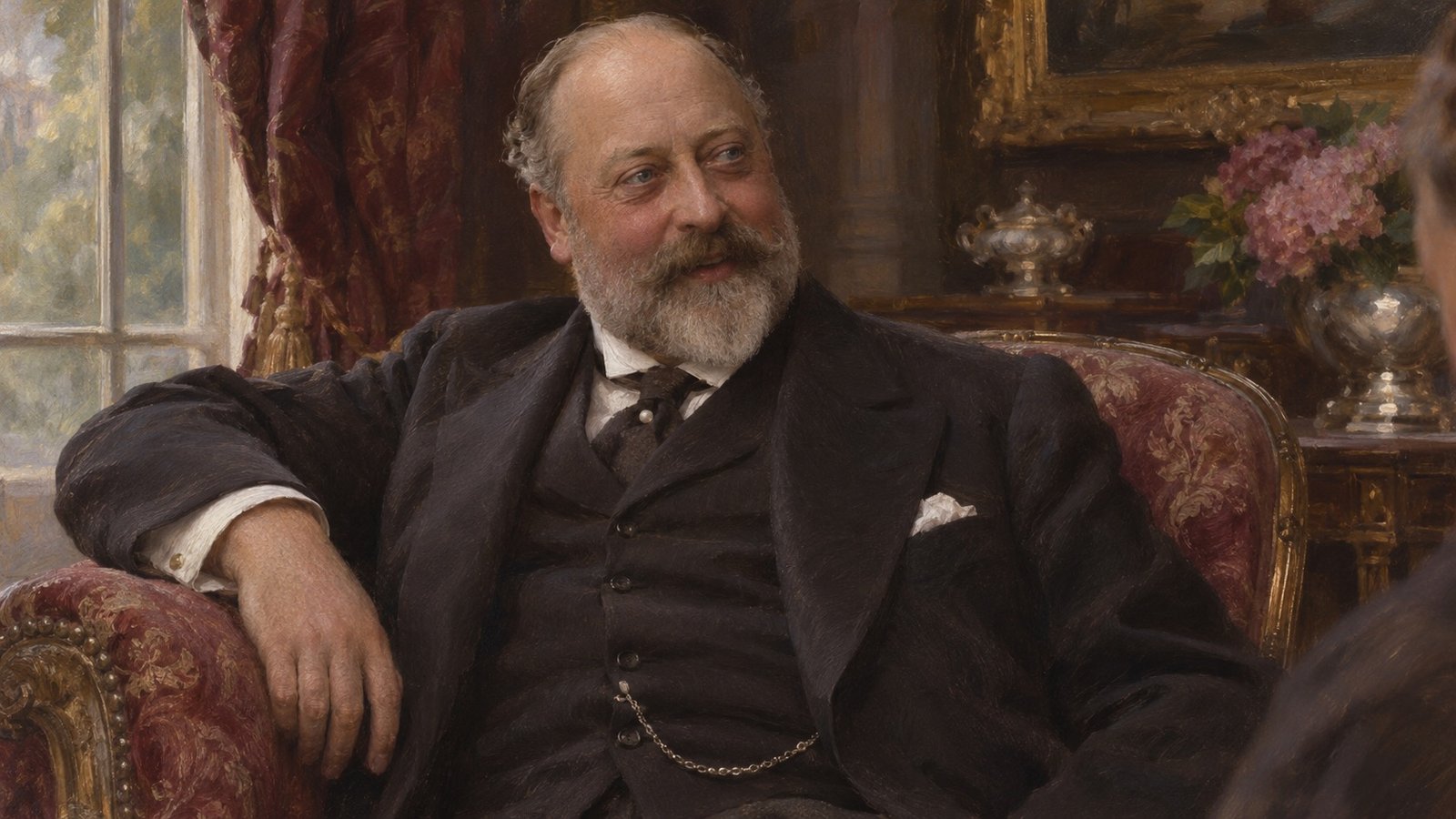
His reputation has suffered from a different sort of delay. The familiar Edward remains the portly pleasure-seeker: a man of substantial meals, fashionable clothes and an apparently inexhaustible appetite for company. Those characteristics were real enough, but they obscure a more useful question. How did a prince whose parents worried about his suitability become a king remembered for helping Britain improve relations with France? Part of the answer lies in the very qualities that made him seem insufficiently serious. Edward understood people, enjoyed meeting them and rarely considered conversation a regrettable interruption to useful work.
Born at Buckingham Palace on 9 November 1841, Albert Edward carried expectations almost as cumbersome as his names. His father, Prince Albert, devised a demanding education intended to produce a thoroughly prepared sovereign. The resulting programme often left the boy exhausted and rebellious. Albert’s conscientiousness was formidable; reproducing it in another human being proved less straightforward. The family called their son Bertie, but affection did not remove the pressure to become a particular kind of prince. His parents approached kingship as something for which enough lessons might provide a reliable qualification.
Bertie’s talents developed along less academic lines. He wanted an army career, although his position as heir restricted that possibility. Travel offered a wider education. In 1860 he toured Canada and visited the United States, becoming the first heir to the British throne to cross the Atlantic. These journeys placed him before crowds and unfamiliar hosts, where social judgement mattered more than examination results. His later travels took him across Europe, the Middle East and India. Long before he acquired the crown, he had accumulated something no tutor could supply: extensive practice at representing it.
His marriage to Princess Alexandra of Denmark in March 1863 gave this public role a partner. With Queen Victoria spending much of her widowhood away from public view, Edward and Alexandra supplied a more visible royal presence. Their residences at Marlborough House and Sandringham became centres of entertaining, collecting and social display. The contrast with Victoria’s mourning was striking. Here was monarchy conducting its business through dinners, visits and fashionable gatherings. Pleasure undoubtedly motivated Edward, but hospitality also gave the institution a social life beyond the sovereign’s increasingly secluded court.
That distinction matters because entertaining can look suspiciously like doing nothing, especially when someone else pays for it. Edward’s taste for luxury deserves no democratic disguise. He belonged to a world in which access depended heavily on wealth, connections and invitations. Yet an ability to make people comfortable could serve a constitutional monarch well. A king who could neither dictate government policy nor command foreign governments still possessed useful tools: attention, courtesy, familiarity and the capacity to make a formal encounter feel less hostile. Edward had spent much of his adult life practising exactly those skills.
He became king on 22 January 1901, aged fifty-nine. His most consequential diplomatic performance followed in Paris in 1903, against a background of Anglo-French resentment. Colonial rivalry had brought the countries close to conflict at Fashoda only five years earlier, while the South African War had further damaged Britain’s reputation abroad. Edward’s enthusiasm for France gave his visit credibility. He helped soften public feeling towards Britain and made closer relations easier to imagine. A successful royal visit could not settle competing imperial claims, but it could improve the atmosphere in which officials attempted the settlement.
The Entente Cordiale followed in April 1904. Edward did not personally negotiate it, and credit belongs to the diplomats and ministers who worked through its agreements. Its immediate substance concerned colonial disputes, rather than a sweeping promise of friendship or an automatic military alliance. This gives the episode a sharper edge than the comfortable image of a sociable king making peace over dinner. Britain and France improved their relationship partly by accommodating each other’s imperial ambitions. The charm was genuine; so were the interests beneath it. Edward helped the machinery move, without having designed or controlled it.
His collecting reveals another side of the same personality. At Marlborough House he assembled a room devoted to Napoleon, a striking enthusiasm for a British heir. In 1907 he commissioned Fabergé to create hardstone portraits of animals at Sandringham. The project expanded beyond favourite dogs and horses to include farm and wild animals from the estate. It became the largest order placed through Fabergé’s London branch. These were expensive pleasures, certainly, but also unusually personal ones. Behind the formal portraits stood a man sufficiently attached to his surroundings to have their animal inhabitants translated into stone.
The end of his reign provided little support for the idea of an uncomplicated golden age. In 1909 the House of Lords rejected the Liberal government’s Budget, provoking a constitutional struggle over taxation, representation and the powers of the upper chamber. Edward found himself drawn into a dispute that good manners could not dissolve. The January 1910 election left the Liberals dependent on other parties, and the Lords eventually passed the Budget in April. The larger argument over their veto continued. Edward died on 6 May, aged sixty-eight, leaving George V to inherit both the throne and an unresolved political confrontation.
The label “Edwardian” now suggests an entire civilisation of country houses, elaborate clothes and confidence before catastrophe. Edward himself ruled for only nine years, and his Britain contained plenty of conflict beneath the polished surfaces. His achievement was narrower, and more plausible, than the title of universal peacemaker suggests. He recognised the usefulness of personal contact in an institution built around distance. The boy subjected to an exhausting programme of preparation eventually found his own working method. After all those lessons, one of his most effective qualifications turned out to be knowing how to put a guest at ease.