Imagine waking up on a quiet Sunday morning and learning that every driver in the country must now use the opposite side of the road. Not next month, not after a trial period, but today. Sweden did exactly that on 3 September 1967, when cars, buses, lorries, bicycles and bewildered motorists moved from the left-hand side to the right. The event became known as Dagen H, or H Day. The letter stood for högertrafik, meaning right-hand traffic.
At precisely 5 a.m., Sweden changed a system that had shaped everyday travel for generations. It sounds like the sort of national experiment that should end with overturned buses, furious taxi drivers and someone accidentally reaching Norway. Instead, it became a remarkable example of planning, public communication and unusually disciplined confusion.
Sweden had driven on the left since the eighteenth century, although the rules developed long before modern cars filled the roads. By the twentieth century, this historical habit looked increasingly awkward. Norway and Finland, Sweden’s land neighbours, drove on the right. Drivers crossing the border had to perform a small piece of automotive choreography, moving from one side to the other while remembering which country they had entered.
The cars themselves created an even stranger contradiction. More than 90 per cent of Swedish vehicles reportedly had the steering wheel on the left, despite travelling on the left side of the road. That placed drivers next to the kerb rather than near the centre line. When overtaking on narrow roads, they struggled to see approaching traffic without moving dangerously far into the opposite lane. Sweden had built a traffic system in which many cars seemed designed for somewhere else.
Still, most Swedes did not want change. In a 1955 referendum, roughly 83 per cent voted to retain left-hand traffic. It was a spectacularly clear answer, the democratic equivalent of “absolutely not”. Yet the referendum was consultative rather than binding, and the practical arguments refused to disappear. Traffic volumes grew, cross-border journeys increased and European road systems became more integrated.
In 1963, the Swedish parliament approved the change despite the referendum result. This remains one of the great controversies surrounding Dagen H. Supporters argue that politicians accepted responsibility for a difficult but necessary reform. Critics can reasonably reply that asking the public a question and then doing the opposite makes the exercise feel slightly decorative. Sweden eventually switched sides because its government judged long-term safety and compatibility more important than immediate popularity.
Officials then spent four years preparing for a change that would happen in ten minutes. Engineers studied junctions, one-way streets, bus stops, road markings and traffic lights. Hundreds of thousands of signs required removal, replacement or repositioning. New signs and signals stood covered in dark material until the appointed morning, creating the impression that the entire road network had received a mysterious collection of wrapped presents.
Road markings also changed. Sweden had commonly used yellow lines before Dagen H, but the new system introduced white markings. Workers painted new lines and concealed them until the switch. Around 350,000 signs reportedly needed attention, including approximately 20,000 in Stockholm alone. Intersections had to work in reverse, pedestrian habits needed adjustment and headlamps required changes so that their beams would not dazzle approaching drivers.
Public transport presented an even larger headache. Bus doors faced the wrong pavement, which is inconvenient unless passengers enjoy stepping directly into moving traffic. Sweden bought more than 1,000 new buses and modified thousands of older ones. Some vehicles received doors on both sides, while others found new lives abroad. Several tram systems closed because conversion looked too expensive, although networks survived in places such as Gothenburg and Norrköping. Railways and the Stockholm metro continued running on the left, proving that even a nationwide revolution has exceptions.
The government did not rely on drivers reading a polite leaflet. Dagen H became a national publicity phenomenon. Its bold black-and-yellow logo appeared on posters, milk cartons, stickers, clothing and assorted household objects. Television ran information programmes, schools taught children the new rules and businesses distributed reminders. Sweden even held a song competition, won by “Håll dig till höger, Svensson” — “Keep to the Right, Svensson”. Nothing says serious transport reform quite like turning it into a catchy pop number.
The campaign understood a simple truth: people do not change habits merely because officials publish a regulation. They change when reminders surround them, instructions remain clear and everyone expects the same behaviour. Dagen H therefore became less like a road project and more like a carefully managed cultural event. The country rehearsed the idea for years before anyone actually moved a car.
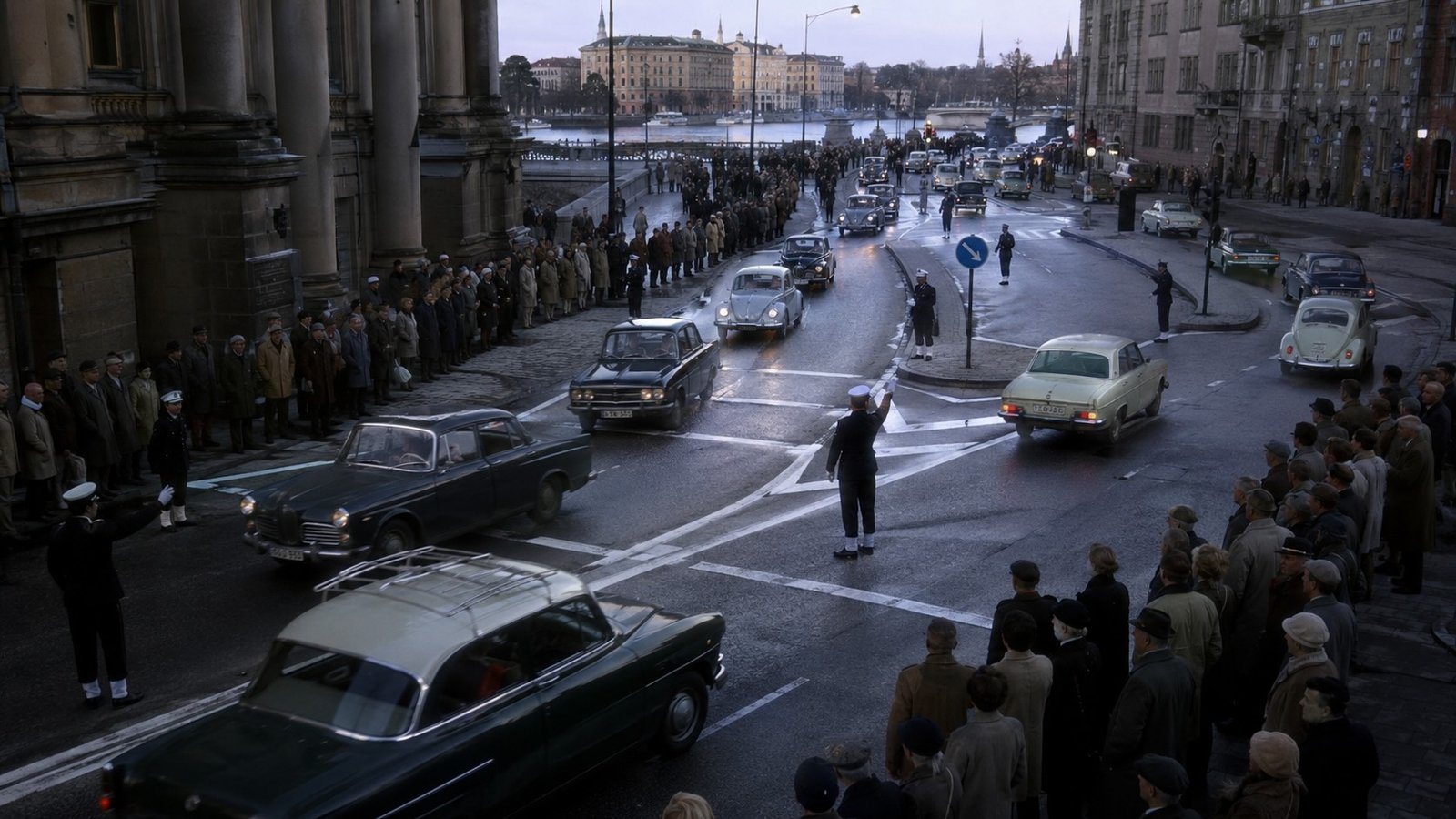
During the early hours of 3 September, most non-essential traffic disappeared from Swedish roads. Restrictions varied by location and lasted longer in major cities, where crews needed extra time to rearrange complex junctions. At 4.50 a.m., vehicles still on the road stopped. Drivers carefully crossed to the right, stopped again and waited. At 5 a.m., police and traffic controllers allowed them to continue.
The famous photographs show cars edging uncertainly across broad streets while police officers wave their arms like conductors leading a nervous mechanical orchestra. Crowds gathered to watch. In Stockholm, spectators sometimes created more disruption than motorists. People wanted to witness the exact moment when a familiar rule became wrong and its opposite became compulsory.
Predictions of carnage proved exaggerated. The transition produced remarkably few serious incidents, partly because drivers became extremely cautious. On the following Monday, authorities recorded 125 non-fatal accidents, compared with a normal range reportedly running from around 130 to 198. Insurance claims initially fell sharply. Drivers slowed down, concentrated intensely and treated every junction as if it contained a hidden examination question.
This improvement did not last forever. As people grew comfortable, old habits of speed, distraction and optimism returned. Within several weeks, accident levels moved back towards normal, and by 1969 broader casualty patterns had largely returned to their earlier levels. Dagen H did not permanently transform Swedish drivers into saints. It temporarily reminded them that driving deserved their full attention.
One persistent myth claims that Sweden switched because left-hand traffic was inherently more dangerous. The reality was more specific. The problem involved incompatible borders, vehicle design, overtaking visibility and the growing standardisation of European transport. Britain still drives on the left without treating every roundabout as a national emergency. Sweden’s old arrangement became impractical because it fitted neither its neighbours nor most of its cars.
Dagen H also offers a useful lesson for modern organisations. Leaders often announce a transformation as though naming it constitutes progress. Sweden did the opposite. It analysed thousands of small consequences, redesigned physical systems, trained the public, repeated the message and controlled the moment of transition. The visible switch lasted minutes because the invisible work lasted years.
The episode remains wonderfully Swedish in the popular imagination: a radical national change carried out with committees, graphic design, educational songs and drivers waiting obediently at 4.50 in the morning. Reality contained plenty of anxiety, political disagreement and expense, but the central achievement still deserves admiration. Sweden moved an entire country across the road without allowing it to collide with itself.