Catherine de’ Medici arrived in France as a teenage Florentine bride with a famous surname, a political marriage, and absolutely no guarantee that anyone at court would take her seriously. Born in Florence on 13 April 1519, she belonged to the Medici family, that astonishing clan of bankers, patrons, schemers, popes, collectors, and professional survivors. At fourteen, she married Henry, the future Henry II of France, in 1533, a match arranged with the blessing of her kinsman Pope Clement VII. It was not exactly a fairy tale. It was more like a diplomatic transaction with better clothes.
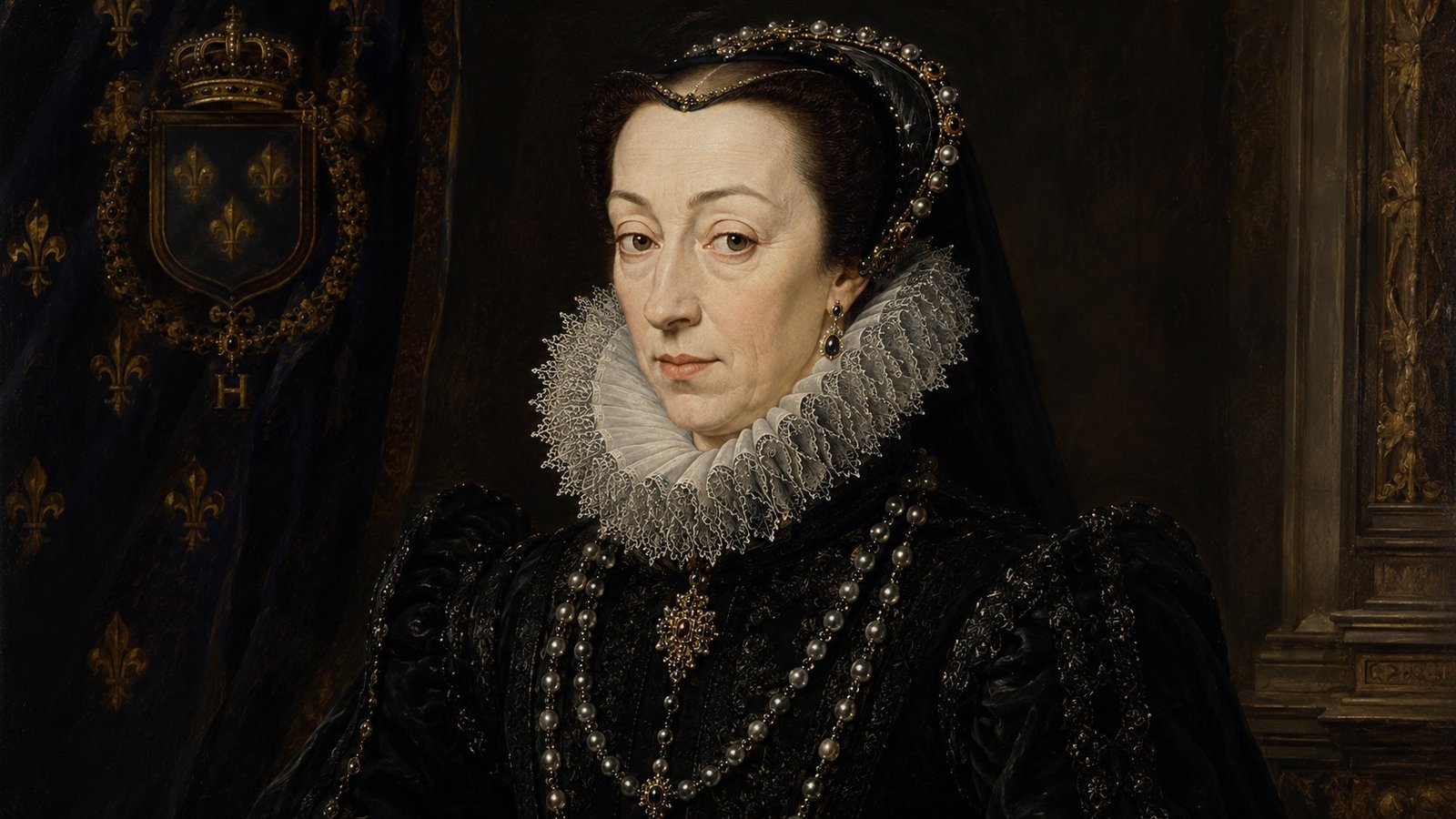
At first, Catherine had one main problem: she was useful but not adored. Henry preferred Diane de Poitiers, his elegant and powerful mistress, who was almost twenty years older than him and still managed to dominate the emotional and political weather at court. Catherine, meanwhile, performed the official duties of wife and queen while watching another woman enjoy influence, affection, gifts, and a rather spectacular position in the royal imagination. If patience was a political skill, Catherine practised it for decades, presumably while smiling in rooms where everyone knew exactly what was going on.
For years, her position looked fragile because she did not produce an heir. In royal Europe, infertility belonged to the woman by default, because biology had not yet been invited to the meeting. Eventually, Catherine had ten children, and history, with its usual lack of moderation, made three of her sons kings of France: Francis II, Charles IX, and Henry III. That achievement alone should have secured her place as one of the great dynastic figures of sixteenth-century Europe. Instead, Catherine became remembered as a spider in silk, supposedly spinning webs behind every French disaster.
Her real power began after tragedy did what tragedy so often did in Renaissance courts: arrived in fancy dress. In 1559, Henry II died after a jousting accident, leaving Catherine a widow and France with a fragile monarchy. Her eldest son, Francis II, ruled briefly and died young. Then Charles IX became king while still a boy, which placed Catherine at the centre of government during one of the most explosive periods in French history. She did not inherit a peaceful country with a few minor admin issues. She inherited a kingdom cracking under religious tension between Catholics and Huguenots, the French Protestants.
This is where Catherine’s reputation turns dark, and not without reason. The French Wars of Religion tore the country apart, and she tried, failed, compromised, panicked, negotiated, and manoeuvred through them. Her defenders see a woman attempting to preserve the monarchy in a world where noble factions treated civil war as a family hobby. Her critics see a cold operator willing to sacrifice lives to protect royal authority. Both views contain something useful, which is irritating but usually true of history.
The darkest stain on her name remains the St Bartholomew’s Day Massacre of August 1572. It began in Paris after the marriage of Catherine’s daughter Marguerite de Valois to the Protestant Henry of Navarre, a union meant to promote reconciliation. Many Huguenot nobles gathered in the capital for the wedding. Days later, after an attempted assassination of the Protestant leader Admiral Coligny, violence erupted. Targeted killings turned into mass slaughter, spreading from Paris to other parts of France. Estimates vary widely, but the massacre became one of the defining horrors of the religious wars.
Was Catherine the mastermind? That question has kept historians busy and popular writers happily dramatic. Some accounts directly blame her for plotting the massacre, while more cautious interpretations stress panic, factional pressure, fear of Protestant retaliation, and the weakness of royal control once violence began. Britannica states that the massacre was plotted by Catherine and carried out by Catholic nobles and citizens, while the Protestant Museum presents the grim irony that the wedding itself had been part of a reconciliation strategy. In other words, Catherine may have tried to stage peace and helped unleash catastrophe. It is hard to imagine a more Renaissance outcome.
Yet judging Catherine only by the massacre makes her story too simple. She was far more complicated than that. She governed through her sons. They were often too young, too ill, too unstable, or too restricted to rule alone. She also had enemies everywhere. She had to handle the Guise family, the Bourbon faction, foreign powers, religious militants, and court rivals. Then there were the male nobles who believed they were the only adults in the room.
Catherine did not have the formal authority of a king. So she used every tool she had. Marriage alliances. Festivals. Patronage. Surveillance. Negotiation. And a remarkable talent for waiting until other people made mistakes.
She also understood spectacle. Renaissance courts did not separate politics from theatre; they wrapped power in costume, dance, architecture, gardens, and ritual. Catherine sponsored elaborate court entertainments and used magnificence as a language of authority. This was not just royal showing off, although there was certainly plenty of that. In a divided kingdom, ceremony created the illusion of order, and sometimes an illusion was the best the monarchy could afford.
Her relationship with Chenonceau tells its own deliciously awkward story. During Henry II’s life, the château was closely associated with Diane de Poitiers, the king’s mistress. After Henry died, Catherine took control and made her own mark there. The official Chenonceau history notes that on 10 July 1559, Catherine displaced Diane and asserted the authority of her young son at the château, where she later governed from her Green Cabinet amid Italian splendour. One can call this revenge, statecraft, or interior redesign with political consequences. All three work rather well.
Then there is the food myth, because Catherine has somehow been blamed or praised for half of French cuisine. According to popular legend, she brought forks, Italian cooks, refined sauces, ice cream, macarons, artichokes, and possibly civilisation itself to a France allegedly chewing through medieval gloom. It makes a wonderful story, especially if one enjoys imagining the French court staring suspiciously at cutlery. Unfortunately, food history rarely behaves so neatly. Catherine probably did bring Italian habits, staff, tastes, and courtly refinements with her, but the claim that she single-handedly created French cuisine says more about later myth-making than sixteenth-century kitchens.
The fork story has some substance, as Italian dining customs did influence French aristocratic habits, and Catherine’s arrival offered a convenient narrative hook. Still, France already had its own culinary traditions, elite networks, trade links, and appetite for refinement. The idea that one Florentine teenager unpacked béchamel, macarons, sorbet, and table manners from her luggage feels charming but suspiciously tidy. History loves a suitcase myth. It gives cultural change a handle, preferably one engraved with a famous name.
Catherine also attracted darker legends. Poison, astrology, secret cabinets, perfumed gloves, sinister Italian advisers — she became the perfect villain for a France anxious about foreigners, women in power, and religious violence. Her Italian identity mattered. “The Italian woman” became an easy insult, loaded with suspicion. In a court culture that admired Italian art and fashion but distrusted Italian politics, Catherine provided a convenient target. When things went wrong, people could blame the widow with the accent, the Medici bloodline, and the unnerving ability to outlive almost everyone.
That does not make her innocent. Catherine could be ruthless, calculating, and painfully pragmatic. She protected the Valois monarchy above almost everything else, and that priority led her into morally disastrous territory. Yet she was not a cartoon villain drifting through corridors with poison in one hand and a macaron in the other. She was a political survivor trapped in a collapsing order, trying to hold together a kingdom where faith, family, ambition, and violence had fused into one terrible machine.
By the time Catherine died at Blois on 5 January 1589, the Valois dynasty was close to collapse. Her favourite son, Henry III, was assassinated later that same year. Then the throne passed to Henry of Navarre. He had been the Protestant bridegroom at the disastrous 1572 wedding. After converting to Catholicism, he became Henry IV of France.
Catherine had spent her life trying to keep France in her family’s hands. In the end, history gave the crown to the man who had survived the massacre that stained her name.
Catherine de’ Medici remains fascinating because she refuses to fit comfortably into any tidy category. She was a mother, widow, queen, regent, patron, foreigner, survivor, negotiator, and alleged monster. She helped shape French politics, court culture, gardens, royal ceremony, and one of Europe’s most infamous massacres. Catherine did not invent French cuisine, though she certainly seasoned French legend.