Afterlife Beliefs Across Ancient Civilisations: Death Was Not the End
The afterlife may be the most ancient long-term strategy humans ever invented. Long before self-help gurus, pension plans, and productivity apps, people looked at death and decided that simply stopping would be a rather poor design choice. So they built stories, rituals, tombs, maps, passwords, offerings, and entire industries around what came next. Ancient civilisations did not treat death as a full stop. They treated it as customs control.
What makes this so fascinating is not just that almost every civilisation imagined some form of existence after death. It is that each one revealed, with almost embarrassing honesty, what it valued most in life. Show me a culture’s afterlife, and I will show you its anxieties, its social order, its favourite symbols, and the things it absolutely refused to leave behind.
Take ancient Egypt, which approached death with the confidence of a civilisation that liked paperwork, ceremony, and making things last. The Egyptian dead did not simply float into bliss. They had to navigate the Duat, survive a series of dangers, and face judgement. The heart would be weighed against the feather of Ma’at, the principle of truth and cosmic order. Fail that test, and things ended badly. Pass it, however, and you could reach the Field of Reeds, a perfected version of earthly life. It was not an abstract cloud-based paradise. It looked reassuringly familiar, only better managed.
That detail matters. The Egyptians did not dream of escaping life. They wanted a cleaner, more eternal edition of it. Therefore they buried the dead with food, furniture, jewellery, cosmetics, shabti figures, and texts that modern people lazily bundle together as the Book of the Dead. These were not decorative extras. They were survival equipment. Even mummification had a practical logic. If the soul needed the body, then preserving the body stopped being morbid and started looking sensible, at least by ancient standards.
Mesopotamia, by contrast, offered a much grimmer post-mortem package. If Egypt sold eternity with strong branding, Mesopotamia sounded like a warning label. Sumerians, Akkadians, Babylonians, and Assyrians often imagined the dead continuing as ghostly beings in a dim underworld. It was dusty, joyless, and not especially aspirational. The dead still depended on the living, which meant descendants had duties. If your family neglected offerings and funerary rites, your ghost could become restless, troublesome, and deeply inconvenient.
That bleakness says a great deal. Mesopotamian afterlife beliefs did not flatter the individual with promises of triumph. Instead, it reinforced the family line, ritual obligation, and social continuity. In other words, death did not free you from administration. It merely changed the department. The famous Epic of Gilgamesh circles this fear repeatedly. Human beings want immortality, but the story keeps pushing them back towards a harsher truth: build, love, rule if you must, but do not expect special treatment from the cosmos.
The Greeks took a different route and made the afterlife dramatically uneven. In early Greek imagination, most people ended up in Hades, a shadowy realm with little sparkle and even less upward mobility. Yet Greek myth also loved exceptions. Heroes could reach the Elysian Fields. Great sinners could suffer spectacular punishments. A few notorious figures turned posthumous misery into performance art. Tantalus never gets his drink. Sisyphus never gets his day off. The Greeks understood that morality becomes far more memorable once you add a theatrical sentence.
Even so, Greek ideas did not stay fixed. Over time, mystery cults such as the Eleusinian Mysteries promised initiates a more hopeful fate. Philosophy also stepped in. Plato, never a man to leave a topic pleasantly vague, gave the soul a much more elaborate destiny. So the Greek afterlife became a crowded intellectual neighbourhood where myth, ritual, philosophy, and local tradition all argued at once. It sounds chaotic, but it also sounds recognisably human.
The Romans inherited much of this and then did what Romans usually did: they absorbed, adapted, organised, and turned belief into public culture. Roman tombs lined roads because memory mattered. Funerary inscriptions spoke directly to passers-by because the dead still wanted an audience. At the same time, Roman views of the afterlife remained inconsistent. Some leaned towards the Greek underworld. Some embraced hero cults or mystery religions. Some philosophical schools treated death as dissolution rather than continuation. Rome managed, with impressive efficiency, to be both ceremonial and sceptical.
That tension feels modern. Public ritual said one thing, personal belief often said another, and the empire held both in place. The dead could become honoured ancestors, protective presences, or names carved into stone against the terror of being forgotten. Therefore Roman afterlife belief was not just about what happened next. It was also about reputation, lineage, and the quiet refusal to vanish.
Ancient China brought yet another variation, one rooted in order, ancestry, and the practical needs of the deceased. Tombs did not simply dispose of the body. They created a functioning environment for the next existence. Families placed mingqi, or spirit goods, inside tombs: model servants, animals, houses, towers, vessels, and later entire miniature worlds. The message was plain enough. The dead still required status, service, protection, and correct arrangement.
Here the afterlife looked less like a distant mystery and more like a parallel bureaucracy. That may sound slightly comic, but it was entirely serious. Ancestor veneration tied the living and the dead into one long moral chain. Ritual obligations kept memory active, while tomb design expressed cosmology, rank, and family ambition all at once. Besides, recent archaeology keeps proving how much thought went into this. Richly furnished Chinese tombs still appear with objects arranged as if the occupant might resume business after a brief interruption.
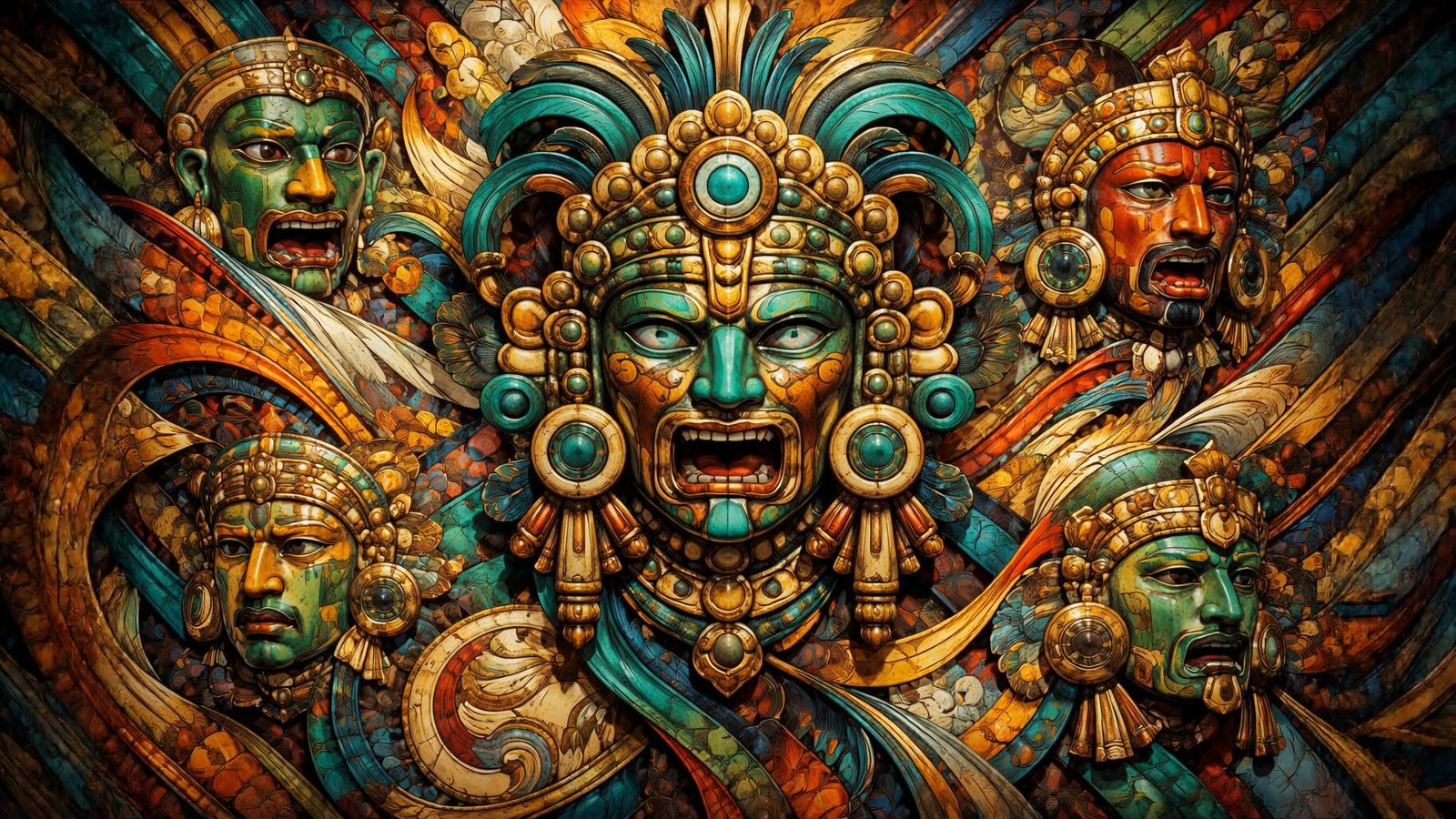
In Mesoamerica, the picture became even more dynamic. The Maya and the Aztecs did not divide the dead neatly into good people and bad people. Fate after death often depended on how a person died, their ritual role, or their relationship to divine cycles. Among the Aztecs, warriors who died in battle and women who died in childbirth could receive especially charged posthumous destinies. In Maya belief, rulers linked themselves to gods whose deaths and renewals shaped cosmic time. The afterlife was not merely a place. It was a process of transformation. Even animals had a role in that journey. The Aztecs believed that the Xoloitzcuintli, a hairless dog with an almost otherworldly appearance, escorted souls across the dangerous rivers of the underworld. Because of this, these dogs were often buried alongside their owners, not as companions in a sentimental sense, but as essential guides for what came next.
That is one of the great myths modern people still carry about ancient afterlife belief: that old religions were simple. They were not simple at all. They were layered, regional, changing, and frequently contradictory. Another myth says ancient people believed these stories in a naive, uniform way. They almost certainly did not. Priests, rulers, families, mourners, and philosophers all approached death through different lenses. Afterlife beliefs had politics in it. It had economics in it. It had social hierarchy all over it.
And here the controversies begin. Were tombs built mainly for sincere spiritual reasons, or did elites use them to stage power beyond the grave? Did moral judgement come first, or did it gradually grow as societies needed stronger ethical narratives? How much did ordinary people truly believe, and how much did they perform because ritual held communities together? Archaeology answers some of this, but never all of it. A grave can show us what people placed beside the dead. It cannot fully reveal what they whispered when the mourners went home.
Still, the broad pattern remains almost touching. Across ancient civilisations, people refused to imagine death as mere disappearance. They packed for it. They mapped it. They argued over it. They hired specialists for it. They filled tombs with instructions, objects, servants, symbols, and hope. In the process, they left us one of the clearest records of what it meant to be human before modernity arrived and pretended it had invented existential dread.
The oldest civilisations knew better. They looked at death, gave it architecture, and then carried on.
Post Comment
You must be logged in to post a comment.