Yosemite: From Granite Giants to Firefalls
Yosemite has a way of making you feel like the Earth spent a bit too much time showing off. The place doesn’t simply sit there being pretty. It struts. It performs. It occasionally throws in an existential crisis for visitors who thought they were quite outdoorsy until they found themselves staring up a granite wall that feels taller than their ambitions. Spending time here means slipping into a landscape that behaves as if it has a personality, and a slightly dramatic one at that.
The valley arrives with confidence. Granite walls shoot up so abruptly that you start wondering whether nature installed them overnight. The sheer faces keep their cool under all that attention, even though they receive millions of visitors every year. El Capitan rises so sharply it looks as though someone dragged a skyscraper into the wilderness and sanded it smooth. Standing below it feels like attending a lecture on insignificance. People gaze upward in silence, except for the occasional hiker who whispers, of all things, that the rock looks quite friendly. The bravado continues with Half Dome. That curved ridge appears soft from afar, like someone carved a massive spoon out of stone, but up close it’s an overachiever with a metallic cable route that turns everyday people into trembling acrobats.
Water in Yosemite also enjoys making an entrance. The waterfalls don’t simply drop. They plunge. They roar. They vanish in late summer, only to reappear in spring as if they’d merely nipped out for lunch. Yosemite Falls, for example, travels so far down the rock face that visitors often lose track of where it begins and ends. In winter, the spray freezes into strange sculptural piles at the base, and those look like the park decorated itself for a festival no one else got invited to. In particularly dramatic years, the wind blows the water sideways, creating the impression that gravity briefly lost interest.
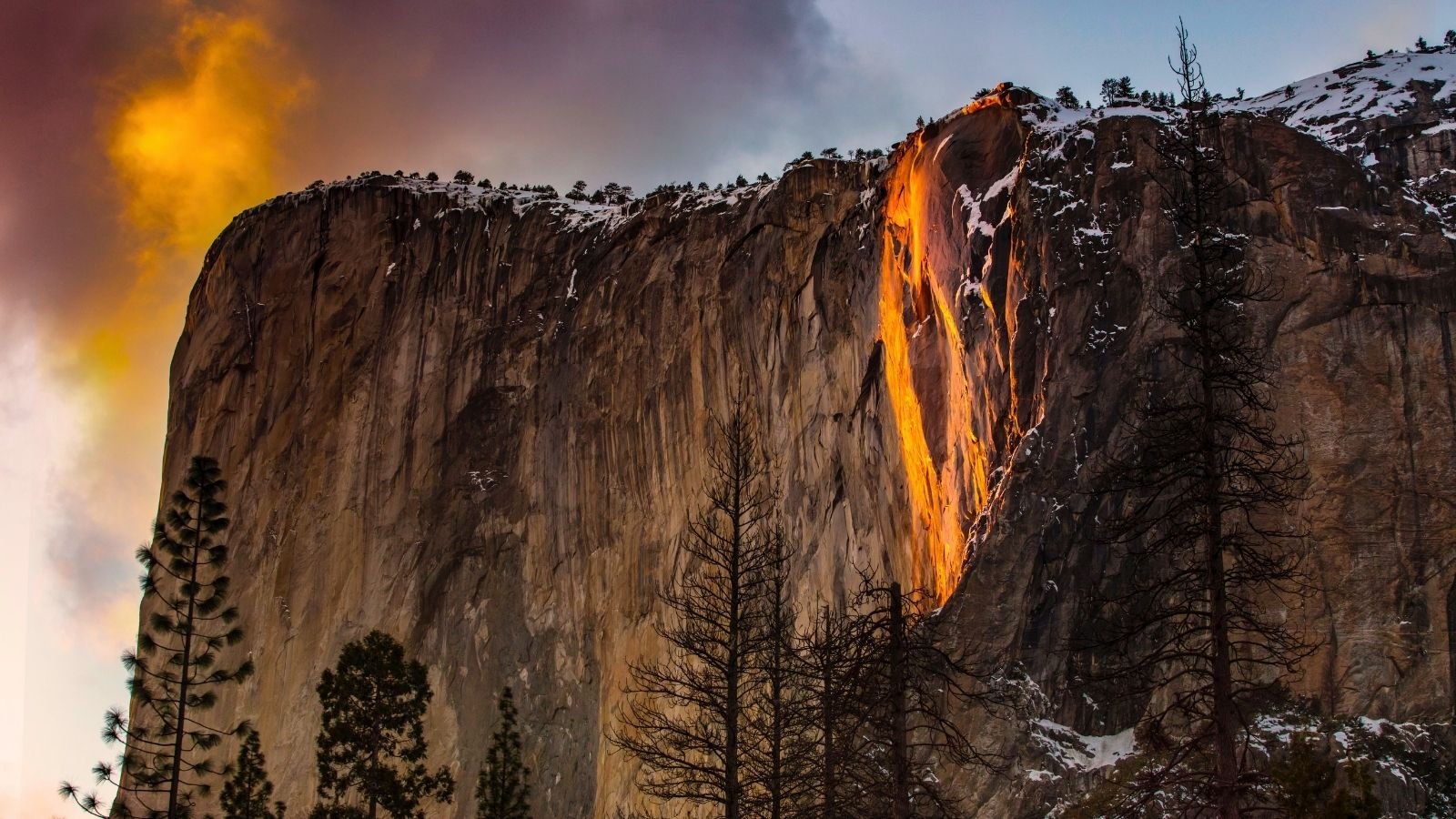
The park’s flair for performance continues with Horsetail Fall, which transforms into what looks like a glowing stream of molten rock for a few minutes each February. This is the famous firefall, a spectacle where sunlight hits the sheet of falling water at exactly the right angle. It glows bright orange, as if the mountain decided to host a pyrotechnic show. Crowds gather, photographers hold their breath, everyone waits for the moment, and then a stray cloud strolls by and ruins the whole thing. Naturally, this only encourages more people to try again next year.
Beyond the theatrics, Yosemite holds forests that feel ancient enough to offer life advice. The giant sequoias tower over everything, old enough to have witnessed empires rise and fall. Stand beside one and you feel your spine straighten in respect. Their bark looks like folds of an old coat that has survived centuries of use. Hikers often go quiet as they approach these trees, perhaps out of awe, or perhaps because the trees seem capable of glaring disapprovingly at loud chatter.
Walking through the Mariposa Grove means stepping into a slower rhythm. Light scatters through foliage in soft patches, and the air smells of resin and dust mixed with something older that you can’t quite name. Some visitors place a hand on the bark. They expect spiritual clarity. Instead, they get the sensation of touching something so ancient that it has absolutely no interest in their worries.
Rock climbers, on the other hand, find Yosemite utterly riveting. This place launched several climbing decades that produced legends, rivalries, and a few cautionary tales. The granite’s smoothness lures athletes into believing they can conquer it with a bit of chalk and bravado. The reality sends most people scrambling back down, muttering about gravity, friction, and life choices. Those who succeed, though, write themselves into the valley’s lore. El Capitan in particular inspires stories so outrageous that newcomers assume they’re myths. A twelve-hour ascent? A free-solo? Sleeping on a portaledge halfway up? Yosemite encourages feats that sound like dares taken too seriously.
For all its grandeur, the valley still has a playful streak. The light here behaves oddly. Dawn paints the cliffs rose-gold, midday bleaches them white, and sunset drenches everything in warm tones that seem lifted from a fantasy film. The sky deepens into the kind of blue usually reserved for postcards. At night, stars appear in a density that makes most urban visitors slightly emotional. The Milky Way arcs overhead with such clarity that people forget to blink.
The wildlife contributes to the park’s character. Deer wander meadows as if running on a schedule. Coyotes cross paths with hikers, casually glancing over their shoulders like mildly curious neighbours. Black bears carry themselves with the confidence of animals who have memorised the park’s food-storage rules better than the humans. They can open car doors. They sometimes test the strength of a poorly latched cooler. Rangers desperately try to outsmart them, while the bears behave like furry cryptographers working on a particularly amusing puzzle.
Yosemite’s weather doesn’t bother with consistency. One moment, clouds hang low, turning the valley into a grey painting. The next moment, the sun bursts through with dramatic timing, giving everything a luminous sheen. Rainstorms start abruptly and end suddenly, leaving behind the scent of wet granite and pine needles. People often pack for dry heat and find themselves wearing every layer they own. The valley delights in reshuffling the atmosphere without notice.
Hiking here becomes a kind of partnership with the landscape. Trails wind through woodland, along rivers, across open meadows, and up steep switchbacks that leave many questioning their fitness levels. Vernal Fall’s Mist Trail, for example, turns visitors into damp, exhilarated walkers. Mirror Lake reflects the cliffs so sharply that it feels like falling into another world. Glacier Point presents a panorama so vast that people stand silently, trying to process how something so immense fits into the same universe as their inbox.
Yosemite also contains quiet corners that escape most itineraries. Tuolumne Meadows offers wide-open terrain where the air feels thinner, the sky seems bigger, and the freedom feels immediate. The high country carries a crispness that encourages long pauses and slow breaths. Water flows differently up here. It moves with a sort of calm purpose, collecting reflections of clouds and peaks. Even the birds sound more relaxed.
Beyond the sights, there’s a peculiar emotional rhythm to Yosemite. Some visitors come for adventure and end up discovering they like tranquillity more. Others arrive seeking serenity and find themselves climbing half a ridge before lunch. The place brings out unexpected sides of people. It nudges them toward curiosity. It offers perspective without being sentimental about it.
Even leaving the valley becomes an experience. You glance over your shoulder and see the granite walls shrinking, the waterfalls sliding out of view, and the forests folding back into the distance. The landscape remains fiercely itself, unaffected by your departure. That indifference carries a strange comfort. Yosemite doesn’t try to impress anyone. It simply exists with such force that people can’t help but admire it.
Spend a day here and you feel like you’ve witnessed a performance. Spend a week here and you realise the performance never stops. Everything keeps shifting, glowing, rumbling, towering, shimmering. The cliffs hold their ancient poses. The water keeps rehearsing its dramatic entrances. The trees lean quietly over centuries of stories. Yosemite remains unusual because it refuses to be ordinary in any direction.
All the natural elements seem to conspire to keep the valley extraordinary. The granite, the water, the light, the wildlife and even the weather join forces to create a place that refuses to settle into predictability. Visitors arrive expecting scenery. They leave carrying a sense of having stepped into something far larger than themselves. Yosemite inspires awe, amusement and a lingering thought that perhaps this is how the planet shows gratitude to those who look up now and then.