Would You Really Live in Victorian Britain? Nearly Half of Us Might
An Interessia poll suggests that 50% of respondents would consider living in the nineteenth century. That is a curious result for an era famous for cholera, factory labour, and forty-year life expectancy.
Exactly half of people would consider living in Victorian Britain. Let that sink in for a moment. An Interessia poll of 328 respondents found that 50% rejected the idea outright — but the other half said they’d consider it, including 29.6% who said “only if wealthy”, 7.3% who said “maybe for a while”, and a bold 13.1% who said yes, full stop, pass me a top hat. That is the number that shouldn’t exist. Victorian Britain was an era of rampant cholera, child labour, lethal factory machinery, and an average life expectancy at birth of around forty years. Yet here we are in 2026, a surprisingly large chunk of us apparently ready to book a one-way ticket to the nineteenth century.
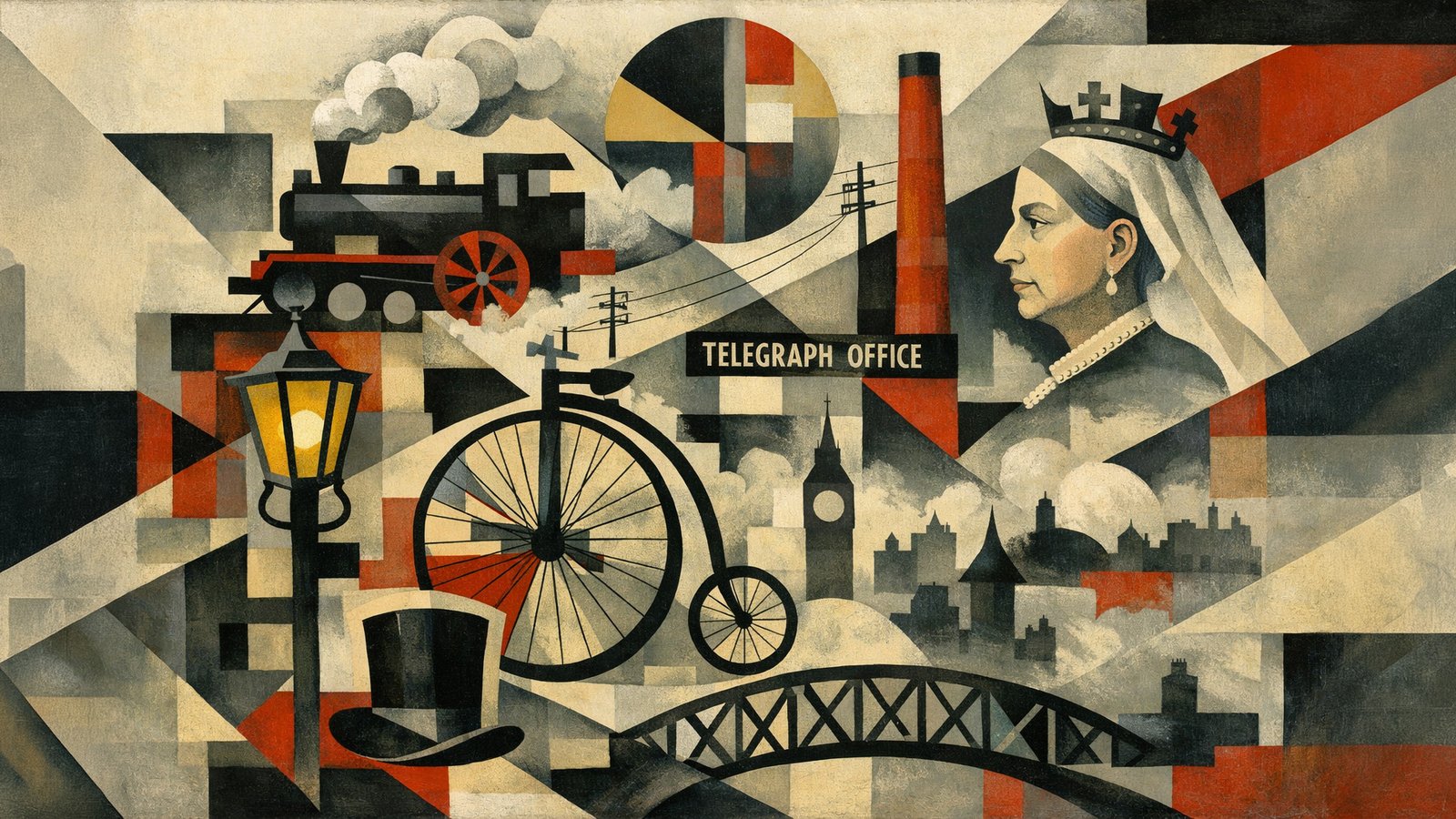
So what on earth are people actually imagining? Modern culture has spent well over a century polishing Victorian Britain into something gorgeous and gaslit. The answer is almost always the theme park version. We’re talking Sherlock Holmes striding through Baker Street fog, steam locomotives thundering across elegant viaducts, women in impossibly structured corsets arranging flowers in vast drawing rooms. It’s the aesthetic, really. The architecture alone is extraordinary — all red-brick grandeur, wrought-iron railings, and ornate clocktowers. Indeed, a whole cottage industry has formed around making the Victorian era look like the greatest period of human civilisation rather than a time when the Thames smelled so catastrophically bad in 1858 that Parliament had to be temporarily abandoned. They called it the Great Stink. Objectively, the best name for any historical event in recorded history.
Now for the part the theme park version conveniently skips. For the majority of people actually living in it, Victorian Britain was genuinely brutal. Life expectancy at birth hovered around forty, though much of that figure was dragged down by catastrophically high infant mortality. If you survived childhood, you had a decent shot at reaching your sixties. Working-class people, however, faced a grimmer arithmetic. Factory workers in Liverpool had an average age of death of just fifteen, according to some mid-century estimates. In Manchester, 57% of working-class children died before their fifth birthday. Cholera arrived in devastating waves, killing thousands each time. Tuberculosis accounted for roughly 40% of urban working-class deaths. Women, meanwhile, faced the very real hazard of their clothing catching fire from open hearths — fashion, apparently, was non-negotiable even near an open flame.
Which brings us to the most revealing answer in that poll: “only if wealthy.” Almost 30% of respondents didn’t say yes to Victorian Britain — they said yes to a very specific, extremely privileged slice of it. Honestly, that’s quite perceptive. Victorian Britain wasn’t really one place. In fact, it was several entirely different countries layered on top of each other, separated not by geography but by class. The upper echelons enjoyed servants (typically between four and twenty of them), education, travel, and elegant dinner parties. Below them, the working class endured fourteen-hour shifts, cramped housing, and dangerous machinery. Those who chose “only if wealthy” have understood the assignment perfectly: they want the country house, not the cotton mill.
Still, the era has something genuinely compelling about it beyond the architecture and the hats. Victorian society was drenched in a particular kind of confidence — a belief, almost religious in its intensity, that progress was not just possible but inevitable. Railways were expanding at astonishing speed. Engineering projects were transforming cities. Darwin was rearranging the entire framework of human knowledge. Between 1867 and 1887 alone, the typewriter, the telephone, the gramophone, the electric light bulb, the internal combustion engine, and the transatlantic cable were all invented. Victorians genuinely believed the future would be magnificent — they were visibly building it with their own hands.
That confidence is, in its own way, intoxicating — especially viewed from 2026, which has the vibe of a group project where everyone has strong opinions and nobody can agree on the brief. Modern life often feels relentlessly chaotic: the digital noise is deafening, geopolitical tension is constant, and economic uncertainty gnaws quietly in the background. Technological change — particularly around artificial intelligence — is moving faster than most people can emotionally process. Moreover, a 2025 Pew Research survey found that 45% of Americans would choose to live at some point in the past rather than the present or future. As a species, we are deeply nostalgic when things feel uncertain. The past — however grim the reality — appears strangely legible. At least the Victorians seemed to know where they were going.
When 50% of an Interessia poll says they’d consider Victorian life, the interesting question isn’t whether they’ve all lost their minds. What the number reveals, instead, is a hunger for direction — for a world that radiates confidence in its own future. Nostalgia, after all, has never really been about going back. It’s about escaping forward from a present that feels shapeless and exhausting. The Victorian era functions as a symbolic exit, not a genuine destination. People aren’t craving the workhouse. They’re craving the certainty.
The Victorians believed — fervently, sometimes delusionally — that the future would be brighter than the past. Ironically, nearly two centuries later, a surprising number of us seem ready to move the other way.
Post Comment
You must be logged in to post a comment.