Why the Venetian Carnival Was Never Just a Party
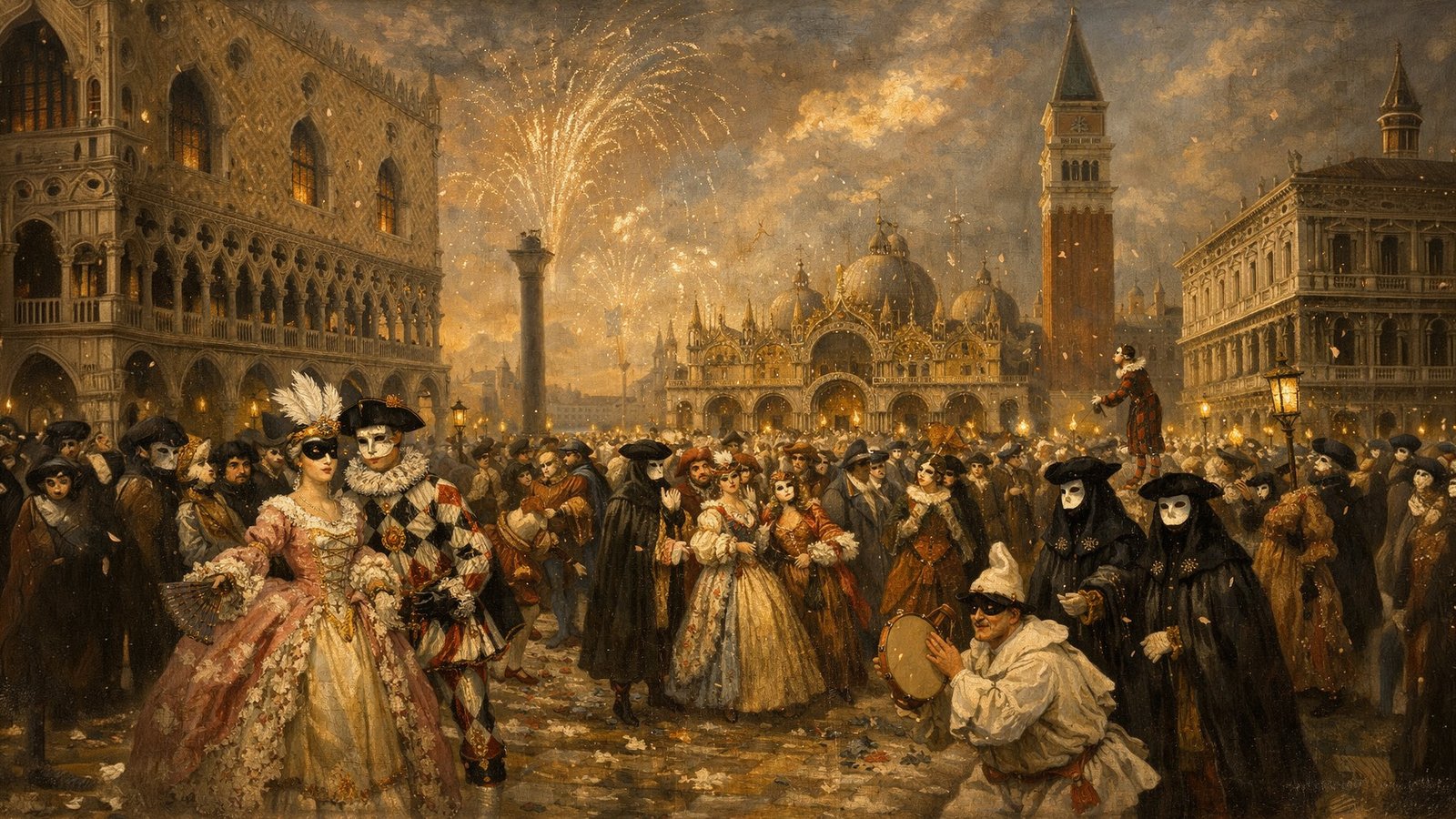
Venice in February does not look entirely real. Mist drifts across the lagoon, bells echo between stone facades, and a figure in white silk glides past as if time misplaced a century or two. Naturally, you check your phone. Meanwhile, the mask checks nothing. That quiet refusal to identify itself forms the first power of the Venetian Carnival.
Long before influencers discovered St Mark’s Square, the city understood spectacle. Back in 1162, after a military victory over Aquileia, Venetians poured into the square to celebrate. The ruling elite observed carefully. A trading republic that negotiates, spies and calculates for a living needs a pressure valve. Therefore, celebration became policy rather than accident.
By 1296, the Republic declared the day before Lent a public holiday. Gradually, the festivities expanded. What began as a single sanctioned feast day stretched into weeks of permitted mischief. Soon enough, the season ran from Christmas towards Lent in some periods. Indulgence built deliberately before austerity took over.
Carnival never functioned as simple merrymaking. Venice operated on hierarchy. Nobles governed. Merchants financed. Sailors hauled cargo. Servants managed households. Foreigners traded under scrutiny. Yet once a mask covered your face, categories blurred. A baker might gamble beside a patrician. A woman could move more freely through public space. A stranger could disappear into the crowd without explanation.
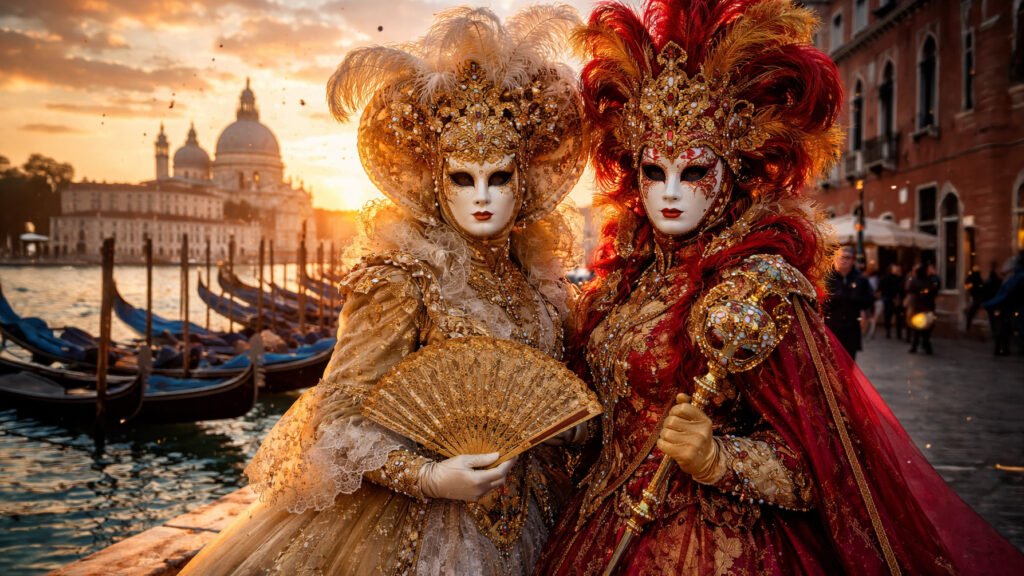
Crucially, that loosening did not threaten the constitution. The Republic understood theatre as a tool of governance. Officials permitted anonymity because it reduced tension. Grievances softened into performance. Flirtation replaced confrontation. Laughter diluted resentment. In that sense, Carnival allowed society to exhale without rewriting the rules.
By the seventeenth and eighteenth centuries, Venice perfected the formula. Travellers described masked balls spilling from palaces into alleyways. Gambling halls hummed until dawn. Theatres staged opera, satire and farce in relentless rotation. Fire-eaters performed beside gondoliers. Musicians played under balconies. As a result, the city resembled a stage set that refused to close.
Giacomo Casanova treated Carnival as peak season. Mystery handled half his introductions. Under a white mask and black cloak, he reinvented himself nightly. Venice rewarded reinvention. Visitors arrived precisely because the city encouraged it.
Masks carried distinct codes. The Bauta, with its sharp white angles and black tricorn hat, allowed the wearer to eat and drink without removal. Practical design met social engineering. The Moretta, a small oval of black velvet, required the wearer to bite an inner button to hold it in place. Consequently, she could not speak. Silence turned into intrigue, although empowerment remains debatable. Meanwhile, the long-beaked Medico della Peste mask borrowed its shape from plague doctors who once stuffed herbs into the nose to filter foul air. Carnival recycled dread into theatre.
For months each year, Venetians wore masks beyond official dates. Authorities tolerated this freedom because it stabilised the system. However, tolerance demanded limits. The state banned weapons. It regulated where masks appeared. It fined those who pushed too far. Even mischief obeyed rules.
Then 1797 altered everything. Napoleon marched in and dismantled the Republic. French administrators distrusted masked gatherings. Austrian rulers shared that suspicion. Conspiracies flourish where faces vanish. Gradually, the grand Carnival faded from prominence.
Smaller traditions survived on islands such as Burano and Murano. Nevertheless, the city lost its theatrical heartbeat. Venice drifted into a quieter nineteenth century. Romantics admired it. Painters immortalised it. Yet the riotous alter ego retreated.
Nearly two centuries later, Italy chose revival. In 1979, cultural organisers and local authorities restored Carnival as a public event. Designers studied eighteenth-century paintings for inspiration. Artisans reopened workshops. Tourism boards quickly recognised the appeal. The formula still functioned.
Modern Carnival balances heritage and commerce with careful calculation. On one hand, genuine artisans shape papier-mâché over clay moulds and apply gold leaf by hand. They paint delicate flourishes that echo centuries of craft. On the other hand, souvenir shops stack cheaper factory-made masks that imitate the look at a fraction of the price. Visitors rarely detect the difference. Purists sigh, whereas cash registers ring.
St Mark’s Square transforms into open-air theatre each February. Early mornings belong to photographers and dedicated costume enthusiasts. They treat the piazza like a fashion set. Elaborate gowns sweep across paving stones. Velvet cloaks ripple in the lagoon breeze. By midday, crowds thicken and selfie sticks rise. Even so, a sudden hush sometimes falls when a masked couple stands motionless against the basilica’s mosaics.
One of the most anticipated rituals, the Flight of the Angel, sends a costumed performer sliding down a wire from the Campanile into the square. The tradition recalls a sixteenth-century acrobat who once tightrope-walked between towers. Today, safety harnesses replace raw bravado. Nevertheless, the symbolism endures. Venice still adores a dramatic entrance.
Private balls unfold behind palace doors. Candlelight flickers against frescoed ceilings. Orchestras tune carefully. Guests pay handsomely for curated fantasy. Outside, street performers juggle fire for free. Consequently, two Carnivals operate side by side: one accessible, one exclusive.
Myths swirl around the festival like lagoon fog. Some insist Carnival served only decadence. In reality, the Republic designed it as controlled inversion. Temporarily, servants mocked masters in comic sketches. Briefly, women navigated public spaces with greater confidence. However, Ash Wednesday arrived reliably, and hierarchy resumed its throne.
Another misconception paints the plague mask as cheerful iconography. Historically, it symbolised fear and medical theory. Physicians believed aromatic herbs might ward off disease. Carnival later repurposed that silhouette into stylised drama. Irony thrives where history runs dark.
Venice has confronted real plagues before. In 2020, Carnival opened with customary flourish, and then news of a new virus accelerated across northern Italy. Authorities curtailed events abruptly. The square emptied. Masks returned to medical necessity rather than ornament. In 2021, organisers shifted much of the programme online. Digital costume contests replaced crowded gatherings. The silence felt uncanny in a city built on performance.
Celebrations resumed gradually in subsequent years. Even so, the interruption reminded Venetians that Carnival never guarantees permanence. The city adapts because it must.
Today, overtourism shadows the festivities. Tens of thousands of visitors converge on narrow streets not designed for modern footfall. Hotels fill months in advance, and prices climb accordingly. Local authorities experiment with entry fees for day-trippers and increased crowd control. Surveillance cameras observe what masks once concealed. Thus, anonymity now competes with algorithmic tracking.
Nevertheless, the deeper appeal persists. Carnival offers transformation without paperwork. You do not require lineage, language fluency or insider connections. Rent a costume, fasten a mask, and you join the choreography. For a few hours, the city treats you as part of the set.
Interestingly, the word carnival likely derives from carne vale, meaning farewell to meat before Lent. Feasting precedes restraint. Indulgence anticipates discipline. Venice understood this rhythm intimately. The Republic traded across continents, accumulated wealth and guarded secrets. Yet it also carved out time for excess because control works better with contrast.
Walk through a workshop in Dorsoduro and you may find an artisan brushing gold leaf onto a freshly shaped mask. He works steadily and without spectacle. Layers build patiently. Colour deepens gradually. Each finished piece carries subtle variations that machines struggle to replicate.
Murano glassmakers once lived under strict rules that prevented departure from the island, lest they reveal trade secrets abroad. Venice protected intellectual property long before the phrase existed. Carnival reflects that same instinct. Share enough magic to attract the world. Retain enough mystery to remain singular.
Late afternoon light softens the lagoon’s edges. Costumed figures drift towards quieter canals. Laughter echoes under low bridges. Gondolas slip past in near silence. You might catch your reflection beside someone dressed as an eighteenth-century noble and realise the contrast feels seamless.
Beneath the romance lies calculation. The Republic survived for over a millennium because it balanced spectacle and stability. Carnival demonstrated that balance publicly. Allow rebellion in costume. Discourage it in council chambers. Encourage fantasy. Maintain order.
Modern Venice confronts different pressures. Climate change threatens rising waters. Residents relocate as property prices soar. Cruise ships spark controversy on the horizon. Amid those debates, Carnival still unfolds each winter. Ritual anchors identity even when economics wobble.
Perhaps that explains its endurance. People crave controlled transformation. Digital life exposes faces constantly and archives them permanently. Social media demands performance yet rarely grants anonymity. Carnival reverses the formula. It invites performance through concealment.
Stand in St Mark’s Square just before dusk and watch the sky shift from grey to rose. A masked figure pauses, lifts gloved fingers in a small theatrical gesture, and disappears into the crowd. No algorithm captures the full meaning of that moment. Venice smiles at its own reflection and carries on.
For a city built on water, uncertainty feels familiar. Tides rise and fall. Trade routes shift. Empires arrive and depart. Through all of it, Carnival returns not as nostalgia but as rehearsal. Each February, Venice reminds itself how to balance freedom and form, excess and restraint, mystery and marketing. The mask remains the invitation, and the city remains the stage.
On a practical note, in 2026, the Venetian Carnival runs from 31 January to 17 February 2026, culminating on Shrove Tuesday before Lent. Most headline events cluster around the opening weekend and the final days, so timing matters. Venice remains easiest to reach via Venice Marco Polo Airport, which connects directly to major European hubs, or by high-speed train into Venezia Santa Lucia station, where you step straight onto the Grand Canal. From there, vaporetto water buses move you around the city, although walking often proves faster during peak Carnival days. Attendance works on two levels: public events in Piazza San Marco and across the city require no ticket, only patience with crowds, while official balls and palace dinners demand advance booking — sometimes months ahead — through event organisers. Accommodation fills quickly, so early reservation is essential. If you want the full effect, rent or commission a costume in Venice itself; many ateliers offer fittings and styling. Alternatively, arrive early in the morning, before the tour groups thicken, and let the city perform around you.