The Secrets of the Cats of Marrakech
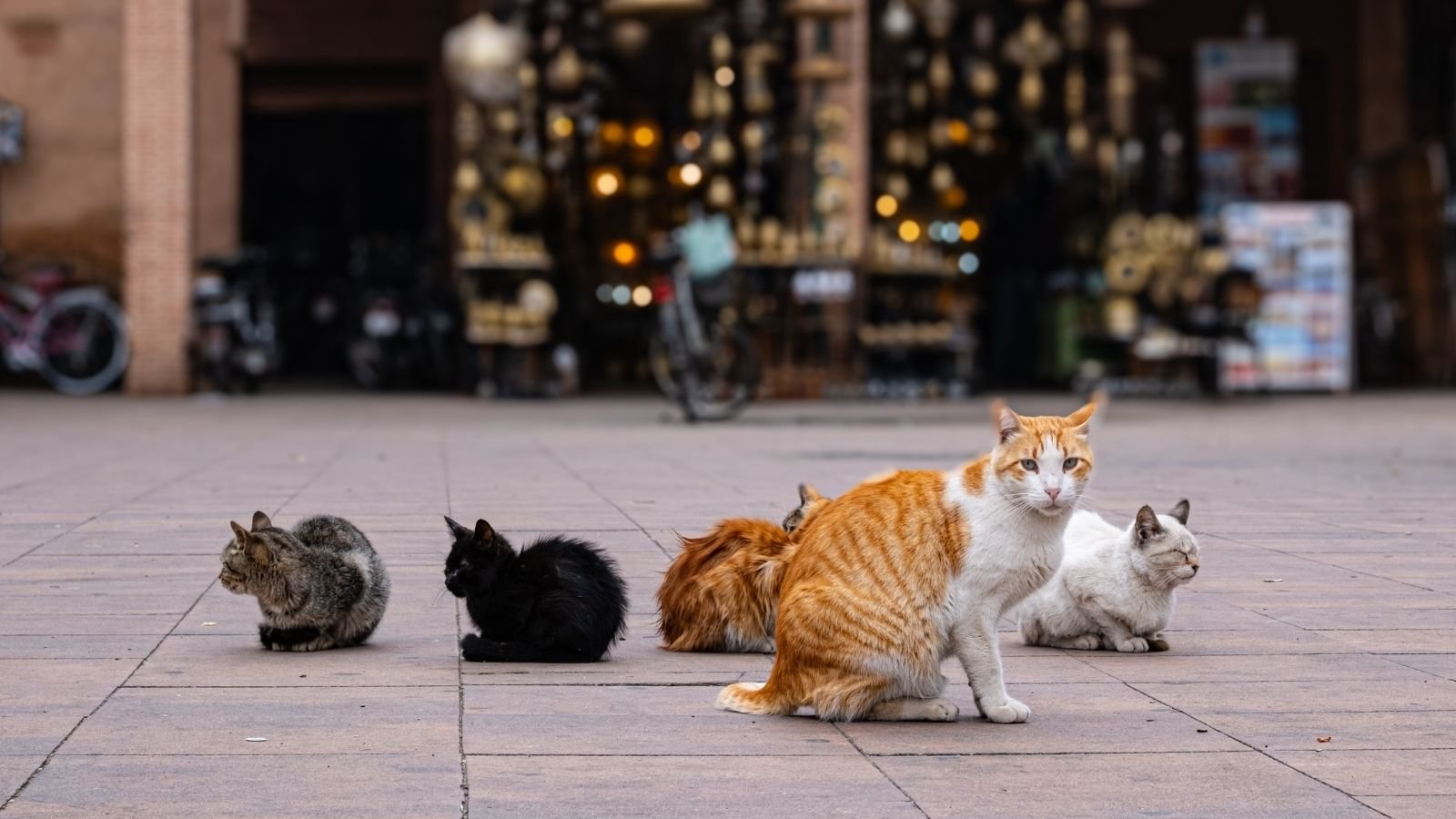
Marrakech does not announce its cats. Instead, they appear gradually. One sleeps on a warm step before the doorway registers. Another, meanwhile, watches from a rooftop edge, as if posted there deliberately. A third slides out from under a cart just as the street seems to run out of surprises. In Marrakech, therefore, cats do not arrive dramatically. They have always been there, quietly waiting for you to catch up.
Because of this, their presence feels inevitable rather than notable. Within hours, the city’s cats fade into the background alongside the call to prayer, the hum of scooters, and the smell of bread baking somewhere unseen. They do not demand attention. Yet, when attention arrives, they accept it calmly. This quiet confidence, in turn, explains much of their success.
Marrakech offers cats something rare in modern cities: space without ownership. The medina, with its tight alleys and layered architecture, functions less like a grid and more like an ecosystem. As a result, walls generate shade. Courtyards, meanwhile, trap cool air. Rooftops also connect homes into continuous pathways above street level. Cats read this environment fluently. They know where the sun pauses in the morning and where it retreats in the afternoon. They also know which steps stay warm long after dusk.
Climate reinforces this adaptation. Winters remain mild, while summers instead demand restraint rather than endurance. Over time, cats become experts in stillness. They rest during heat, then move decisively when it breaks, and waste little energy on spectacle. Consequently, their presence feels calm rather than chaotic. Even when numbers appear high, behaviour still stays measured.
Religion shapes this calm more than guidebooks tend to admit. In Islamic tradition, cats occupy a quietly protected category. They are considered clean animals. For this reason, they may enter mosques. They may also share space with people without ritual concern. This does not mean they are sentimentalised. Rather, it means they are allowed. That distinction, therefore, matters.
Stories circulate, as they always do. The most repeated involves Abu Hurairah, whose affection for cats earned him his name. Whether taken literally or symbolically, the story nevertheless performs useful work. It reinforces the idea that kindness towards cats carries no social penalty. As a result, chasing a cat away often feels unnecessary, even faintly rude.
This tolerance shapes daily life. Cats wander into shops and settle between stacks of leather slippers. They nap beside spice jars and behind café counters. They also stretch across doorways without apology. Nobody asks whose cat it is. Likewise, nobody asks whether it belongs. Belonging, here, therefore functions differently.
Commerce and cats have coexisted in Marrakech for centuries. Practically speaking, cats reduce rodents. Symbolically, however, they soften space. A shop with a cat feels lived-in. It also feels patient. The animal becomes part of the shop’s rhythm, arriving and leaving without negotiation. Tourists notice this quickly. Locals, by contrast, rarely do.
In Jemaa el-Fnaa, cats appear once the crowds thin. They move with purpose among food stalls after midnight, collecting scraps and opportunities. Some vendors feed them deliberately. Others simply tolerate them because they always have. Either way, the square gradually becomes a temporary commons where humans and animals negotiate space through habit rather than rules.
Riads add another layer. Courtyards attract cats the way water attracts light. Consequently, some riads quietly adopt one. Others, instead, host several unofficial residents. Staff may feed them. Guests photograph them. Everyone, however, agrees not to formalise the arrangement. The cat remains free to leave, which it often does, returning later on its own terms.
Tourism complicates this picture. Visitors arrive with expectations shaped by different ideas of pet ownership. They notice injuries, thin bodies, and infected eyes. As a result, some feel alarm. Others feel compelled to intervene. A few even attempt rescues without understanding context. Good intentions, therefore, sometimes collide with local realities.
The truth sits uncomfortably in the middle. Many cats receive regular food from multiple sources. Accordingly, many live long, competent lives. Others, however, struggle. There is no city-wide safety net. Instead, veterinary care depends heavily on non-governmental organisations with limited reach. Trap–neuter–return programmes exist, yet coverage remains uneven.
This unevenness creates contrast. One street supports sleek, well-fed cats with glossy coats. Another, meanwhile, hosts cats that look perpetually tired. The difference often comes down to a single shopkeeper or household that feeds consistently. As a consequence, care becomes hyper-local, almost accidental.
Western narratives often romanticise the city cat as a symbol of freedom. Marrakech both supports and undermines this idea. Cats enjoy autonomy, yet autonomy also includes risk. They fight, they get injured, they suffer heat and illness. Freedom, therefore, does not equal comfort, even when it photographs well.
Photography amplifies this tension. Images of green-eyed cats against pink walls circulate endlessly online. They reinforce a story of harmony. Meanwhile, less aesthetic realities remain outside the frame. This imbalance, in turn, frustrates local animal welfare groups, who struggle to attract sustained support once novelty fades.
Conflicts surface quietly. Newer neighbourhoods sometimes resist cats more strongly than the old city. Noise during mating seasons irritates residents. Hygiene concerns also appear in discussions about tourism branding. Municipal authorities prioritise cleanliness and infrastructure. Consequently, animal welfare enters policy slowly, if at all.
Yet attempts to remove cats entirely would fail. The city’s structure resists simplification. The medina was never designed for strict separation. Instead, humans, animals, trades, and domestic life overlap by design. Cats exploit this overlap elegantly. They survive because, ultimately, the city itself remains porous.
Cats also function as social mirrors. Their behaviour reflects human rhythms. During Ramadan, feeding patterns shift. During festivals, scraps increase. And during quiet seasons, cats relocate or thin out. In each case, they respond to the city’s emotional temperature as much as its physical one.
There is also a generational element. Older residents tend to view cats pragmatically. Younger Moroccans, however, exposed to global pet culture, sometimes adopt more sentimental attitudes. This contrast creates gradual shifts rather than revolutions. Cats, meanwhile, adapt without comment.
Perhaps the most striking feature is how little ceremony surrounds them. Most cats remain unnamed. Nobody celebrates them officially. Instead, they exist without narrative emphasis. That restraint feels increasingly rare. In cities obsessed with categorisation, Marrakech deliberately leaves space for the unlabelled and the unowned.
For travellers, this restraint can feel refreshing. Cats appear to belong everywhere and nowhere at once. As a result, they slow perception. You stop rushing when a cat blocks a narrow alley. You wait. Gradually, the city teaches patience through inconvenience.
This patience runs both ways. Cats wait too. They watch humans hurry past carrying problems far larger than scraps of fish. They wait for shade to shift. Cats of Marrakech wait for night. Over time, their stillness becomes contagious.
Ultimately, cats endure in Marrakech because nobody tries very hard to solve them. They are not framed as a problem requiring resolution. Instead, they are accepted as part of the city’s background noise, like pigeons, dust, and uneven paving stones.
This acceptance does not equal perfection. Suffering exists. Responsibility remains diffuse. Yet the arrangement persists because it fits the city’s temperament. Marrakech tolerates contradiction. It functions, therefore, through negotiation rather than enforcement.
Cats thrive in that ambiguity. They ask for little. In return, they offer atmosphere. They remind visitors that not everything in a city needs management, ownership, or branding.
In a world increasingly obsessed with control, Marrakech’s cats remain stubbornly informal. They sit where they like, they leave when they choose, they exist, quite simply, without permission.
Perhaps that is why they feel inseparable from the city. Not because they are cherished icons, but because they embody something Marrakech refuses to lose: the ability to let things simply be.