Why Polynesian Voyaging Still Dazzles Navigators and Historians
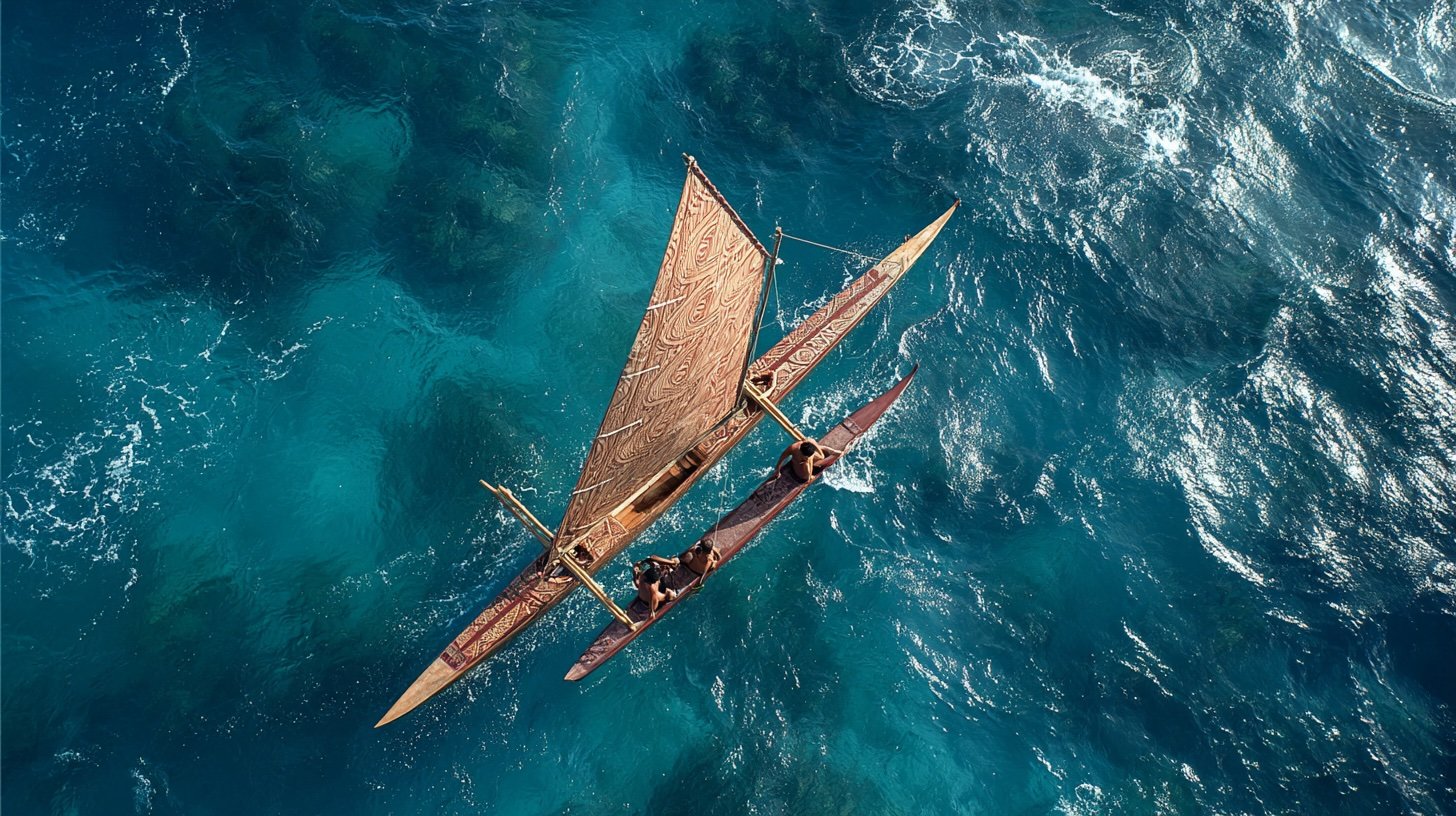
Polynesian voyaging feels like one of those stories that should sit in the mythic corner of human history, except it happens to be true and even more astonishing than the legends suggest. Polynesian voyagers crossed an ocean that covers a third of the planet in canoes lashed together with fibre and navigated with no metal tools, no compasses, no charts. The slow rise of this seafaring world did not begin with a single leap into the blue. It grew from layers of inherited skill, instinct, and curiosity that carried people further and further until a network of islands thousands of miles apart felt connected by well-worn ocean paths.
Picture a coastline in ancient Samoa or Tonga. Canoe builders shape hulls from breadfruit trees with stone adzes; children watch elders scratch constellations in the sand, mapping star paths like train schedules. Polynesian voyaging depended on learning the sea like a language. Winds had moods, swells had rhythms, clouds had clues, and stars rolled across the sky in fixed patterns that created a celestial grid. This grid turned the Pacific from a terrifying emptiness into something chartable in the mind. Navigators memorised hundreds of stars, their rising points, their seasonal tracks, and the way their paths stitched together the night. The star compass became the beating heart of long-distance travel.
Polynesian voyaging worked because navigators trusted details that most people never notice. A faint greenish haze over the horizon might hint at a distant island reflecting sunlight. Bird patterns offered hints too. Certain species fly out to sea in the morning to feed and return to land before dark. Canoes followed them like commuters. Swells bent around islands, creating subtle cross-currents. Navigators felt these in their ribcages through the movement of the hull. A skilled wayfinder could read the ocean like a fingerprint.
All of this emerged from communities that valued exploration as part of life. The Lapita people, ancestors of the Polynesians, sailed east from Taiwan and Island Southeast Asia, carrying with them distinctive pottery and an appetite for pushing boundaries. Over centuries they reached Fiji, Tonga and Samoa, where the Lapita pottery ceased but the voyaging spirit grew stronger. Polynesian culture flourished here and later fanned outwards again. They reached the distant Marquesas, the open expanse of Hawai‘i, the isolated speck of Rapa Nui, and the green hills of Aotearoa. These are journeys that still leave oceanographers blinking at the distances.
Polynesian voyaging did more than plant settlements. It knitted islands together. Archaeologists now recognise that Polynesia was never a scattering of isolated communities waiting for European ships. Instead, it operated like a maritime web. Canoes travelled between archipelagos with gifts, spouses, chants, genealogy, and technology. Stone adzes made of basalt from one island have been found thousands of kilometres away on others. Oral traditions echo shared stories and common ancestors. Even genetic studies tell tales of repeated contact rather than lonely outposts.
Some islands became navigational hubs. The Society Islands and the Marquesas sat at crossroads of routes to Hawai‘i and Rapa Nui. Tonga held political sway over a wide region during its classical era. Navigators travelling between these places relied on an ocean memory so strong that they could sail hundreds of miles without seeing land and still know exactly where they stood in relation to it. The ocean became a thoroughfare, not a barrier.
The canoes themselves played starring roles. Double-hulled vessels offered stability, speed and the ability to carry families, animals and supplies for voyages lasting weeks. Their design came from generations of refinement. Builders shaped hulls to cut waves cleanly, tied parts together instead of using nails, and balanced sails that could be angled to catch the wind from many directions. These canoes did not compromise. They were the aerospace engineering of their time.
Voyaging connected politics as well as families. Leaders forged alliances through marriage between islands, exchanged prized items, and sometimes launched expeditions to settle new lands when resources tightened at home. Exploration mixed with necessity. Some migrations happened because populations grew quickly on fertile islands; others arose from ambition or dreams. Polynesian voyaging carried stories, rituals and innovation across thousands of miles, so culture evolved in motion.
The network thrived until disruptions began. Climatic shifts may have influenced sailing conditions. European arrival fractured knowledge traditions. Missionaries discouraged practices tied to old religions. Colonial powers undermined local authority structures that protected navigational guilds. Slowly the number of traditional navigators declined. The threads of the voyaging network frayed.
Yet the story did not end in silence. The revival of Polynesian voyaging in the twentieth century began when many doubted that ancient navigators had intentionally crossed the Pacific at all. Some scholars insisted it must have been accidental drift. Others claimed the distances were simply too vast. Islanders knew otherwise. They had kept stories, chants and fragments of navigational knowledge alive, even if practice had faded.
In 1975, the Polynesian Voyaging Society introduced Hōkūleʻa, a replica double-hulled canoe. Her maiden long voyage to Tahiti in 1976 relied entirely on traditional navigation taught by master navigator Mau Piailug from Satawal in Micronesia. The achievement stunned the world. Polynesian voyaging proved itself again with sails, stars and ancestral memory. Hōkūleʻa became a floating classroom for a cultural renaissance. Her voyages have since circled the globe, carrying messages about environmental stewardship and indigenous knowledge.
This revival sparked a wider movement. Voyaging societies emerged across Hawai‘i, Tahiti, the Cook Islands, Aotearoa and other parts of the Pacific. They rebuilt canoes, trained new navigators and restored a sense of oceanic identity. Young people learned to read swells, feel wind shifts and memorise the star compass. The network that once pulsed with movement found new life through education, performance, and pride.
Modern research has begun to support what navigators always knew. Experimental voyages show that traditional canoes handle open seas remarkably well. Archaeologists map trade routes through artefact origins. Linguists trace patterns that match known sailing paths. Geneticists observe shared ancestry between island groups that align with oral traditions of travel. The scientific picture increasingly mirrors the cultural one.
Polynesian voyaging also offers a different perspective on human ingenuity. While many civilisations built power through land empires, Polynesians built skill on water. They treated the Pacific as a living partner rather than an obstacle. Their methods emphasised intimate connection with natural forces. Wayfinding relied on attention, memory and training rather than instruments. In an age of satellite navigation, the rediscovery of this approach feels almost unbelievable.
What stands out today is the scale of the voyaging network and the elegance of its logic. Routes often followed reliable trade winds or seasonal star patterns. Return voyages required different strategies than outbound ones. Some islands served as stepping stones. Navigators carried mental maps of swells shaped by islands hundreds of miles away. They travelled with intention.
In the revival era, voyaging reveals its relevance beyond heritage. It encourages environmental awareness because success depends on reading ecosystems with care. It strengthens community because a canoe crew survives only through cooperation. It reinforces identity because it recalls a time when Polynesians shaped the largest maritime culture on the planet. Canoes teach patience, respect and confidence. They remind people that their ancestors crossed oceans as a normal part of life.
Every island that once pulsed in the voyaging network still carries echoes of this past. Place names preserve references to canoe landings. Genealogies trace lines back to founding navigators. Chants describe sea paths. Archaeological sites reveal old canoe houses. Even in modern cities, festivals and educational programmes honour the traditions of wayfinding.
The network endures not only in memory but in practice. Each new training voyage that leaves port carries centuries of knowledge. When a young navigator stands at the stern of a canoe under a night sky and names rising stars, they participate in something that shaped the history of half the Pacific. Polynesian voyaging lives because people keep choosing to sail.
The renewed interest in this tradition continues to spread. Schools integrate wayfinding lessons. Museums highlight the technological brilliance of ancient canoes. Documentaries follow modern voyages. Communities across the Pacific share research and celebrate shared ancestry. Scholars treat oral tradition as legitimate historical evidence alongside scientific data.
The phrase Polynesian voyaging now refers to more than the past. It describes a living cultural system that adapts while staying rooted in ancient practice. It reflects resilience, creativity and the astonishing truth that humans once navigated an ocean bigger than any empire without a single written chart.
Every swell, star and cloud becomes part of the story. The canoes that glide across the Pacific today carry memories, but they also carry future navigators who will reinterpret the tradition in their own ways. The network of islands still waits on the horizon. The ocean still speaks. And Polynesian voyaging continues to answer.