Why Octopuses Are Earth’s Only Real Aliens
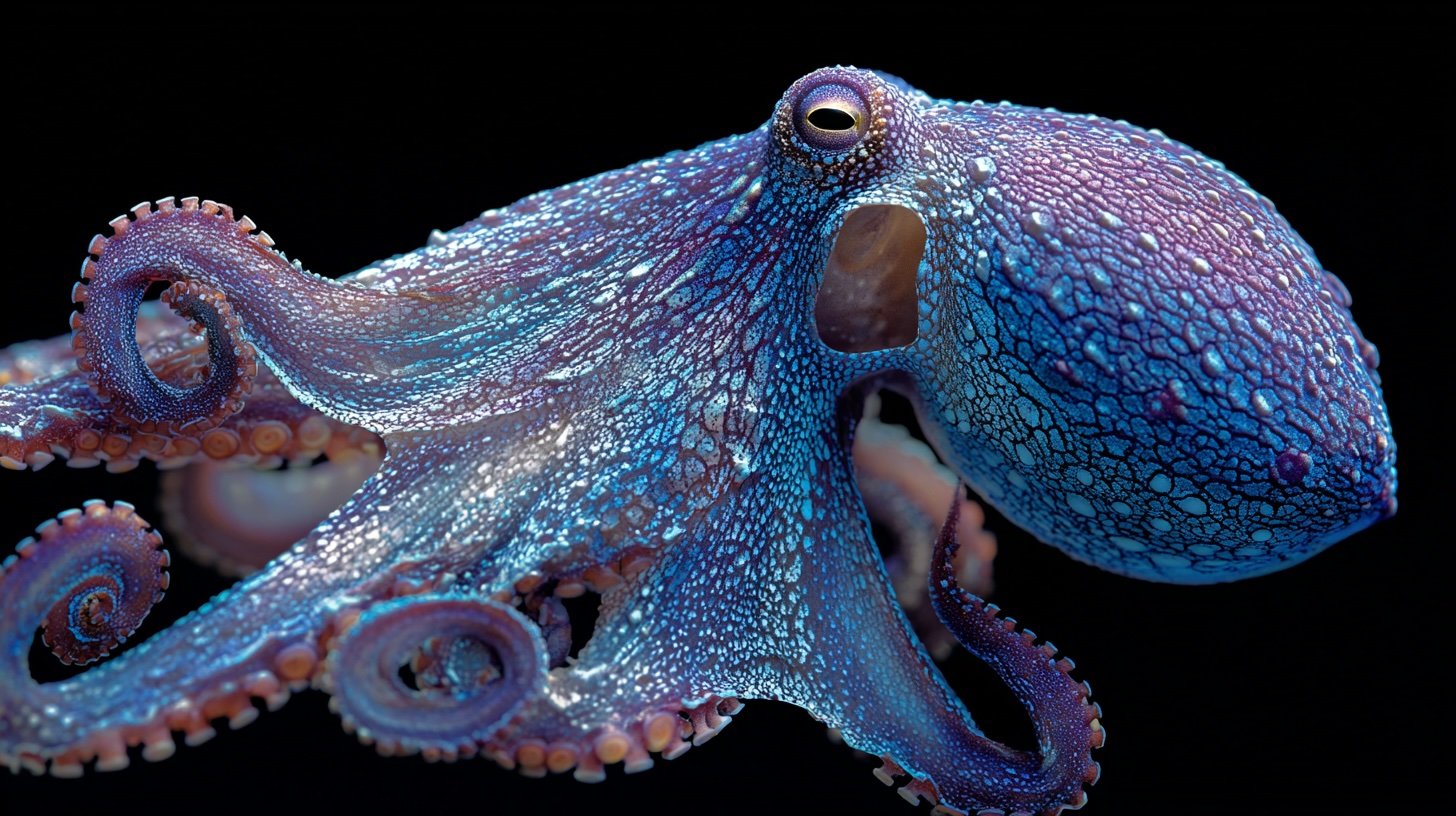
Swimming through the murky depths of the Pacific Ocean, an eight-armed creature glides past kelp forests with hypnotic grace. Its skin ripples through a kaleidoscope of colours—mottled brown, then speckled grey, then suddenly pale white. Within milliseconds, it transforms into something barely visible against the rocky seafloor. This isn’t CGI magic. This is Tuesday afternoon for your average octopus.
For centuries, these cephalopods have been treated as curiosities at best, monsters at worst. Yet recent scientific discoveries suggest something far stranger: they might be the closest thing to meeting an intelligent alien we’ll ever find on Earth. Not because they literally came from outer space (though we’ll get to that bonkers theory in a moment), but because their evolutionary journey unfolded along such a radically different path from ours that encountering their intelligence is genuinely like meeting a mind from another world.
Consider this: our last common ancestor with the octopus was a primitive worm-like creature that wriggled through ancient seas roughly 600 million years ago. Since that evolutionary fork in the road, vertebrates and cephalopods have been on utterly separate journeys. Whilst we mammals were busy developing centralised brains protected by skulls, spinal cords running through backbones, and intelligence concentrated in our heads, octopuses were inventing something completely different.
They’ve got nine brains. Yes, nine. One central brain sits in their head, but each of their eight arms contains what scientists call a “mini brain” capable of acting independently. Two-thirds of an octopus’s 500 million neurons don’t reside in its head at all—they’re distributed throughout its arms. Imagine if your fingers could taste what they touched, think for themselves, and solve problems without consulting your brain.
This decentralised intelligence isn’t just unusual—it’s architecturally alien. As neurophysiologist Antonio Figueras describes them, cephalopods are “evolution’s aliens, having developed intelligence along a parallel, alternative path to that of humans.” When an octopus hunts, individual arms explore crevices whilst the central brain scans for predators. It’s parallel processing that would make a supercomputer jealous.
The weirdness doesn’t stop at their distributed nervous system. Octopuses have three hearts and blue blood. Two hearts pump blood through their gills whilst the third circulates it to the rest of their body. The blue colour comes from haemocyanin, a copper-based protein that’s far more efficient than our iron-based haemoglobin at transporting oxygen in cold, low-oxygen environments. It’s such an effective system for deep-sea life that it makes one wonder whether octopuses were designed for an entirely different planet.
Here’s where things get properly mental: the main heart stops beating when an octopus swims. Completely. This is why they prefer crawling along the ocean floor rather than swimming—it literally exhausts them. Imagine your heart taking a break every time you went for a jog. Furthermore, if their blood becomes deoxygenated (such as when they die), it loses its blue colour and turns clear. They’re basically walking chemistry experiments.
Then there’s their genome, which reads like it’s been assembled by an overenthusiastic science fiction writer. In 2015, scientists sequenced the California two-spot octopus genome and discovered around 33,000 protein-coding genes—more than humans possess. The real shock wasn’t quantity; it was structure. Genes that cluster together in virtually every other animal are scattered randomly throughout the octopus genome. Scientists describe it as utterly bizarre, genuinely alien.
Nevertheless, the octopus’s secret weapon is RNA editing, a biological superpower that sets them apart from nearly every creature on Earth. Whilst most animals evolve through random DNA mutations, octopuses have largely abandoned that approach. Instead, they edit their RNA—the molecular instructions that translate DNA into proteins—on the fly.
This isn’t just tweaking around the edges. When researchers examined octopuses in cold versus warm water, they found changes at over 13,000 RNA sites in the nervous system. The animals were literally recoding their brains in response to temperature shifts. These changes happen within 24 hours. It’s as though octopuses can rewrite parts of their brain every time they learn something new.
Only cephalopods do this to such an extreme degree. Humans have RNA editing too, but in tiny, carefully controlled amounts. Octopuses have weaponised it, using it to modify most of their neural proteins. Some researchers speculated this ability might explain why octopuses are so strangely smart. Their brains are running on software that can be patched and updated constantly.
Of course, all this biological strangeness led a group of 33 scientists to publish a properly bonkers paper in 2018 suggesting that octopuses might literally be aliens. Their theory, rooted in the panspermia hypothesis, proposed that frozen octopus eggs crashed into Earth aboard icy comets during the Cambrian explosion about 540 million years ago. Alternatively, they suggested an extraterrestrial virus might have infected early squid, causing them to evolve rapidly into modern octopuses.
The scientific community responded with what can only be described as a collective eye-roll. “Many of the claims in this paper are beyond speculative,” noted virologist Ken Stedman. The octopus genome was mapped in 2015, showing that octopus nervous system genes split from squids only around 135 million years ago—long after the supposed alien invasion. Additionally, no meteorite collected on Earth contains genetic material that would support this theory. The octopus genome, however strange, fits perfectly within the genetic makeup of Earth life.
Nevertheless, the theory captured public imagination precisely because octopuses seem so otherworldly. Their camouflage abilities alone look like technology rather than biology. Millions of specialised cells work together to create instant colour changes. Military researchers actually study octopus camouflage to develop adaptive systems for soldiers. The octopus can change both colour and texture—transforming from smooth to bumpy—within milliseconds.
What makes this especially mind-bending is that octopuses are colour-blind. They have only one type of visual pigment in their eyes, yet somehow they match background colours with uncanny accuracy. Scientists still don’t fully understand how they pull this off. It’s yet another example of octopuses solving problems in ways that seem almost deliberately alien.
Astrobiologists now use octopuses as models for what intelligence might look like on other planets. Because their cognitive abilities evolved completely independently from vertebrates, they demonstrate that there are multiple evolutionary pathways to complex intelligence. As philosopher Peter Godfrey-Smith notes, octopuses represent “the closest we will come to meeting an intelligent alien.”
What does this alien intelligence look like in practice? Octopuses can navigate mazes, solve problems, remember solutions, and use tools. They recognise individual humans and respond differently to each person. In captivity, they’ve been observed opening childproof caps, escaping from tanks, and taking apart equipment for sheer entertainment. The famous case of Inky the octopus, who escaped from New Zealand’s National Aquarium through a narrow drainpipe and made his way back to the ocean, demonstrates their problem-solving prowess.
They also communicate through colour, texture, and shape. Some researchers believe this could be a precursor to visual language—a form of syntax we haven’t decoded yet. Male Caribbean reef squid can even split their body colouration down the middle, displaying red to attract a female on one side whilst showing white to repel a rival male on the other.
Perhaps the most profound implication is what octopus intelligence suggests about consciousness itself. These creatures show us that sophisticated minds don’t need to look anything like ours to be real. Their distributed nervous system, blue blood, RNA editing, and decentralised intelligence prove that nature has explored multiple solutions to creating complex cognition.
Biologically, octopuses evolved right here on Earth over millions of years. But functionally? They genuinely are alien in the most meaningful sense. They represent an entirely separate experiment in building intelligence, using completely different architectural principles than vertebrates. If we ever make contact with extraterrestrial life, it probably won’t be humanoid. Instead, it might be something far stranger—something decentralised, colour-changing, and utterly brilliant. Something, perhaps, not entirely unlike the eight-armed philosopher dwelling in the alien realm beneath the waves, reminding us daily that sophisticated minds can take forms we’ve yet to fully imagine.
The octopus isn’t just an animal. It’s a living thought experiment about the diversity of intelligence in our universe. Moreover, it’s right here, next door in our oceans, waiting for us to understand it better. That’s either deeply reassuring or profoundly unsettling, depending on your perspective. Either way, the next time you see an octopus, remember: you’re not just looking at a clever invertebrate. You’re glimpsing what alien intelligence actually looks like.