Why Lukla Airport Is the Most Dangerous in the World
Prefer to listen? Enjoy the full story of Lukla Airport on Youtube
Lukla Airport doesn’t bother pretending to be welcoming. It sits in the Himalayas at nearly three thousand metres, perched like a daredevil who knows you’ll look down even though you shouldn’t. People call it the most dangerous airport in the world, usually with the same energy as someone recounting a thrilling near‑death experience they secretly enjoyed. The place has a charm, but the kind that arrives wrapped in turbulence.
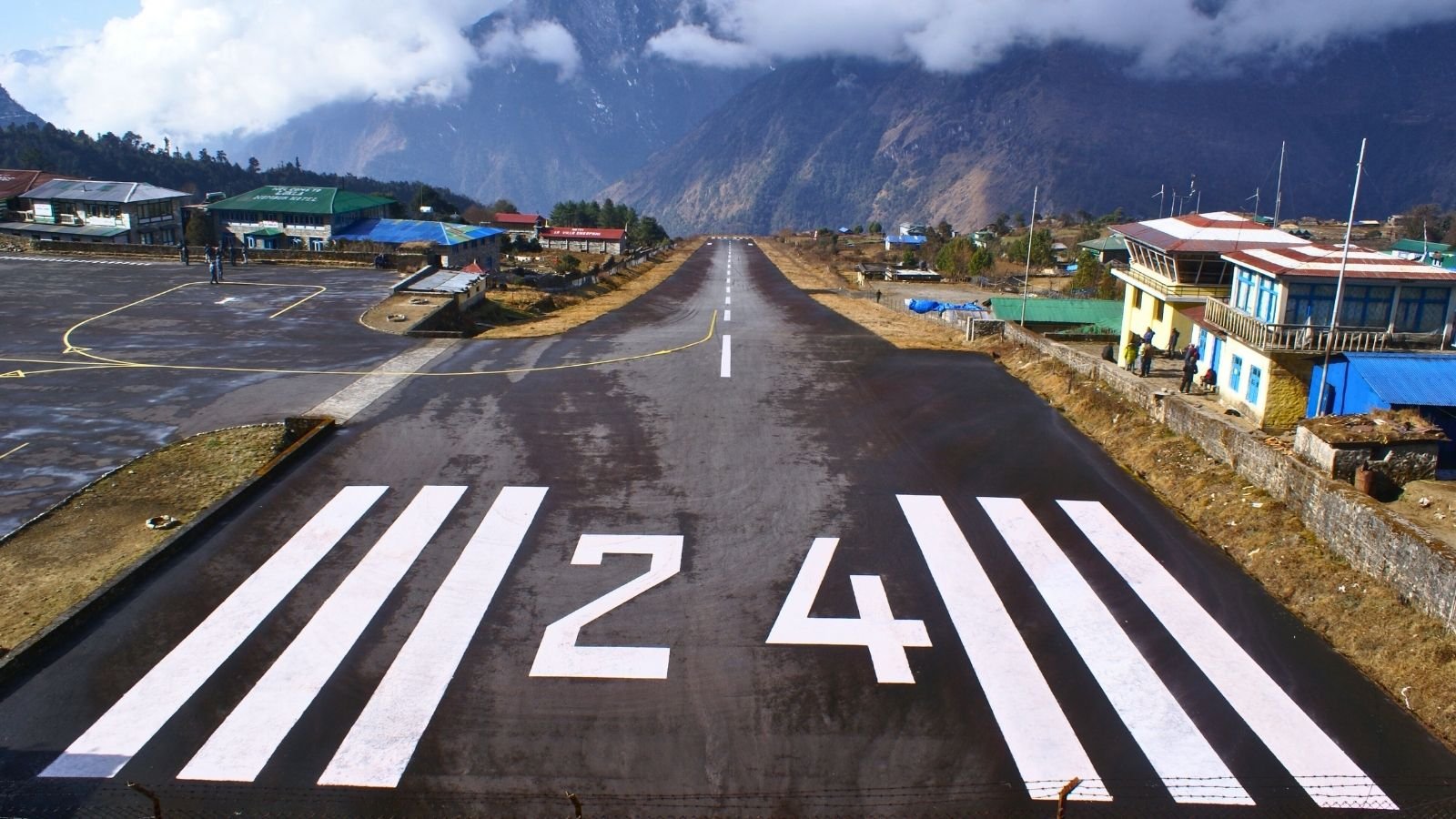
The first thing that hits you isn’t the height, although you do notice the air feeling thinner and your breath turning into short paragraphs. What gets you is how impossibly short the runway looks. It stretches for about five hundred and twenty‑seven metres. Runways at major airports are longer than entire villages, yet Lukla’s would barely qualify as a warm‑up track. One end disappears into a valley, which is a polite way of saying there is absolutely nothing there to catch you. The other end smacks straight into a mountain wall, the sort of thing you’d expect to see in a cartoon chase where the coyote realises too late that he has miscalculated.
Pilots who land here tend to be a special type. They don’t swagger about it, but the stories circulate anyway. The training requirements for landing at Lukla are famously strict and designed for those who understand that you only get one attempt. There is no circling around for another go because the runway sits uphill at about a twelve‑percent gradient and the geography simply says no. Once you commit, you’re doing it. The hill helps slow the aircraft, but only if everything goes right. When it doesn’t, well, that’s why the pilots have nerves reinforced with Himalayan realism.
Weather in the region doesn’t behave so much as improvise. It can be bright and crisp one moment, and then mist drifts in as if someone up above has nudged a fog machine out of curiosity. Clouds gather around the peaks without warning. Visibility changes faster than your phone’s screen when someone peeks over your shoulder. Many trekkers learn the hard way that flights in and out of Lukla can vanish from the schedule with all the ceremony of a disappearing magician. Entire trips have been reshaped because the mountains decided the sky was closed for the day.
The aircraft themselves add to the theatre. These are small STOL machines, usually Twin Otters or Dorniers, which feel both sturdy and slightly heroic at the same time. They handle steep climbs, short take‑offs and thin air better than most, yet passengers often swear the wing flexes more than seems decent. Reduced engine performance at this altitude means the aircraft needs determination to lift off. You feel every bump, every gust, every minor decision the pilot makes. For many, the flight is the point where their trekking adventure actually begins. It’s the prelude that weeds out the faint‑hearted.
People talk about the danger, but the community depends on this airport. Supplies, equipment, fresh produce, and an entire economy move through this tiny strip of asphalt. Without it, everything would take days of walking. For locals, the thing isn’t a novelty; it’s infrastructure. The sound of a Twin Otter circling isn’t drama. It’s groceries, medicine, relatives, opportunity. Danger may fill the headlines, but practicality fills the manifest.
Tourists, naturally, spin their own myths. There’s the belief that the airport closes half the year, which isn’t true, although the monsoon season certainly makes pilots consider their choices with extra care. There’s the idea that only adrenaline seekers fly there, yet most passengers are simply trekkers who booked a package and now find themselves praying the clouds cooperate. Then there’s the rumour that the approach is performed blindfolded, which is absurd, but you can see how the legend might have arisen. The terrain forces pilots to approach through a narrow valley corridor, turn at the last possible moment, and commit to the runway whether they like it or not.
Incidents have, of course, influenced its reputation. A few crashes over the decades carved the airport’s myth into stone. These events weren’t frequent, but each one shook the aviation world because the circumstances made them feel personal. Poor visibility, sudden downdrafts or simple bad luck at Lukla can’t be solved with the usual array of modern instruments. There is no full instrument landing system. Pilots rely on their skill, judgement and an airport team that knows every weather quirk the mountain can conjure.
Ironically, the rules and procedures have become stricter over time. The airport used to operate more freely, with varying levels of caution depending on who was flying. Now it follows tight restrictions. Flights are scheduled in the early morning because winds tend to be calmer. Aircraft types are controlled. Pilots undergo specific checks. Travellers sometimes interpret this as unnecessary bureaucracy, but when you’ve watched weather flip itself inside out, you start appreciating rules.
For many visitors, the anxiety of landing melts into excitement as soon as the wheels touch the ground. It’s usually the moment when adventure becomes real. People step out into cold air and realise Everest Base Camp, or at least the first step towards it, lies just beyond the terminal door. Trekkers pose for triumphant photos in front of the airport sign. Guides gather their groups. Porters organise luggage with the steady precision of people who know exactly what the mountains demand.
The airport’s position in the trekking industry also tells a story about ambition. Decades ago, reaching the Khumbu region required long, exhausting overland travel. The airport opened the way to mass tourism, for better or worse. Entire villages transformed around the flow of travellers. Lodges expanded. Shops appeared. Connectivity increased. Lukla became not just a physical gateway, but an economic one.
There’s a certain irony in the fact that such a perilous place has become a symbol of accessibility. Without it, many people would never experience the mountains beyond postcards or documentaries. Yet the same mountains shape every second of the airport’s operations. They allow passage but on their terms.
Travellers planning the journey often find themselves obsessing over the weather forecast, checking apps that rarely agree. Guides tell them to keep buffer days at the end of the trek, and they nod politely while secretly hoping to be the exception. It never quite works out that way. The mountains don’t offer exceptions. Seasons shift. Clouds take their time. Everyone learns patience.
There’s also a quiet pleasure in watching seasoned pilots walk across the apron. They move with the grounded confidence of people who have made peace with the mountain’s whims. They greet the staff, inspect the aircraft, nod at the sky as if checking whether the mountains are in a cooperative mood. Passengers see the gesture and feel an odd surge of reassurance.
Many travellers recall the departure more vividly than the landing. Taking off downhill, watching the runway race beneath you before the valley swallows the aircraft in open space, is a moment that reaches straight into your stomach. The plane dips slightly before climbing hard, engines working with a determination you can feel through the seat. Then everything smooths out and the view, if the weather allows, becomes unreal. Peaks stretch beyond the horizon. Clouds swirl around the ridges. For a few minutes, fear and awe sit comfortably together.
Some propose improving the airport, perhaps extending the runway or installing more advanced systems. Engineers typically respond with a polite version of are you joking? The entire valley conspires against such ambitions. Extending the runway would mean reshaping the mountain, which isn’t keen to cooperate. Installing high‑tech landing systems would require stable conditions that rarely exist. The airport operates in a delicate balance of possibility and limits.
Yet there is something admirable about the way it functions. It’s a reminder that not all infrastructure needs to be modern to be essential. Sometimes a place succeeds because the people around it understand its constraints better than any machine could. Lukla airport works because a community of pilots, staff and locals treat it with respect rather than complacency.
Visitors sometimes say they survived Lukla, which is a dramatic way to phrase what is, for the most part, a routine short flight handled by experts. But the sentiment speaks to the airport’s mythology. It offers a taste of vulnerability in a world where travel usually feels over‑organised. People step onto the tarmac knowing they’ve crossed a threshold. Something about that stays with them.
Anyone heading to the Everest region inevitably passes through Lukla, unless they choose days of trekking from alternative entry points. Most don’t. The airport promises speed, drama, a story to tell, and the chance to begin a journey in one of the world’s great landscapes. It remains a place of extremes, but also one of connection.
In the end, Lukla isn’t dangerous for the sake of danger. It’s simply a place shaped by geography, weather and necessity. It doesn’t pretend otherwise. The runway rises into the mountains like a challenge. The aircraft descend with purpose. The pilots walk with quiet confidence. And the mountains watch over everything, deciding moment by moment who may pass.
That’s what makes it unforgettable, and why so many travellers step back onto solid ground with a grin that says they’ve just experienced something rare. The runway might be short, but the memory stretches far.
Photography: Moralist