Why London Rarely Sees the Northern Lights
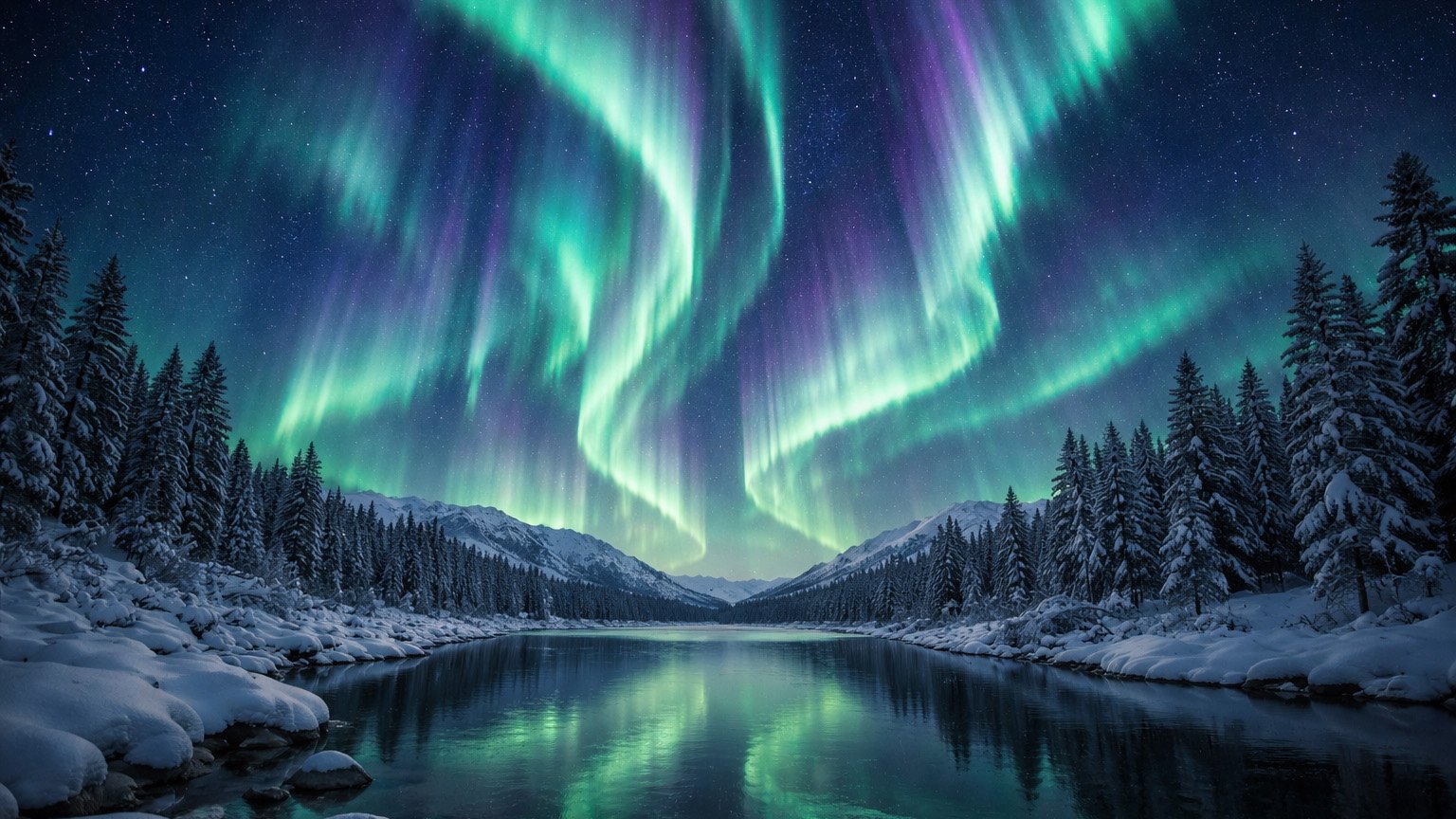
The first time you see the northern lights (aurora borealis), the instinct is to look for a source. Something must be projecting this, surely. A hidden spotlight behind the horizon, a trick of atmosphere, a clever illusion staged by a planet with a sense of theatre. Instead, what you are watching is the Earth itself quietly negotiating with the Sun.
That negotiation does not happen everywhere equally. Some places sit right in the middle of the conversation, while others, like London, barely hear a whisper. The difference comes down to geography, but not the sort you see on a standard map. It is a geography of invisible lines, magnetic fields, and particles that have travelled ninety million miles only to end their journey in a flicker of green light.
Start with the Sun, because this story always does. The Sun constantly releases a stream of charged particles known as the solar wind. Most of the time, it is a steady outflow, background noise on a cosmic scale. However, during solar storms, that flow intensifies dramatically. Billions of particles rush outward, carrying energy that will eventually collide with Earth’s magnetic defences.
Now imagine Earth not as a simple sphere, but as something wrapped in a protective bubble. This bubble, the magnetosphere, deflects most of that incoming energy. Without it, life would look very different. Yet the shield is not perfectly uniform. Near the poles, it opens slightly, allowing charged particles to slip through along magnetic field lines.
That is where the aurora begins. When those particles enter the upper atmosphere, they collide with oxygen and nitrogen atoms. Energy transfers, electrons jump, and when they settle back down, light is released. Oxygen tends to glow green or sometimes red, while nitrogen can produce purples and blues. It sounds almost polite, but the scale is enormous. Entire curtains of light ripple across the sky, shaped by forces that operate far above weather and clouds.
However, this still does not explain why Tromsø seems to host a nightly performance while London usually gets darkness and drizzle. The answer lies in something called the auroral oval.
The auroral oval is not a fixed ring painted onto the Earth. Instead, it is a shifting band that circles each magnetic pole. Within this band, auroral activity is most likely to occur. Think of it less as a location and more as a probability zone. If you stand inside it, you have a strong chance of seeing the lights. Step outside it, and your odds drop quickly.
Cities like Tromsø, in northern Norway, sit comfortably within this oval. Reykjavík, though slightly further south, often finds itself close enough to the action to catch regular displays, especially when solar activity increases. These places are not just geographically northern; they are magnetically well positioned. That distinction matters more than latitude alone.
London, by contrast, sits far outside the usual boundaries of the auroral oval. Even on a clear night, the magnetic field lines guiding those charged particles rarely dip low enough to reach it. The lights are happening, just not overhead. They remain confined to higher latitudes, tracing arcs that never quite extend far enough south.
Occasionally, the Sun becomes more dramatic. During strong solar storms, the auroral oval expands. It stretches toward lower latitudes, and suddenly places that almost never see the phenomenon get a brief, surreal glimpse. In those moments, London might catch a faint glow on the horizon, or a washed-out green haze that feels more like a rumour than a spectacle. Social media fills with excitement, photos circulate, and for a night or two, the city joins the conversation.
Yet even then, the experience is different. In Tromsø, the lights move overhead, dynamic and immersive. In London, they tend to linger low in the sky, diluted by distance and often by light pollution. Urban brightness competes aggressively with subtle atmospheric colour, and the result rarely wins.
There is also a seasonal rhythm to all of this. The northern lights favour long, dark nights, which is why winter becomes the prime viewing season. However, this is not because the aurora disappears in summer. It continues as usual, but the midnight sun washes out the display. Darkness, in this case, is not a limitation but a requirement.
Weather, of course, adds another layer of uncertainty. Clear skies are essential, which is why regions with stable winter conditions often outperform places with frequent cloud cover. Northern Norway, parts of Iceland, and inland areas of Scandinavia benefit from this balance. They combine proximity to the auroral oval with relatively reliable viewing conditions.
Meanwhile, geomagnetic activity follows its own cycles. The Sun operates on roughly an eleven-year cycle of increasing and decreasing activity. During solar maximum, auroras become more frequent and more intense. The oval expands more often, and sightings at lower latitudes become slightly less rare. Even then, though, geography does not lose its influence. It merely relaxes its rules for a while.
There is something slightly ironic about all this precision. The aurora feels spontaneous, almost whimsical, yet it obeys a strict set of physical constraints. You can predict probabilities, track solar wind speeds, and map magnetic field interactions with impressive accuracy. And still, when the lights appear, they feel like a surprise.
That tension is part of the appeal. Travellers head to Tromsø or Reykjavík not because the lights are guaranteed, but because they are likely. The uncertainty becomes part of the experience. People wait in the cold, check forecasts, scan the sky, and hope. When it works, the reward feels disproportionate to the effort, as though the planet has briefly decided to perform.
London, meanwhile, remains mostly an observer from afar. It hears about the lights, occasionally glimpses them, but rarely hosts them. The city sits outside the main corridor of interaction, geographically ordinary in a story that favours the extremes.
And that is the quiet logic behind the geography of light. It is not about north versus south in the usual sense. It is about alignment with invisible structures that shape how energy moves around the planet. Stand in the right place, and the sky becomes a stage. Stand elsewhere, and the performance carries on without you.
Post Comment
You must be logged in to post a comment.