Why Germ Theory Sounded Absurd to 19th-Century Doctors
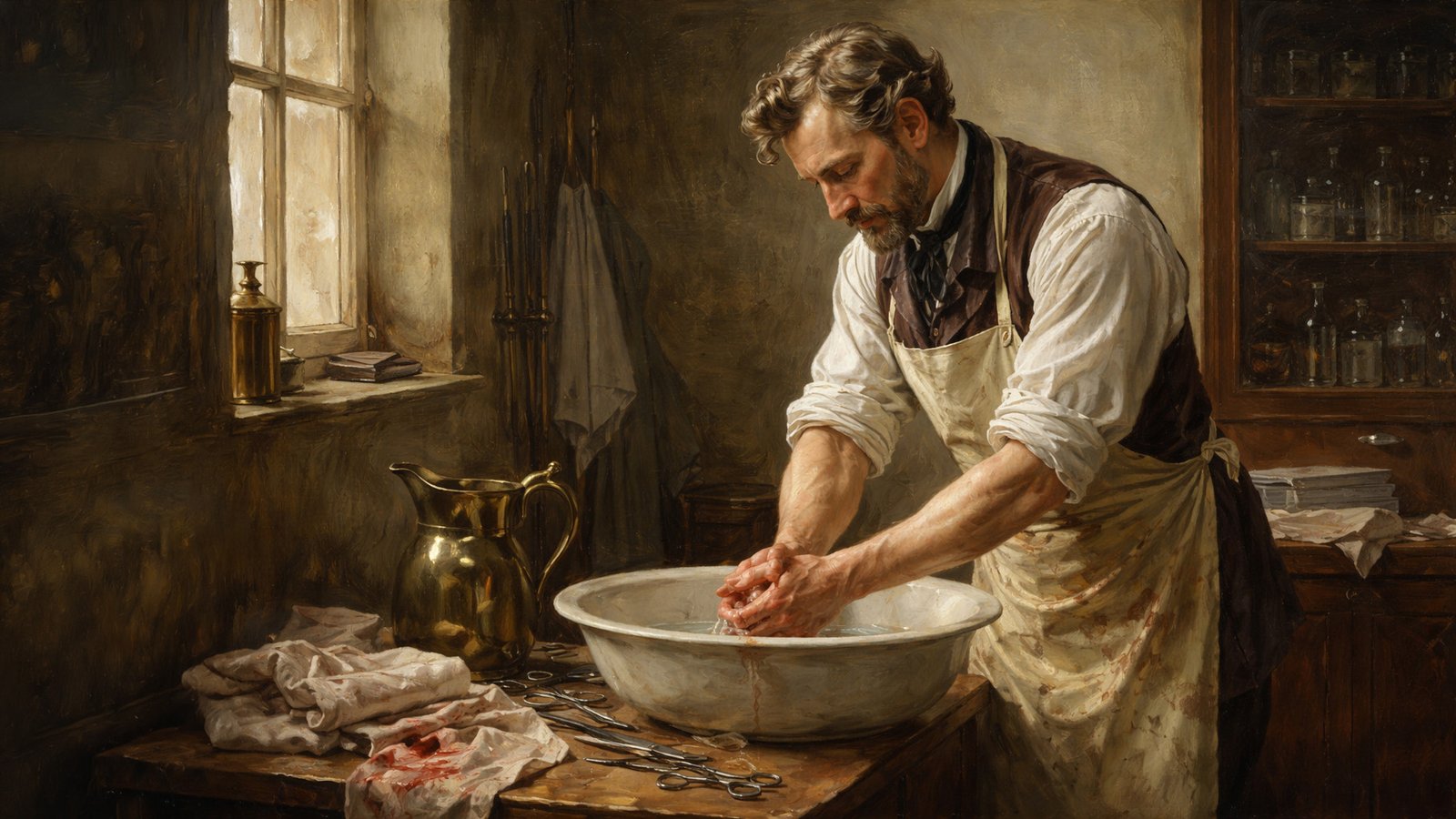
For much of the nineteenth century, medicine lived in a world where danger had a smell. Disease seemed to creep in on foul air, lurk in damp basements, and rise from rotting waste. As a result, if a place stank, it felt unhealthy. Conversely, if it smelled fresh, it felt safe. That assumption appeared so obvious that few doctors felt any urge to question it. Against this background, the idea of germ theory sounded not merely wrong, but faintly ridiculous.
At the same time, doctors did not see themselves as enemies of progress. On the contrary, many believed they already practised modern, rational science. They read classical texts, quoted Galen with ease, and attended lectures in imposing halls. Moreover, they wore black coats that signalled seriousness and authority. Experience mattered, hierarchy mattered, and tradition mattered most of all. Medicine, therefore, did not reward radical explanations, especially when those explanations arrived from outside its inner circle.
At the heart of nineteenth-century medicine sat the miasma theory. According to this view, diseases such as cholera, typhus, and plague arose from poisonous vapours released by decaying organic matter. These vapours corrupted the body once inhaled. Crucially, the theory aligned neatly with everyday observation. Epidemics thrived in crowded cities. Poor neighbourhoods smelled dreadful. Marshes produced fever. Clean air felt restorative.
Because of this apparent coherence, the theory offered practical guidance. Improve ventilation. Remove waste. Widen streets. Drain swamps. In many cases, these measures genuinely reduced disease. Consequently, miasma theory became deeply entrenched. It shaped urban planning, hospital design, and public health policy. Medical textbooks repeated it confidently, while senior physicians taught it as settled fact. Any alternative explanation, therefore, had to fight not only scepticism, but institutional momentum.
Germ theory entered this world awkwardly and without manners. Instead of bad air, it blamed microscopic organisms for disease. These organisms invaded the body, multiplied, and caused damage. Yet they could not be seen with the naked eye. They had no smell. They offered no immediate sensory warning. To many doctors, this sounded closer to folklore than science.
Although microscopes existed, most physicians did not trust them. Early instruments distorted images, required skill, and produced results that varied between observers. In addition, microscopy belonged more to natural philosophy and chemistry than to bedside medicine. Surgeons and physicians prided themselves on direct observation of patients, not on peering down lenses at unfamiliar wriggling shapes.
Beyond technical doubts, resistance ran deeper. Germ theory challenged professional identity. If invisible organisms caused disease, then traditional explanations lost authority. More unsettling still, accepted medical practices fell under suspicion. Bloodletting, purging, unwashed hands, reused instruments, and filthy wards no longer looked neutral. Instead, they began to look dangerous.
This tension explains why the story of Ignaz Semmelweis remains so uncomfortable. Working in Vienna in the 1840s, he noticed that women giving birth in wards staffed by doctors died of childbed fever far more often than those attended by midwives. Gradually, he traced the difference to a single habit. Doctors performed autopsies, then moved directly to the maternity ward without washing their hands.
In response, Semmelweis ordered handwashing with a chlorinated solution. The results proved immediate and dramatic. Mortality rates collapsed. Numbers replaced theory. Lives were saved. Nevertheless, instead of praise, Semmelweis encountered ridicule and hostility. Colleagues dismissed his findings as coincidence. Others took offence at the suggestion that gentlemen doctors were responsible for deaths.
The deeper problem lay in explanation. Semmelweis could show that handwashing worked, yet he could not explain why in terms his peers accepted. He spoke of particles from corpses rather than bacteria. Without a recognised theoretical framework, his results felt threatening instead of enlightening. Evidence alone, therefore, failed to overturn hierarchy.
Elsewhere, similar patterns emerged. When Louis Pasteur demonstrated that microorganisms caused fermentation and spoilage, his work attracted attention, but also suspicion. Pasteur was a chemist, not a doctor. Consequently, many physicians viewed his laboratory experiments as clever but irrelevant to human illness.
Pasteur’s insistence that invisible organisms caused disease struck some as an invasion of medical territory. Biology and chemistry appeared to be instructing medicine how to think. That reversal of authority sat uneasily with established professionals.
Even after germ theory gained intellectual traction, applying it in practice remained difficult. Hospitals continued to function as dangerous places. Surgeons operated with bare hands and wore blood-stiffened coats as badges of experience. Instruments moved from one patient to another without cleaning. Infection, therefore, seemed an unfortunate but inevitable consequence of surgery.
Joseph Lister attempted to disrupt this fatalism. Influenced by Pasteur, he introduced antiseptic techniques using carbolic acid to clean wounds and operating environments. Once again, results improved. Infection rates fell, and survival increased. Predictably, resistance followed.
Some surgeons complained that antiseptics irritated their skin. Others found the procedures slow and inconvenient. Many insisted their personal skill mattered more than any theoretical concern about microbes. Surgery, they argued, succeeded through expertise rather than cleanliness.
Behind these objections lay something more human. Germ theory suggested that success depended not only on talent, but also on humility. It implied that even the best surgeon could fail if invisible forces were ignored. That idea threatened pride as much as tradition.
Meanwhile, public health reforms complicated matters further. Cities introduced sewage systems, clean water supplies, and organised waste removal. Mortality rates fell. Supporters of miasma theory pointed to these successes as confirmation that bad air caused disease. In reality, sanitation reduced exposure to pathogens, but the conceptual shift had not yet occurred.
As a result, germ theory often appeared unnecessary. If cleaning streets worked, why invoke microscopic speculation? Practical outcomes masked theoretical disagreement, allowing scepticism to linger.
Medical education reinforced this inertia. Students learned by memorising accepted knowledge rather than challenging it. Examinations rewarded conformity. Professors controlled careers. Consequently, young doctors who questioned orthodoxy risked ridicule or isolation. In such an environment, caution felt sensible.
By the late nineteenth century, however, evidence accumulated too heavily to ignore. Improved microscopes revealed bacteria with clarity. Culturing techniques linked specific organisms to specific diseases. Vaccination demonstrated targeted prevention. Antiseptic, and later aseptic, surgery transformed hospitals from death traps into places of recovery.
Gradually, laughter faded. Germ theory moved from fringe idea to medical foundation. Handwashing became routine. Sterilisation became standard. Invisible killers gained names, shapes, and life cycles. What once sounded absurd became obvious.
Yet the delay cast a long shadow. Millions died in hospitals from preventable infections. Childbirth remained dangerous far longer than necessary. Surgical progress stalled beneath the weight of tradition. These costs rarely feature in triumphant stories of scientific progress, but they matter.
Looking back, judgement feels easy. However, the history of germ theory concerns authority more than ignorance. It shows how professional identity, social hierarchy, and intellectual comfort shape what people accept as reasonable.
Germ theory demanded several uncomfortable admissions. Doctors could not rely on their senses alone. Long-trusted practices caused harm. Outsiders using unfamiliar tools might understand disease better than experienced clinicians. Unsurprisingly, that combination provoked resistance.
In this light, the laughter makes grim sense. Mockery acted as a defence. By ridiculing invisible killers, doctors protected their worldview and status. The cost of being wrong felt higher than the cost of delay.
The story also reveals something enduring about science itself. Evidence rarely speaks alone. Data require interpretation, and interpretation happens inside social systems. New ideas do not triumph simply because they are true. Instead, they succeed when institutions, incentives, and identities realign.
Today, germ theory feels almost banal. Children learn it at school. Hand sanitiser stands by every doorway. Yet its history remains a warning. What sounds absurd in one era may later define common sense. Expertise, therefore, can become a barrier as easily as a guide.
The invisible killers were always present. What changed was not their existence, but our willingness to take them seriously.