Asia is losing forests faster than you think
Asia is losing its forests at a speed that still surprises people who assume the real damage happens elsewhere. The Amazon dominates headlines, while the Congo gets periodic attention. Meanwhile, the most intense and compressed forest loss of recent decades has unfolded across Asia, often in plain sight. Satellites record it year after year, governments acknowledge it, and the consequences arrive fast, visible, and difficult to reverse. At the heart of deforestation in Asia sits an uncomfortable reality.
The region combines almost every pressure forests dislike, all at once. Population density leads the list. More than half of humanity lives here, and forests rarely sit in distant wilderness zones. Instead, they exist beside villages, plantations, highways, ports, and swelling cities. In many places, forest is not a frontier. Rather, it is the last remaining patch between one human activity and the next.
Because of that proximity, deforestation rarely unfolds slowly. When land-use change begins, it tends to arrive fully formed. Roads appear, heavy machinery follows, processing facilities open, workers move in, and markets wait nearby. As a result, forests disappear decisively rather than gradually. This compression of change explains why the region feels as though it is losing trees faster than anywhere else, even when total forest area remains smaller than in South America or Africa.
The economic logic behind this loss is brutally simple. Land in Asia holds immediate value because people need it now. Forests compete with farms, housing, infrastructure, and export crops in places where land scarcity is normal. When a hectare can feed a family, employ workers, or generate foreign currency, trees struggle to make a convincing counter-argument.
Palm oil reshaped the tempo of forest loss more than any other single factor. Once oil palm proved how productive it could be per hectare, especially in humid tropical climates, large areas of forest became economically obsolete almost overnight. The crop promised fast returns, predictable yields, and strong global demand. Consequently, governments saw export revenue, rural communities saw wages, investors saw scale, and forests saw clearance.
Unlike selective logging, oil palm usually involves total conversion. Trees go, peat drains, soil compacts, and ecosystems collapse into uniform rows. Because the change is so complete, recovery becomes extremely difficult without major intervention. This is why Southeast Asia’s forest losses appear so stark from space. They are not subtle. They are geometric.
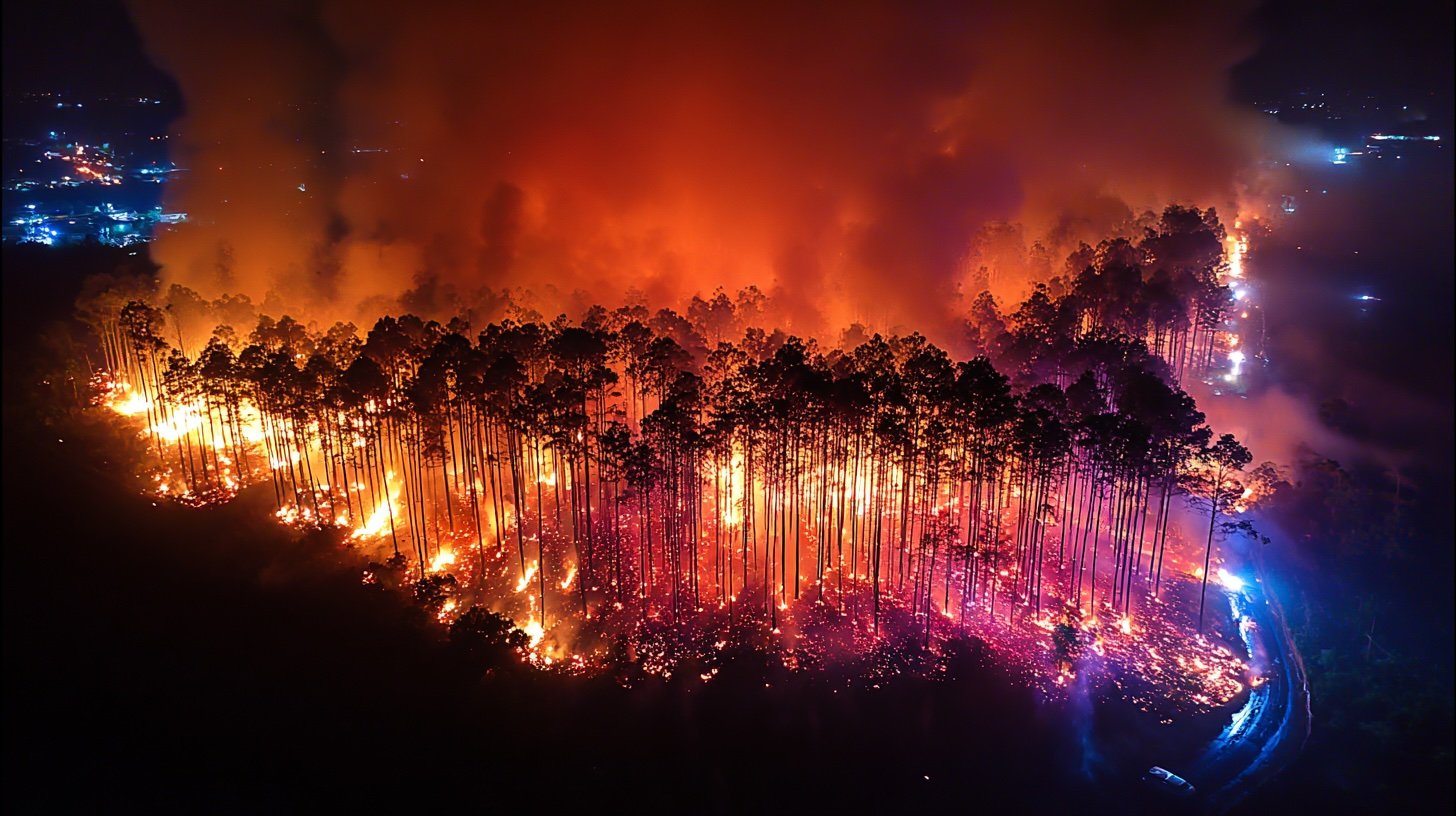
Fire adds another layer of speed and damage. In peat-rich regions, drained forests behave differently from most ecosystems. Fires do not simply burn along the surface. Instead, they smoulder underground for weeks or months, killing trees, releasing vast quantities of carbon, and leaving soil sterile. Even areas that were not deliberately cleared can vanish once fire takes hold.
The seasonal haze that spreads across borders makes deforestation impossible to ignore. Schools close, flights stop, and hospitals fill. What may begin as a land-clearing shortcut soon turns into a regional public-health crisis. Yet enforcement remains inconsistent because fire is cheap, fast, and difficult to trace back to individual responsibility.
Land governance sits at the centre of the issue. Across much of Asia, forest boundaries exist clearly on paper but not always on the ground. Land titles overlap, customary rights clash with state claims, and permits sometimes appear retroactively. Meanwhile, local officials face pressure from both communities and investors. In that environment, forests rarely benefit from uncertainty. Ambiguity usually favours whoever arrives first with capital and equipment.
This does not mean Asian governments ignore conservation. On the contrary, many promote ambitious forest protection targets, reforestation schemes, and climate commitments. However, enforcement gaps persist between policy and practice. When rural livelihoods depend on land conversion today, while conservation benefits arrive decades later, rules struggle to hold their ground.
Fragmentation makes matters worse. Asian forests tend to be smaller, more broken, and more tightly interwoven with human activity than those in other tropical regions. As a result, they are biologically rich but ecologically fragile. Once roads slice through forest, edge effects multiply, and species that rely on continuous canopy disappear quickly. Biodiversity often collapses long before the last tree falls.
Mountainous terrain amplifies the damage. In monsoon climates, deforestation rapidly destabilises slopes. Soil erodes, landslides follow heavy rain, and flooding intensifies downstream. Communities that cleared land for survival often become more vulnerable as a result, which reinforces cycles of poverty and further environmental stress.
Global demand quietly drives much of this loss. Timber, paper, palm oil, rubber, minerals, and agricultural commodities flow from Asia to markets that rarely see the forests they replace. From a distance, consumption feels abstract. On the ground, it feels inevitable. Even countries that restrict domestic logging often import forest-linked products from neighbours, shifting pressure rather than removing it.
Urbanisation also plays a decisive role. Asia’s cities grow fast and outward. Infrastructure corridors cut through forested areas to connect ports, industrial zones, and energy projects. Once access exists, land values change overnight. Consequently, forest protection becomes harder, not because of malice, but because opportunity arrives faster than planning can respond.
Small, everyday consumption habits add quieter pressure. Disposable products, packaging, and low-value wood items do not clear rainforests on their own. Still, at the scale of billions of consumers, even minor demand reinforces extraction systems already under strain. These choices rarely dominate deforestation statistics. Even so, they normalise a culture of disposability that forests ultimately pay for.
Disposable chopsticks illustrate this logic neatly. They are not a primary driver of deforestation in Asia, yet their sheer scale makes them environmentally awkward. Billions of pairs are used every year, largely for convenience rather than necessity. Most come from fast-growing bamboo or plantation wood rather than old-growth forest, which limits the damage. However, when demand rises faster than sustainable management, harvesting still strips hillsides, simplifies ecosystems, and replaces mixed landscapes with single-species production. Chopsticks do not cause forest loss on their own. Instead, they act as a multiplier, embedding routine extraction into everyday life and making forest use feel invisible, normal, and endlessly replaceable.
Climate change complicates everything further. Hotter temperatures and shifting rainfall patterns stress forests already fragmented by roads and plantations. Droughts increase fire risk, while extreme weather accelerates tree mortality. In this context, deforestation not only removes carbon sinks but also weakens ecosystems precisely when resilience matters most.
Reforestation efforts offer some hope, yet they come with caveats. Tree-planting programmes often prioritise speed and numbers over ecological complexity. Monoculture plantations may increase canopy cover on paper while offering little biodiversity value. As a result, forests return statistically but not functionally.
This creates a misleading sense of balance. A hectare planted does not replace a hectare of primary forest lost. Old ecosystems hold carbon, species, and cultural meaning that new plantations cannot replicate for generations, if ever. Counting trees without counting quality risks understating the true cost of deforestation in Asia.
Still, it would be wrong to frame the region as uniquely careless. The pressures here are structural. High population density, rapid economic growth, export dependence, and limited land all push in the same direction. Where other regions can afford to pause, Asia rarely can.
Slowing deforestation in Asia therefore demands more than protected areas and satellite monitoring. It requires credible rural livelihoods that do not rely on forest clearance. It requires land rights that communities can trust. And it also requires supply chains that reward conservation rather than speed. Above all, it requires time, something Asia’s forests have very little of.
Deforestation in Asia is not a story of ignorance or neglect. Instead, it is a story of usefulness. Forests fall because they are valuable, accessible, and surrounded by people who need land now, not later. Understanding that tension remains the first step toward any solution that hopes to last.