Who Were The Etruscans, Really?
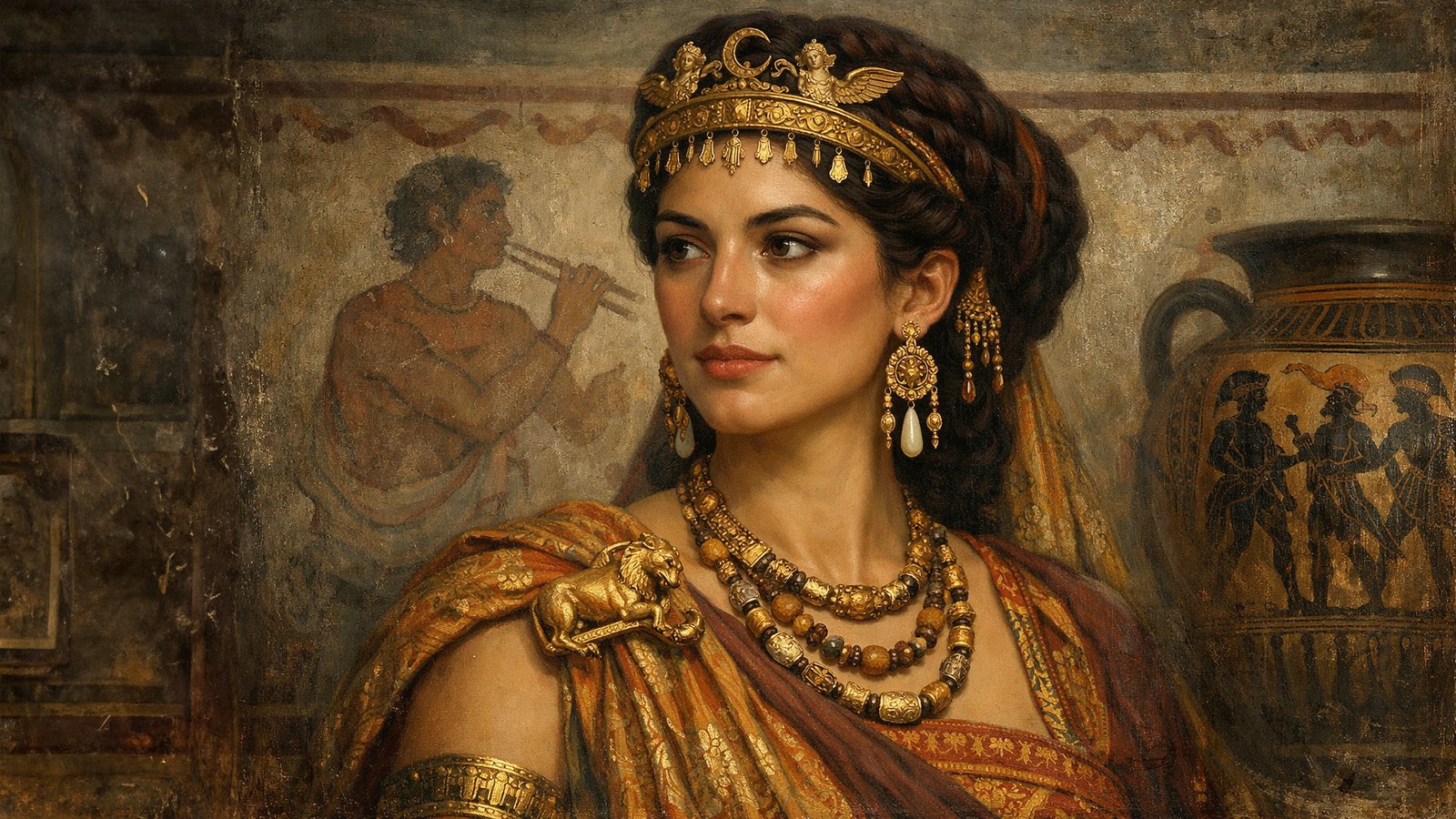
The Etruscans sit in an awkward place in European history. They were not marginal, nor were they short-lived. Yet they remain oddly undefined, like a civilisation that forgot to leave a forwarding address. They ruled central Italy for centuries, built wealthy cities, shaped Rome’s earliest institutions, and then vanished so thoroughly that even their own origins remain an argument rather than a fact.
Ask a simple question about where the Etruscans came from and the answers begin to contradict each other almost immediately. Ancient historians disagree, while archaeology points one way and linguistics points another. Meanwhile, DNA studies complicate everything further. Instead of converging, the evidence spreads outward, as if the Etruscans themselves were quietly resisting classification.
They appear in the historical record around the early first millennium BCE, occupying what is now Tuscany and parts of Lazio and Umbria. Their cities were independent, competitive, and wealthy. Moreover, they traded aggressively across the Mediterranean, exported metals, imported Greek pottery by the shipload, and buried their elite in tombs that resemble furnished apartments rather than graves. At the same time, Rome was still a junior neighbour watching closely.
Despite this prominence, the Etruscans never left a single text explaining who they were or where they believed they came from. No foundation myth survives, no migration story remains, no heroic ancestor leads the people across mountains or seas. Instead, their past must be reconstructed through fragments: tomb paintings, short inscriptions, foreign commentary, and the uncomfortable silence between them.
Ancient writers noticed this silence too, and accordingly tried to fill it. Some assumed the Etruscans must have come from elsewhere because they felt too strange to be native Italians. Their customs appeared unusual. Their religion felt excessive. And their language sounded foreign. For Greek observers, therefore, difference demanded an explanation, and the most satisfying explanation involved a journey.
The most famous version of that journey comes from Herodotus, writing centuries after the events he describes. He claimed that the Etruscans originated in Lydia, in western Anatolia, and that a devastating famine forced part of the population to leave. According to his account, the migrants sailed west under a leader named Tyrrhenus and eventually settled in Italy. It is an elegant explanation that neatly accounts for the Etruscans’ strangeness and adds a touch of narrative drama. However, it also sits uneasily with the physical evidence, which stubbornly refuses to show any clear sign of such a journey ever having taken place.
Archaeology, which deals in soil rather than stories, tells a quieter tale. The material culture of central Italy shows strong continuity from the earlier Villanovan period into what is recognisably Etruscan society. Settlements do not vanish and reappear. Burial customs evolve rather than reset. Crucially, there is no clear moment when newcomers replace locals.
Because of this, the idea of a large-scale migration becomes difficult to support. There is no trail of Anatolian pottery marking a route. No abandoned settlements suggest displacement. Instead, the landscape looks busy and uninterrupted. Consequently, many archaeologists argue that the Etruscans emerged locally, shaped by long-term interaction rather than sudden arrival.
Language, however, refuses to cooperate with this conclusion. Etruscan is not related to Latin, nor is it related to Greek. It does not fit into the Indo-European family that dominates Europe. While it can be read aloud thanks to its Greek-derived alphabet, its deeper structure remains elusive. Vocabulary lists remain incomplete, and grammar rules feel provisional.
This linguistic isolation unsettles scholars. It implies either a very old language surviving against the odds or a population that arrived carrying its speech without leaving obvious physical traces. Neither option feels comfortable. As a result, researchers must choose which type of evidence they trust more.
Some linguists propose a small family of related languages, sometimes called Tyrsenian, linking Etruscan to inscriptions found in the Alps and on the island of Lemnos in the Aegean. In that case, the language would point to deep prehistoric connections spread across southern Europe. Even so, it still fails to indicate a clear homeland. It suggests age rather than direction.
Genetics entered the debate with the promise of resolution. Early DNA studies, working with limited samples, hinted at links between Etruscan remains and populations from the eastern Mediterranean. Unsurprisingly, headlines followed. Migration theories resurfaced with renewed confidence. For a brief moment, it seemed biology might settle what historians could not.
Larger and more recent studies tempered that optimism. When broader datasets were analysed, the Etruscans appeared genetically similar to their Italian neighbours, including later Roman populations. Continuity, not replacement, dominated the data. In other words, whatever their language, their DNA looked local.
This result created an awkward paradox. The Etruscans appear genetically indigenous yet linguistically foreign. Normally, languages and genes travel together. Here, they seem to have taken different routes. Therefore, scholars increasingly point to social dominance, cultural inheritance, or the survival of an older linguistic layer beneath newer populations.
Archaeology reinforces this sense of continuity. Etruscan cities show steady growth rather than abrupt foundation. Their wealth comes from trade networks, metal resources, and strategic geography. Although they adopted Greek artistic styles enthusiastically, they reshaped them in distinctly local ways. Nothing in their material culture suggests invasion.
Their tombs offer another revealing perspective. Painted scenes depict banquets, music, athletics, and intimate domestic life. Women appear prominently, dining alongside men and named in inscriptions. As a result, Greek and Roman observers found Etruscan society unsettling. These images reflect values that feel deeply embedded rather than hastily imported.
Religion complicates matters further. The Etruscans developed an elaborate system of divination, interpreting lightning, entrails, and omens with obsessive precision. Later Romans both relied on and mocked these practices. On the one hand, they consulted Etruscan specialists. On the other, they portrayed them as excessively ritualistic.
This Roman discomfort reveals something essential. Rome inherited vast amounts of Etruscan knowledge, including symbols of authority, urban planning techniques, and ceremonial rituals. At the same time, Roman writers worked hard to frame the Etruscans as an earlier and morally suspect culture. Absorption, therefore, was followed by quiet erasure.
As Rome expanded, Etruscan political independence collapsed. Cities lost autonomy, while Latin replaced Etruscan in public life. Over generations, the language faded from daily use. By the early Imperial period, it survived mainly in religious formulae and scholarly curiosity. A civilisation that shaped Rome’s beginnings disappeared into Rome’s success.
What remains today is a puzzle assembled from mismatched pieces. Archaeologists see locals becoming complex. Linguists see isolation and antiquity. Geneticists see continuity with a twist. Meanwhile, ancient historians offer stories that satisfy narrative instincts yet resist verification.
The frustration lies in the refusal of these strands to align. Usually, evidence converges over time. In this case, it does not. Instead, it highlights how identity works differently across biology, culture, and language. People can inherit one without inheriting the others.
Perhaps the Etruscans were never a single answer waiting to be discovered. Instead, they may have been a mosaic from the start, formed through centuries of contact, adaptation, and selective memory. If so, their ambiguity becomes the most honest thing about them.
Modern fascination with the Etruscans reflects a broader discomfort with uncertainty. We prefer origins that can be mapped, dated, and labelled. Yet the Etruscans resist that urge. Consequently, they force historians to accept limits, tolerate overlap, and live with unresolved questions.
That resistance may explain why they continue to attract attention. In a Mediterranean world obsessed with lineage and myth, the Etruscans remain stubbornly undefined. They shaped history without explaining themselves, and they mattered enormously without leaving a manifesto.
In the end, asking who the Etruscans really were may miss the point. They were neither a footnote nor a mere prelude. Rather, they were a civilisation that thrived, influenced, and then dissolved into something larger. Their origins remain disputed not because evidence is missing, but because identity itself refuses to behave neatly.
The Etruscans remind us that history is not always a straight line from somewhere to somewhere else. Sometimes, instead, it is a long conversation between place, people, and time, with no final word at all.