When Laundry Meant Fire: Why Victorians Boiled Their Clothes
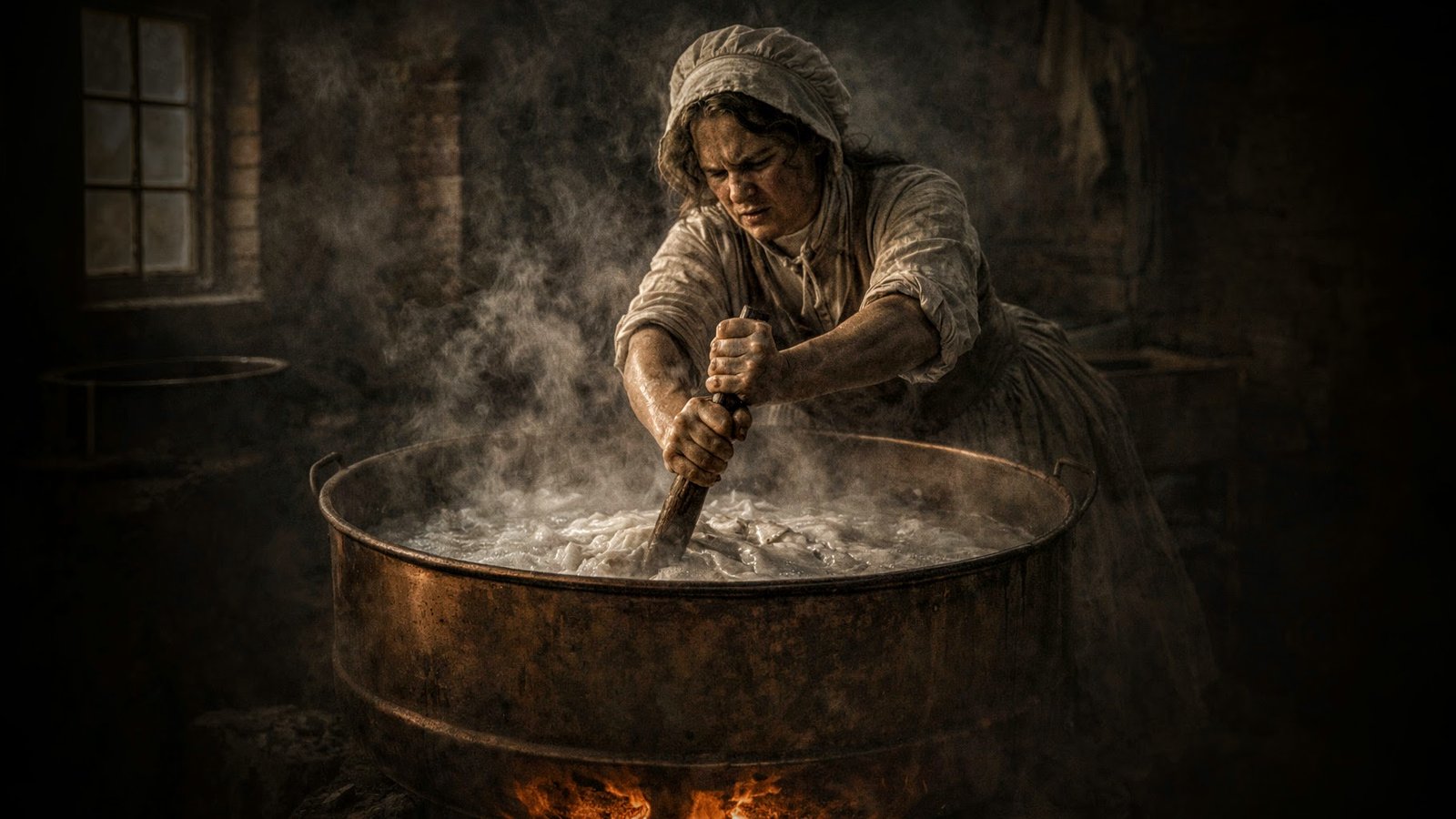
Boiling your own clothes sounds like a punishment invented by an especially vengeful appliance manufacturer. Yet for most of the nineteenth century, it was simply what sensible households did. Laundry day did not whisper efficiency or convenience. Instead, it roared, steamed, and demanded muscle. Clothes went into giant tubs of near-scalding water, stirred like stew, hauled out dripping and heavy, and only then judged clean.
In that period, the surrounding world made this logic feel obvious. Cities ran on coal. Homes burned fires from dawn to dusk. Streets were unpaved or barely improved. Horses dominated transport, and they left generous evidence behind them. As a result, smoke settled on everything. Curtains absorbed it. Shirts trapped it. Sheets collected it night after night. Cleanliness was not a default state. Rather, it was something you actively fought for.
Cold water alone stood little chance. Grease from cooking fires clung stubbornly to fibres. Sweat mixed with soot to form grime that refused to shift. Linen and cotton, the backbone of everyday clothing, were tightly woven and unforgiving. Without heat, dirt stayed put. Soap helped, of course, but Victorian soap was a blunt instrument. Often homemade from animal fat and lye, it varied wildly in strength. Because of that, heat became the reliable partner. Boiling water softened fibres, dissolved fats, and allowed soap to do its work properly.
At the same time, laundry carried moral weight. Clean linen was not just about comfort. It also spoke of respectability. A crisp shirt or fresh petticoat suggested discipline, order, and a household that knew how to manage itself. By contrast, dirty clothes implied neglect. Therefore, boiling laundry felt reassuringly thorough. You could see the steam. You could smell the change. Something visible was happening, and that visibility mattered.
Victorians did not need modern microbiology to trust heat. Long before germ theory gained acceptance, people already linked boiling with safety. Water became drinkable when boiled. Food stopped killing you when cooked properly. Consequently, it followed that clothes, especially those touched by illness, needed the same treatment. Bedding from sickrooms went straight into the copper. Shirts worn during fevers followed soon after. Boiling did not require explanation. It simply felt right.
The physical setup made this routine possible. Many homes, even modest ones, had a copper boiler built into the scullery or yard. These large metal vessels sat in brick surrounds with a fire beneath. Lighting it was the first job of washday. Water then had to be fetched, bucket by bucket. Clothes were added gradually. Someone, usually a woman or a hired laundress, stirred the mass with a long wooden dolly to keep fabrics moving and prevent scorching.
Washday dominated the week. Monday became its unofficial home. Entire households bent around it. Meals grew simpler. Children stayed out of the way if they were wise. The work lasted hours, sometimes all day. Steam soaked clothes and skin alike. Floors grew slick. Arms ached. Yet this routine repeated with little complaint, because the alternative felt worse. Dirt lingered. Smells returned. Appearances suffered.
Boiling also matched how Victorian clothing was designed. Most people did not own vast wardrobes. Instead, they relied on layers. Underclothes absorbed sweat and dirt and were meant to be punished. Shirts, chemises, drawers, collars, and cuffs took the brunt of daily wear. These pieces went into the boil regularly. Outer garments, by contrast, avoided it whenever possible. Wool coats, silk dresses, and tailored items were brushed, aired, or spot-cleaned. Their structure depended on it.
This separation explains many oddities of Victorian dress. Detachable collars existed because boiling them separately made sense. White undergarments dominated because colour rarely survived repeated boiling. Dyes faded fast. Whites, on the other hand, could be revived. Sunlight helped. Bluing masked yellowing. Together with boiling, these tricks produced the crisp brightness Victorians admired.
Naturally, the process shortened fabric lives. Boiling weakened fibres over time. Linen frayed. Cotton thinned. Clothes wore out, and people accepted this as normal. As a result, mending filled the gaps. Patching, darning, and careful reuse extended usefulness. When garments finally failed, they did not disappear. Instead, they became rags. Nothing escaped the cycle.
Smell mattered as much as appearance. Victorian homes were full of competing odours. Coal smoke, cooking fat, damp wool, and bodies in close quarters all collided. Boiling laundry stripped away much of it. Freshly washed linen smelled neutral, even faintly sweet. That absence of odour signalled cleanliness better than any scientific explanation. You could trust your nose.
The social side of boiling laundry also mattered. Neighbours noticed. Lines of white sheets and shirts flapping outdoors broadcasted competence. They suggested that a household had time, fuel, and labour to spare. In crowded urban areas, public washhouses amplified this effect. Women gathered, boiled, scrubbed, and exchanged news. Laundry became communal theatre.
Public washhouses reveal another layer of the story. Boiling laundry cost money in private homes. Fuel was expensive. Space was limited. Those without yards or boilers struggled. Municipal washhouses, which spread through cities later in the century, offered shared coppers and tubs. In doing so, they acknowledged that boiling was necessary, even for the poor. Cleanliness became a public concern.
The practice also intersected with changing ideas about health. As cholera outbreaks and other epidemics swept through cities, attention increasingly turned to cleanliness. While theories varied, washing and boiling gained authority. Doctors might argue about causes, yet they rarely argued against clean linen. As a result, boiling clothes slipped into a broader campaign to civilise and sanitise urban life.
It is tempting to frame Victorian boiling laundry as ignorance. In reality, it was adaptation. Given the tools available, the materials worn, and the environments endured, boiling made sense. It solved several problems at once. It cleaned, deodorised, reassured, and aligned with moral expectations.
Modern laundry relies on chemistry, machines, and controlled temperatures. We trust enzymes and spin cycles. Victorians trusted heat and effort. The contrast feels stark. Yet the goal remains familiar. Clean clothes still signal care. They still shape how we judge ourselves and others.
Standing over a steaming copper, stirring shirts like soup, may feel absurd now. Yet in its own time, it represented order wrestled from chaos. Boiling laundry was not a mistake waiting to be corrected. Rather, it was a logical answer to a dirty world.
Perhaps that is the most revealing detail. Victorians did not boil clothes because they enjoyed it. They did it because cleanliness mattered enough to justify the work. In an era before convenience, effort became proof. Steam rising from a copper said something had been done properly. That belief carried weight, and it lingered long after the fire died down.