What Really Happens When You Mix Garlic with Honey
Garlic and honey have been called many things over the centuries. Folk medicine heroes. Kitchen saviours. The ingredients your grandmother insisted would fix anything from a winter sniffle to heartbreak. Modern science, with all its shiny equipment and careful scepticism, now circles back to these old favourites and quietly admits that they might have been onto something. Not miracle cures, of course, but certainly not just storytelling.
The story of garlic usually starts with someone chopping a clove and instantly regretting how long the smell clings to their fingers. That sharp aroma is allicin announcing its presence. The moment garlic is crushed or chopped, its previously harmless compounds collide and create this rather volatile character. Researchers measured how fresh garlic compares to aged or fermented versions and discovered that raw garlic emerges as the stronger fighter. Allicin seems to enjoy disrupting microbes, poking holes in bacterial defences and making them decidedly uncomfortable.
One recent exploration of raw garlic showed how it managed to push back against some stubborn bacteria such as E. coli and Staphylococcus aureus. These aren’t friendly microbes, yet garlic appeared to irritate them enough to slow them down or stop them from spreading. In a world where antibiotics lose their power far too quickly, any food that has even mild antimicrobial tendencies becomes interesting. Garlic doesn’t perform dramatic rescues, but it nudges the system in directions that support health.
Aged garlic behaves differently. It spends its time mellowing out, losing the sharpness and developing new compounds. These new molecules seem calmer but surprisingly effective against biofilms, those protective microbial barricades that make infections so persistent. Researchers working with oral pathogens noticed how aged garlic disrupted these films, making it easier for other treatments to perform their tasks. It’s almost as if garlic, in its older, wiser state, learned a new trick.
None of this turns garlic into a proper antiviral medication. Its effects on viruses remain more modest, though still intriguing. Some studies hint that garlic strengthens certain immune responses, giving macrophages and natural killer cells a small performance boost. Viruses might not be impressed by garlic directly, but facing a slightly more alert immune system certainly complicates their day.
Honey enters the story with a very different temperament. While garlic storms into a room with its unmistakable scent, honey prefers charm. Darker honeys in particular carry a mixture of enzymes, minerals and plant-derived antioxidants. Several modern studies put honey under laboratory scrutiny and found surprising strength in its gentle sweetness. Honey suppresses bacteria by dehydrating them, lowering pH and producing small amounts of hydrogen peroxide. Under a microscope, it behaves like a slow, patient disciplinarian.
Comparisons between different honeys revealed striking differences. Fir honeydew honey from Central Europe showed antiviral properties that challenged even Manuka, the celebrity of the honey world. When scientists tested both types against viral surrogates, honeydew occasionally performed better. It doesn’t mean honey replaces antivirals, but it does mean honey is far from simple sugar water.
Some honeys even seem to stimulate immune pathways. Experiments with honey from the Hovenia dulcis tree showed increased activity in interferon-beta production and the cGAS–STING pathway, both important in early antiviral defence. The laboratory dishes lit up with signs that cells were preparing themselves for battle. Whether this translates to humans eating a spoonful at breakfast remains to be confirmed, but the possibility is fascinating.
Honey’s reputation for soothing sore throats remains deserved. The texture coats irritated tissue, the sugars calm the cough reflex and the gentle antimicrobial action keeps opportunistic bacteria from making themselves at home. Children’s hospitals often recommend honey in warm drinks for night-time coughs, not as a cure but as comfort.
Combining garlic and honey has become one of those home remedies that either delights or horrifies people. The mixture looks suspicious, tastes surprisingly tolerable and gives you the strange satisfaction of doing something bold for your health. Traditionally, people used it for colds, early flu symptoms and general immune support. Modern research doesn’t argue with that tradition, though it prefers the phrase complementary support.
The combination blends the best features of each ingredient. Garlic brings its bold antimicrobial compounds and potential immune stimulation. Honey contributes its soothing nature, its ability to slow bacterial growth and its unexpected antiviral quirks. The two together feel like a tiny household alliance.
What they cannot do is perform medical miracles. They will not eradicate serious infections, defeat influenza in its tracks or serve as a substitute for antibiotics or antivirals when those are necessary. Studies still rely heavily on laboratory conditions, often using high concentrations that would be impractical in a real body. Viral studies, in particular, lean on models and surrogates. Scientists always remind readers that promising does not mean proven.
Despite these limitations, the combination fits comfortably into a modern lifestyle that values simple, nutrient-rich foods. A spoon of honey at bedtime soothes a scratchy throat. A clove of raw or lightly crushed garlic in a salad brings more than flavour. Both appear to encourage the immune system to behave just a little more efficiently.
People with certain conditions need to be careful. Honey carries a high sugar load, so diabetics need to use it thoughtfully. Infants under one year must not be given honey at all. Garlic, meanwhile, can irritate the stomach if eaten in excess and may interact with blood-thinning medications. The safest approach is to view these ingredients as supportive, not medicinal.
Research continues to uncover nuances. Scientists examining biofilms become increasingly interested in how both garlic and honey interfere with them. Biofilms protect bacteria from antibiotics and immune attacks, so anything that weakens them could help future treatments. Garlic seems to disrupt biofilm formation, while honey gently corrodes their structure. This is an area where traditional foods intersect with modern medical challenges.
Cultural history adds another layer. Ancient Egyptians used garlic as part of medicinal mixtures. Greek physicians described its effects, sometimes with great enthusiasm. Honey appears in medical texts across civilisations, particularly in wound treatments. Many modern hospitals still use medical-grade honey for chronic wounds. That ancient instinct, to apply honey to keep infection at bay, turns out to have been rather practical.
In today’s kitchen, the two ingredients sit peacefully on shelves, ready to offer modest benefits without making grand promises. They join the long list of foods that support overall wellbeing but don’t claim supernatural power. Their charm lies in their accessibility. Anyone can use them, and many do so without giving it much thought. The science adds a modern sheen to what people have always known: certain foods simply help the body behave a little better.
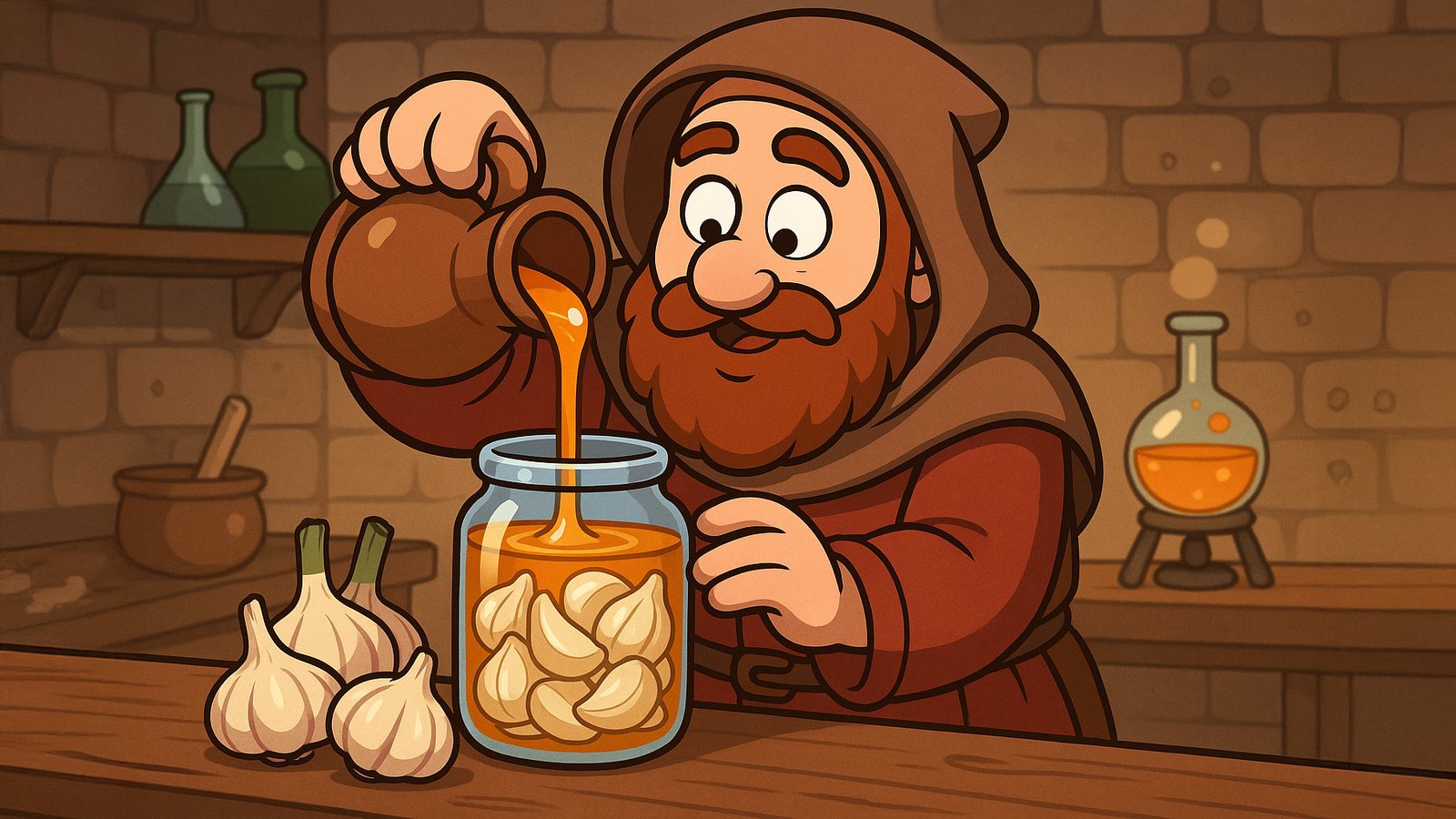
Anyone tempted to take garlic-honey mixtures daily should think about balance. Mixing a few crushed cloves with honey and letting the blend sit for a day creates a pungent tonic. Some people take a teaspoon each morning. Others prefer to spread it thinly on toast or stir a little into warm water. The ritual feels comforting, and comfort plays its own quiet role in health.
One of the motivations behind modern research into these ingredients is antibiotic resistance. As bacteria adapt to our medications, scientists search for safer, gentler tools that support treatment rather than replace it. Garlic and honey may become part of a multi-layered strategy in the future. For now, they remain everyday allies.
What stands out most from current research is not dramatic breakthroughs but the consistency of findings. Study after study describes mild to moderate antimicrobial behaviour, useful antioxidant activity and slight immune reinforcement. When multiple ingredients repeatedly show similar traits, they become interesting to medical researchers.
People often ask how much garlic or honey they need. The truthful answer is that no official dosage exists. Adding one or two raw cloves a day to food appears sensible for most adults. A teaspoon or two of honey is enough to enjoy its benefits without overloading on sugar. More isn’t automatically better. It rarely is.
For those fond of numbers, some studies used concentrations of honey above 50 percent to inhibit bacteria in laboratory dishes. You won’t replicate that concentration inside your body, but the principle remains valid. With garlic, researchers sometimes test extracts equivalent to several cloves. Again, everyday meals involve smaller amounts, and that’s perfectly fine.
Food-based support doesn’t need to be extreme. A balanced diet, adequate sleep and stress management do the heavy lifting. Garlic and honey join the cast as helpful supporting actors. They don’t demand attention, but they make the scene work better.
What becomes clear in the end is that these foods earn their place in both ancient tradition and modern curiosity. They offer a touch of antimicrobial action, a whisper of antiviral help and a noticeable boost in comfort when illness starts creeping in. Science keeps learning why, while people simply enjoy the taste.
So the next time someone hands you a garlic-honey tonic, you can smile knowingly. It isn’t a miracle potion, but it isn’t nonsense either. It’s a small, fragrant reminder that some everyday ingredients carry more character than we realise.