What really caused the Bronze Age Collapse?
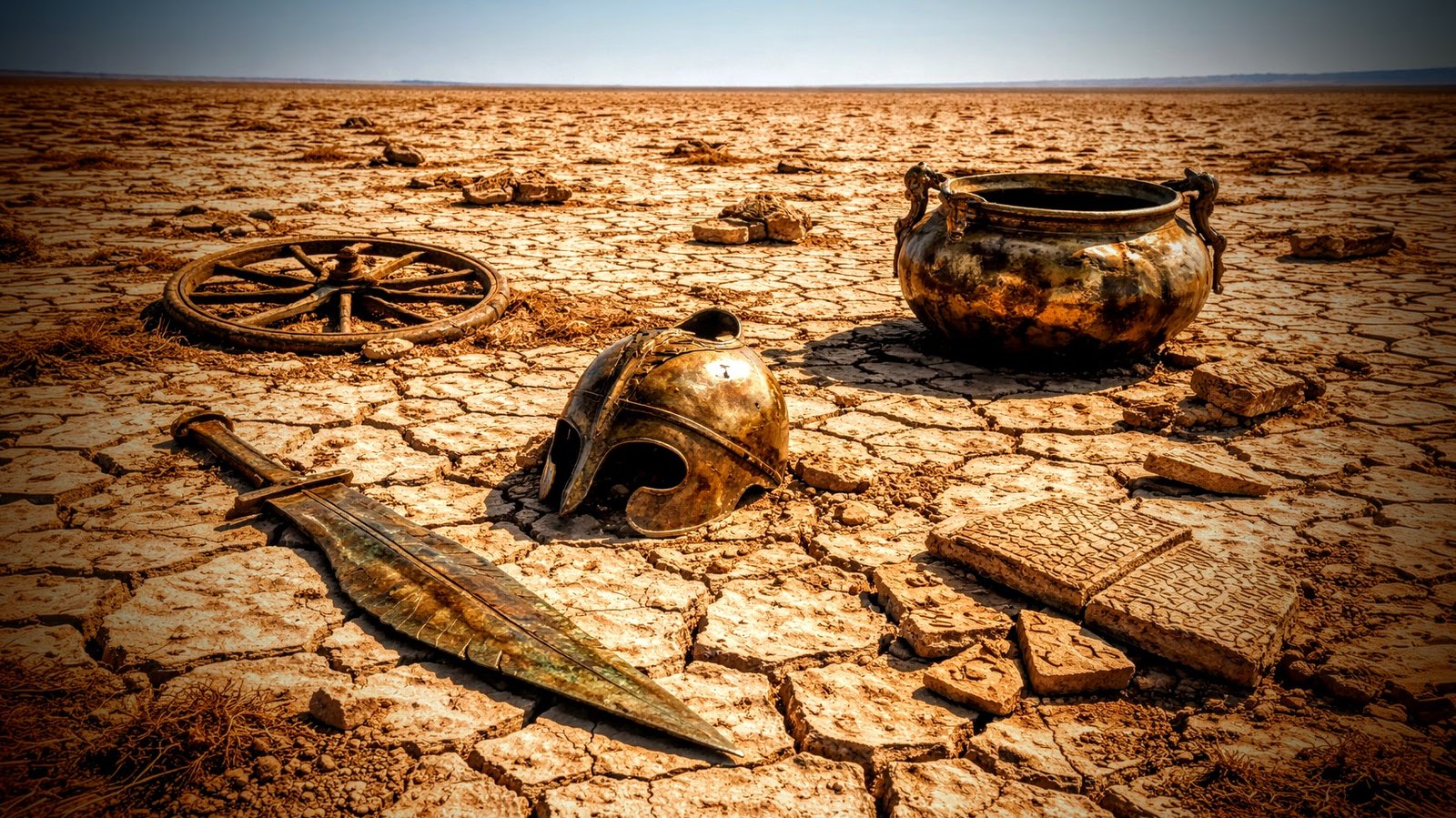
The eastern Mediterranean once ran like a well‑oiled machine, and then it began to cough, splutter, and fall apart. Around 1200 BCE, cities that glittered with imported gold and diplomatic ambition burned or emptied. Palaces that tracked every jar of oil and every ingot of copper fell silent. Trade routes stretching from Cyprus to Canaan snapped like old rope. For years, historians hunted for a single villain. They wanted a dramatic culprit with a name and a fleet. Instead, the story behaves more like a slow‑motion pile‑up on a crowded motorway.
Before everything cracked, the Late Bronze Age looked impressively modern. Kings wrote to each other in Akkadian, the diplomatic lingua franca of the era. Couriers crossed seas with clay tablets tucked under their arms. Merchants hauled copper from Cyprus and tin from distant regions to produce bronze, the metal that powered tools and weapons. Meanwhile, palaces in Mycenae, Hattusa, and Ugarit kept meticulous records. Scribes counted sheep, tallied grain, and logged deliveries. Elites exchanged gifts that travelled hundreds of miles.
This world thrived on connection. However, connection cuts both ways. Bronze required copper and tin, so rulers depended on stable trade. Prestige relied on exotic goods, so kings needed distant partners. Armies demanded equipment, so supply chains had to function smoothly. When everything worked, complexity looked like brilliance. Once strain appeared, complexity turned into fragility.
Naturally, people asked who knocked over the first domino. For more than a century, the favourite answer featured the so‑called Sea Peoples. Egyptian reliefs show dramatic naval battles, with feathered warriors clashing against the forces of Ramesses III. Inscriptions boast of enemies arriving “from the islands” and sweeping through Anatolia and the Levant. The imagery almost begs for a blockbuster adaptation. Invaders surge across the horizon and civilisation trembles.
Yet archaeology refuses to follow such a tidy script. Some cities show violent destruction, whereas others do not. In several places, walls collapsed in ways that resemble earthquakes more than sieges. Moreover, Egyptian pharaohs excelled at public relations. They carved victories into stone because stone lasts. That habit does not prove invention, although it does encourage caution.
Even if migrating groups attacked certain regions, movement rarely begins without pressure. Communities do not abandon homes for sport. Therefore, historians widened the lens.
Climate research has added weight to the debate. Scientists analysed pollen cores, sediment layers, and isotopic data from across the eastern Mediterranean. The evidence points to prolonged drought around the time of the collapse. Crops failed in several regions and rivers ran lower than usual. Letters from Ugarit mention food shortages and urgent pleas for grain shipments. Consequently, palace systems that relied on steady harvests faced serious strain.
Drought does not swing swords. Nevertheless, it empties granaries. Without grain, soldiers lose loyalty and officials lose leverage. Surplus once underpinned elite authority, so repeated harvest failures weakened the hierarchy. Famine fuels unrest, and unrest invites conflict. Conflict disrupts trade, and trade disruptions weaken armies. Gradually, the dominoes begin to wobble.
At the same time, the Late Bronze Age world had grown deeply interdependent. Copper might come from Cyprus, tin from Central Asia, timber from the Levant, and luxury goods from Egypt. Ships crossed the sea with impressive regularity. Therefore, when piracy increased or ports fell, shortages rippled outward. If tin shipments stalled, bronze production slowed. In turn, weapon manufacturing suffered and military power weakened.
Such a network delivered prosperity, yet it demanded constant maintenance. In many ways, it resembled an ancient version of just‑in‑time logistics. Efficiency ruled the system, while redundancy lagged behind. As stress mounted, the margin for error shrank.
Meanwhile, geology added another layer of instability. The eastern Mediterranean sits on active fault lines, and studies indicate clusters of seismic activity during this period. In several cities, walls toppled in patterns consistent with tremors. A single earthquake rarely ends a civilisation. However, repeated shocks can undermine infrastructure and morale. Rebuilding drains resources, and rebuilding again drains them further.
Politics also shifted beneath the surface. Palace centres in Mycenaean Greece show signs of internal upheaval. Administrative tablets stop abruptly, as if scribes never returned. Elite compounds burned and were not always rebuilt. Some scholars suggest internal revolts played a decisive role. Heavy taxation, rival factions, or power struggles may have fractured authority. Although motives remain elusive, the pattern hints at social strain.
Now consider how these pressures might overlap. A drought reduces harvests and shrinks surplus. Food shortages spark unrest and weaken loyalty. Trade falters as ports struggle or ships avoid risk. Earthquakes damage key cities and infrastructure. Migrating groups move into already weakened regions. Local rulers lose authority and confidence erodes.
Each problem alone might prove manageable. Combined, they compound. Complexity magnifies stress instead of absorbing it.
During this turbulent era, iron began to edge onto the scene. Iron technology did not instantly replace bronze, yet it offered an alternative that relied less on distant tin supplies. Consequently, regions that adapted could rearm without the old trade web. Transitions rarely unfold smoothly. Elites who built power on bronze networks may have resisted change. New groups who mastered iron could challenge established hierarchies.
Because writing systems in parts of the Aegean vanished after palace collapses, later generations labelled the following centuries a “Dark Age”. The term sounds dramatic, although it misleads. Literacy declined in certain regions, yes. Communities still farmed, traded locally, and experimented socially. Smaller settlements replaced grand palaces, and oral traditions flourished. Over time, new political forms emerged.
The search for a single “true reason” tempts us with clarity. Humans prefer tidy narratives and decisive villains. Nevertheless, the Bronze Age collapse resists such comfort.
The Late Bronze Age functioned as a complex system, and complex systems rarely fail for one reason. Instead, they erode under cumulative strain. Stress weakens key nodes, and feedback loops amplify damage. Eventually, an additional shock pushes the structure beyond recovery.
Modern scholars often describe this process as a cascade. Imagine a network of tightly connected cities. Remove one major hub and neighbouring centres absorb extra pressure. Remove another and the load increases again. Soon even stable regions feel strain. Collapse spreads because failure propagates through connection.
Elite diplomacy may have masked deeper fragility. Royal letters sound cordial and confident, with kings calling each other “brother”. Daughters travelled in diplomatic marriages and gifts crossed seas. However, such politeness can conceal anxiety. If harvests shrank or borders felt porous, rulers would hardly advertise weakness. Public messages rarely reveal private panic.
Archaeological timelines also complicate the drama. Some cities fell earlier, whereas others lingered. Destruction unfolded over decades rather than in one cinematic week. In certain places, rebuilding followed devastation. In others, abandonment prevailed. The map flickered instead of blacking out instantly.
By roughly 1100 BCE, the political landscape had transformed. The Hittite Empire vanished as a centralised power. Mycenaean palace culture fragmented into smaller communities. Ugarit lay in ruins, and Egypt withdrew from many overseas ambitions. The international club of Bronze Age great powers dissolved.
Afterwards, new societies emerged from the debris. In the Levant, smaller kingdoms took shape. In Greece, communities gradually coalesced into early city‑states that would later produce epic poetry and philosophy. Iron tools spread more widely and trade resumed in altered patterns. History did not stop; it changed tempo.
What does this ancient unravelling suggest? First, it warns against monocausal thinking. Whenever one invasion, one drought, or one earthquake receives all the blame, scepticism helps. Real systems rarely obey single‑factor explanations. Second, it highlights how interconnected prosperity breeds vulnerability. The more specialised and interdependent a network becomes, the more it depends on stability.
Today, global supply chains stretch across continents and energy flows through cables and pipelines. Food travels thousands of miles before reaching plates, and financial markets react in milliseconds. We celebrate efficiency and speed. However, efficiency often reduces buffers. When disruption hits, shocks travel quickly.
Modern societies differ profoundly from Late Bronze Age kingdoms, of course. Technology, communication, and institutional depth provide resilience that ancient palaces lacked. Even so, the structural lesson endures. Complexity amplifies both success and risk.
Interestingly, the Bronze Age collapse challenges the idea that history advances in straight lines. Civilisations surge, stabilise, strain, and sometimes fracture. Afterwards, they reconfigure and adapt. Progress zigzags rather than marches.
Because the collapse spanned multiple regions, it invites interdisciplinary study. Archaeologists excavate burn layers, while climate scientists analyse cores. Epigraphers translate tablets and geologists map faults. Each discipline contributes a fragment of evidence. Together, they form a mosaic rather than a single portrait.
That mosaic suggests convergence above all. Environmental stress weakened agriculture and reduced surplus. Trade disruptions undercut elite authority and prestige. Seismic events damaged infrastructure and morale. Population movements intensified competition for resources. Internal revolts eroded political control.
No single factor explains everything. Interaction forms the persuasive pattern. Under stress, systems behave differently than in calm conditions. Feedback loops accelerate decline and trust erodes. Cooperation falters while leaders scramble for solutions. Ordinary people adapt as best they can, sometimes by leaving.
Picture a merchant in Ugarit hearing rumours of failed harvests inland. Picture a Mycenaean official watching tablet supplies dwindle. Picture an Anatolian farmer facing another dry season. Each decision might seem minor in isolation. Collectively, such decisions reshape history.
The most convincing explanation therefore lacks cinematic flair. A complex, interconnected world encountered overlapping shocks and lacked sufficient resilience to absorb them. That formulation may sound unsatisfying. It aligns closely with the evidence.
Yet there is something quietly hopeful in that interpretation. Collapse did not erase humanity’s capacity to rebuild. Communities reorganised, technologies shifted, and cultural forms evolved. Out of the ruins emerged new stories, new gods, and new political experiments.
When we look back at burned cities and silent palaces, nostalgia helps little. Fatalism helps even less. The Late Bronze Age achieved remarkable integration, although it revealed how fragile integration can become under pressure. Stability demands maintenance, flexibility, and buffers against the unexpected.
History rarely offers simple morals. Still, it offers perspective. Around 1200 BCE, the world as many people knew it ended. Trade maps redrew, power structures dissolved, and writing disappeared in some regions. Life continued, however, and new civilisations rose from the same shores.
The urge to identify one dramatic trigger may never vanish. Humans crave clean answers and decisive moments. The deeper truth of the Bronze Age collapse lies in entanglement. Climate, politics, economics, migration, and geology intertwined in dense patterns. Pull one thread and the tapestry shifted. Pull several at once and the pattern unravelled.
That tangled explanation lacks the punch of a single invading fleet on the horizon. Nevertheless, it captures the complexity of a world that looked sophisticated, confident, and secure—right up until it was not.