What Manchester Canals Remember That the Streets Forgot
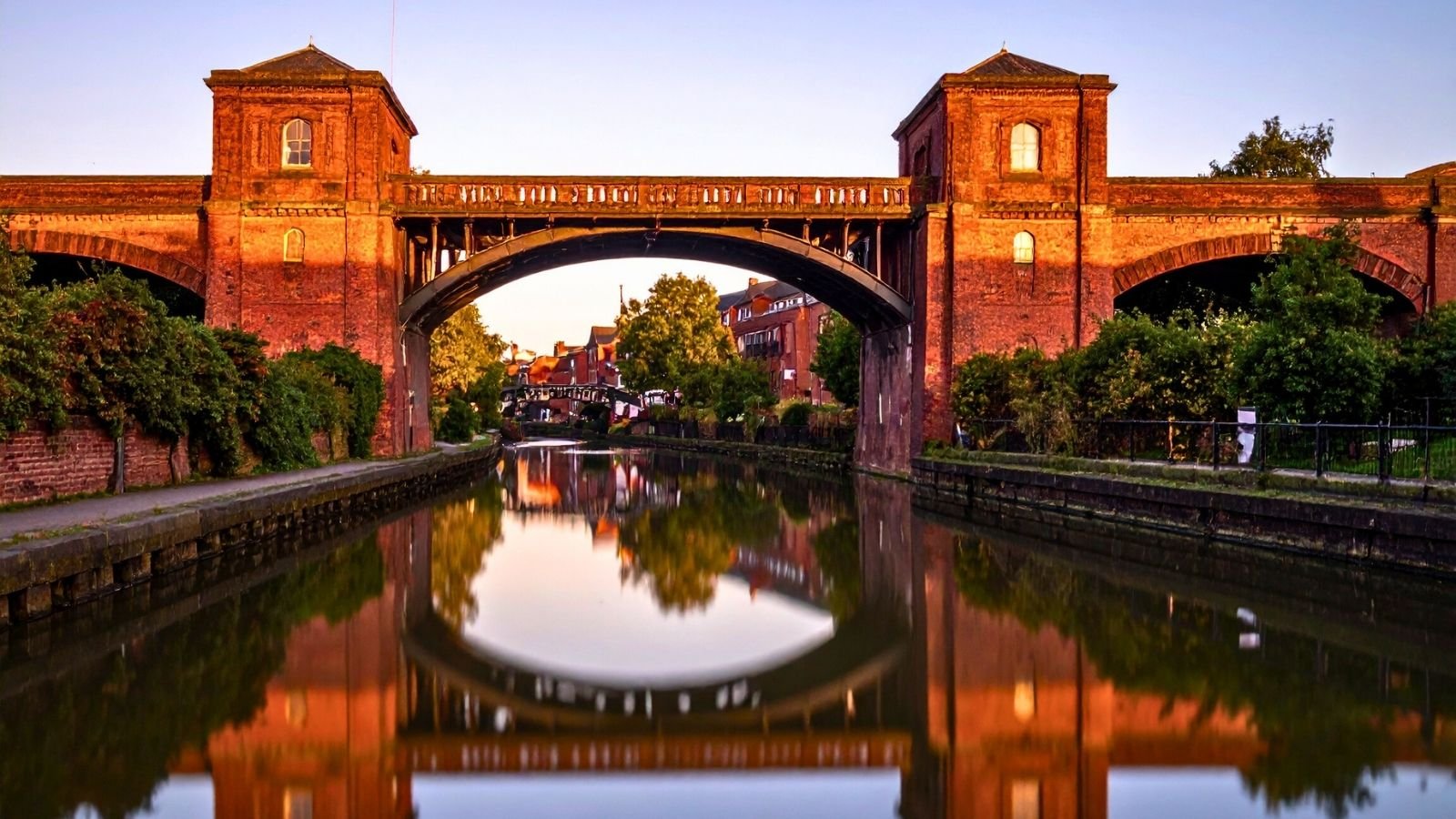
Manchester canals do not announce themselves. Instead, they slip between buildings, duck under roads, and surface just long enough to hint at a slower city. In a place famous for engines, mills, music and momentum, the canals remain oddly resistant to drama. They sit still, doing what they have always done: holding time in place.
Before Manchester learned to build upwards, it learned to dig sideways. The canal network arrived before railways, before mass housing, and before the city imagined itself as a destination. These waterways existed to move coal, cotton, grain and chemicals cheaply and predictably. Importantly, they did not exist to be seen. That utilitarian logic still shapes how the canals feel today. As a result, they remain marginal, functional, and slightly awkward. You find them by accident or by intention, but never through spectacle.
The Bridgewater Canal changed everything when it opened in the eighteenth century. It cut coal prices dramatically and made energy predictable. That predictability mattered more than speed. Manchester’s early industrial power depended on regular flow, not rapid delivery. Walk the Bridgewater today and the design logic remains legible. Long, flat stretches glide through the city with minimal interruption. Locks feel like an afterthought. The water barely seems to move, which was precisely the point.
By contrast, other Manchester canals tell a harder story. The Rochdale Canal, slicing through the city centre and climbing east, demanded effort at every stage. Locks multiplied and labour intensified. Consequently, progress slowed and boats queued. The canal never fully recovered its costs, and that failure echoes forward. When industry declined, this route declined faster and harder. For decades, it became a boundary rather than a passage. People crossed it but rarely walked alongside it. Even now, parts of it feel provisional, as if the city has not quite decided what to do with them.
Walking along Manchester canals forces a recalibration of pace. The towpath refuses urgency. It narrows without warning, while surfaces change underfoot. Sightlines collapse beneath bridges and reopen into sudden light. You cannot rush without effort. This matters in a city that otherwise optimises movement aggressively. Roads push traffic through and trams glide efficiently. Meanwhile, pavements funnel bodies with intent. The canals interrupt that logic. They invite loitering without encouraging consumption.
They also expose how labour once structured urban life. Canal work relied on repetition rather than innovation. Horses pulled boats at the same speed regardless of cargo. Locks demanded the same motions, day after day. Families lived aboard in cramped cabins, and children worked alongside adults. Accidents vanished into the water with little record. Unlike mills, canals left few monuments to individual workers. For that reason, they slipped from cultural memory with surprising ease. They powered the city without demanding attention.
By the early twentieth century, canals lost their competitive edge. Railways outran them, and lorries bypassed them entirely. Maintenance faltered and water quality deteriorated. Some stretches became dumping grounds, both literal and symbolic. In popular imagination, canals turned dangerous and unclaimed. That long neglect reshaped behaviour. Even today, some locals carry inherited warnings about towpaths that no longer apply, while others quietly still do.
Regeneration arrived late and unevenly. When the Rochdale Canal reopened through the city centre in the early 2000s, it signalled a shift in thinking. Water became an asset again, though of a different kind. Developers followed canals not for transport but for atmosphere. Warehouses became apartments, brickwork was cleaned, and lighting improved. Gradually, the language shifted from industry to lifestyle.
That shift remains uncomfortable. Manchester canals were never designed to be pretty. Their narrowness, blind corners and dampness resist easy polishing. Attempts to soften them entirely tend to fail. Even in regenerated sections, the canals keep their edge. You still brush past other walkers. You still hear water slap against stone. And you still feel enclosed. This friction gives the canals credibility. They have not turned into parks pretending to be history.
Walking the canals reveals a city that feels layered rather than planned. One moment you pass cafés and glass balconies. The next, you move behind blank brick walls stained by centuries of use. These transitions happen without signage or ceremony. The water provides continuity while the city rearranges itself around it. In this way, the canals offer narrative without curation.
They also highlight class contrasts more honestly than many regeneration schemes. Waterside apartments signal prosperity, yet just beyond them lie stretches that remain ordinary or underfunded. Anglers share space with commuters. Dog walkers pass construction workers on lunch breaks. The canals accommodate overlap without resolving it.
Myths cling to these spaces. One suggests that Manchester canals have fully reinvented themselves. Another treats them as tranquil escapes from the city. Both ideas simplify reality. Many sections remain fragile, with limited maintenance and unclear ownership. Tranquillity exists, but it is conditional. Trains thunder overhead and sirens cut across the water. The city never disappears; it simply refracts.
Romantic images of canal life also distort the past. Life aboard working boats was harsh. Cabins stayed cold and cramped, and income fluctuated. Leisure barely existed. Nostalgia tends to arrive once difficulty fades from view. The canals resist that nostalgia by remaining stubbornly physical. They do not perform history; they carry it.
Environmental questions now reshape the conversation. Manchester canals have become accidental ecological corridors. Birds nest along edges once black with soot, and fish return unevenly. Towpaths provide green movement routes through dense neighbourhoods. At the same time, increased foot traffic brings erosion, litter and pressure. The canals now juggle roles they were never designed to hold.
Climate adaptation adds further complexity. During heatwaves, canals cool surrounding air. During heavy rain, they absorb overflow. Infrastructure built for eighteenth-century industry now supports twenty-first-century survival. This quiet reuse feels fitting. The canals adapt without rebranding.
Ultimately, walking Manchester canals reveals continuity rather than nostalgia. These waterways refuse both abandonment and total reinvention. They sit between usefulness and memory. They ask walkers to slow down, notice texture, and accept unevenness. In a city that markets reinvention confidently, the canals offer something rarer: persistence.
They remain overlooked because they demand effort. You must step off main routes and accept partial views. Stories arrive incomplete and unresolved. Yet that is precisely their value. Manchester canals show the city without explanation. They let time coexist rather than compete. Follow them long enough, and Manchester stops performing and starts existing.