The Three R’s: What Victorian Children Actually Studied
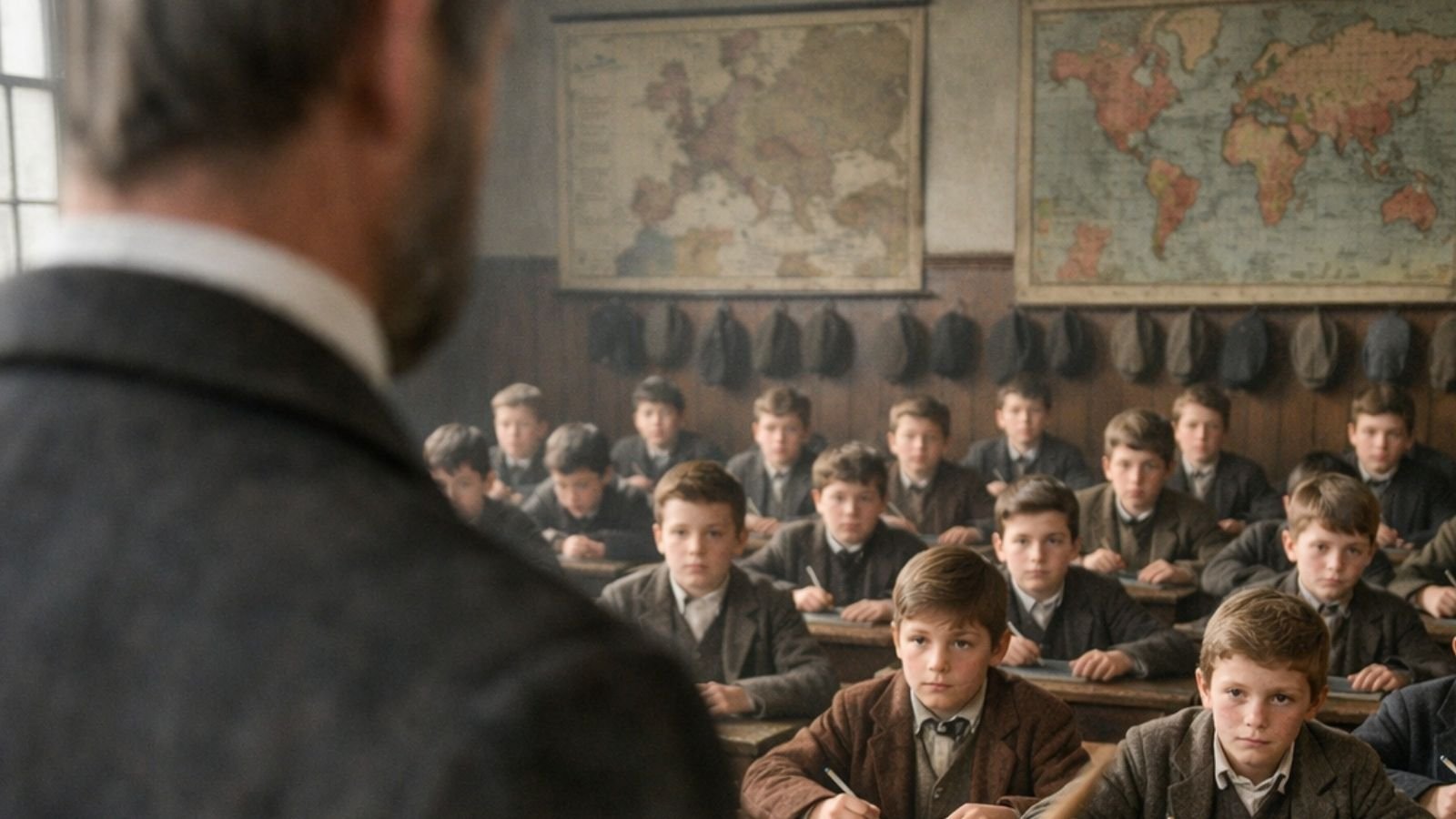
Picture the classic Victorian classroom and you can almost hear it before you see it. A teacher calls out a line, thirty children repeat it in chorus, someone scratches on a slate, and a boy in the back realises with horror that arithmetic has found him again. It was not a place built for self-expression. It was a place built for order.
The famous Three R’s — reading, writing, and arithmetic — really did sit at the centre of Victorian schooling. They were the spine of the system, especially in elementary schools for working-class children. If a child could read a passage, copy words correctly, and wrestle a few sums into submission, that counted as progress. If the school could prove enough children had done exactly that, so much the better.
However, the Victorian classroom was not quite the tiny educational menu people often imagine. It was narrower than today’s curriculum, certainly, but it was not only those three basics all day long forever. Scripture loomed large. So did spelling, dictation, poetry recitation, and, in many schools, object lessons designed to teach observation through ordinary things. Depending on the school, children might also get geography, history, drawing, drill, singing, sewing, or needlework.
Still, the Three R’s ruled the room because the whole system pushed them to the front. After the Revised Code of 1862, government grants became heavily tied to what inspectors could test in reading, writing, and arithmetic. That had a predictable effect. Schools taught what would be measured, and they measured what the state was willing to pay for.
So Victorian era education developed a slightly grim logic. If children had to pass individual tests, teachers drilled them for those tests. If grant money depended on results, lessons became practical, repetitive, and painfully focused. Consequently, memorisation was not some accidental side effect. It was the engine.
Reading often meant much more than enjoying a story. Younger children worked through simple reading books in stages, building up from very basic texts. Older pupils were expected to read paragraphs, bits of poetry, and even short newspaper passages as they moved through the standards. Fluency mattered, but so did accuracy, obedience, and the ability not to freeze when called upon.
Writing had its own rituals. Children copied letters, words, and sentences, first on slates and then on paper when they were trusted not to waste it. Dictation played a major role because it tested both listening and spelling at once. Besides that, handwriting itself mattered enormously. A neat hand suggested discipline, respectability, and the faint possibility that one day you might become a clerk instead of losing fingers in a factory.
Arithmetic, meanwhile, had all the warmth of a tax return. Pupils learned sums by rule and repetition, chanting tables until the numbers stuck. They began with simple addition and subtraction, then moved into multiplication, division, money, weights, measures, and practical calculations. This was not mathematics as a realm of beautiful ideas. It was mathematics as training for shops, wages, bills, and adult life.
Yet the stereotype of Victorian schooling as nothing but parroting does miss a wrinkle. Some schools used object lessons, where teachers introduced real items such as plants, materials, tea leaves, or manufactured goods, then drew questions out of them. In theory, this encouraged children to observe, describe, compare, and connect. In practice, even that could become a rather controlled performance, but it was at least an attempt to make learning more than endless chanting.
Then there was religion, which Victorian schools treated not as an optional extra but as part of the air. In many schools, children learned Bible passages, catechisms, commandments, and moral instruction by heart. So when people say Victorians learned only the Three R’s, that is not really true. They also learned how to behave, how to sit still, how to answer together, and how to absorb a moral universe without too many cheeky follow-up questions.
Meanwhile, boys and girls did not always study exactly the same things. Girls were often taught needlework and sewing, partly because schools saw these as essential domestic skills and partly because future employers might value them. Boys might get drill, more drawing, or manual exercises. The lesson was clear enough. Victorian education was not just about knowledge. It was also about preparing children for the social roles adults had already picked for them.
Class mattered just as much as gender. Middle-class and upper-class children often had broader and richer educations, whether at home, at private schools, or with tutors. They were more likely to study literature, languages, music, science, and the sort of subjects that suggested one might someday govern an empire rather than sweep around it. By contrast, elementary schooling for poor children aimed above all at basic literacy, basic numeracy, discipline, and usefulness.
That is why the phrase “creative thinking” sits awkwardly in a Victorian classroom. Teachers were not usually asked to nurture originality. They were asked to keep order, raise standards, and get children through inspections. As a result, recitation, repetition, and copying made far more sense to the system than open-ended debate or imaginative interpretation. A classroom of sixty children did not lend itself to free expression unless your definition of free expression included being caned for it.
Even so, Victorian era education was not frozen in one shape across the whole century. Early in the era, many children had patchy schooling or none at all. Later reforms widened access, and by the end of the century more children were in school more regularly. Schools also added extra subjects over time, and some reformers pushed for better teaching methods. Nevertheless, the basic image remains stubbornly accurate: rows of pupils, repetitive drills, close supervision, and a curriculum that prized solid basics over sparkling originality.
There is also a small irony hiding in all this. Modern people often laugh at the Victorian obsession with rote learning, then spend half the year complaining that children today cannot spell, write neatly, or do mental arithmetic. The Victorians would have found that amusing. They may have overdone the discipline, crushed plenty of joy, and treated imagination like a suspicious substance, but they knew exactly what skills they wanted schools to produce.
So what did Victorian children actually study? Yes, reading, writing, and arithmetic dominated the timetable. But around those famous Three R’s clustered religion, recitation, dictation, spelling, moral training, and, depending on the school, subjects like geography, history, drill, drawing, and needlework. The curriculum was basic, but it was not empty.
The real difference lies in how children were expected to learn it. They repeated. They copied. They recited. They memorised. And through that process, Victorian schools were trying to do something larger than teaching lessons. They were trying to manufacture literate, orderly, respectable citizens, preferably without too much noise. In that sense, the Three R’s were never just school subjects. They were part of a social machine with slates, hymn books, inspection tables, and very little patience.
Post Comment
You must be logged in to post a comment.