Up Helly Aa: Lerwick, Vikings, and Fire
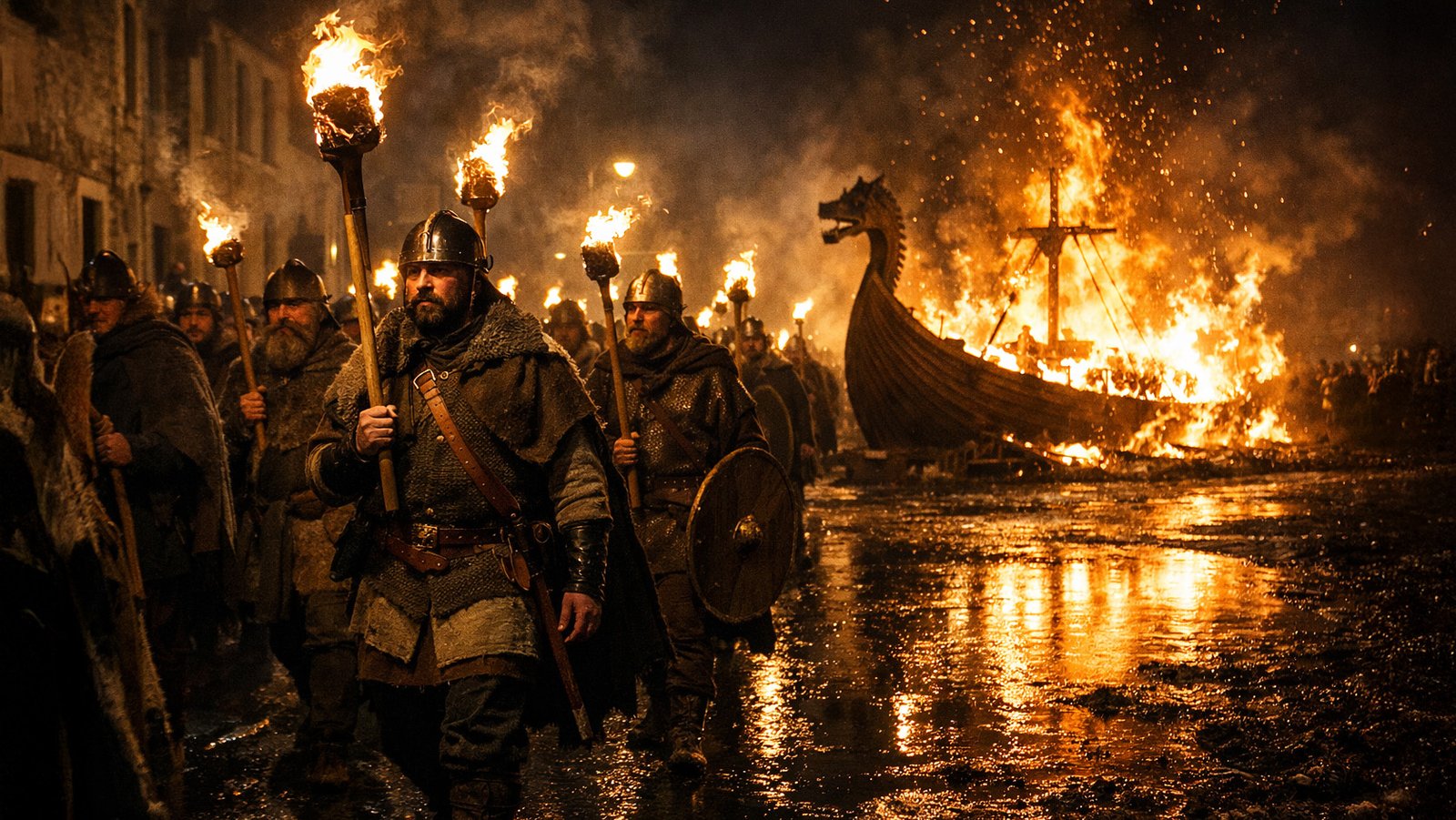
January in Shetland does not negotiate. It arrives heavy, dark, and entirely uninterested in comfort. Brief daylight appears like a visitor who has already checked the ferry timetable. Meanwhile, the sea keeps moving. The wind, for its part, keeps opinions to itself. In that setting, Up Helly Aa does not feel eccentric. Instead, it feels practical.
The festival takes place in Lerwick at the exact moment winter starts testing everyone’s patience. The calendar calls it late January, yet emotionally it sits closer to defiance than celebration. This is not a polite welcome to a new year. Rather, it is a collective decision to burn something and move on.
Fire dominates the evening. Hundreds of torches cut through the streets in disciplined formation, carried by people dressed as Vikings with a seriousness that leaves no room for irony. Helmets gleam. Shields catch the light. Faces glow red and gold. Meanwhile, the crowd watches quietly, partly from respect and partly because cold weather discourages unnecessary commentary.
At the centre waits a longship. It is not a symbolic nod or a decorative prop, but a full-sized galley built over months for a single use. The vessel never sees the sea. It does not need to. Its role ends where the procession does. When torches are thrown aboard, the moment feels rehearsed yet intimate. Flames rise fast. Wood gives way. The ship collapses into fire without hesitation.
Many assume this ritual stretches back to Viking times in an unbroken line. In reality, it does not. Up Helly Aa, in its modern form, belongs firmly to the nineteenth century. Earlier winter fire customs in Lerwick were chaotic affairs involving burning barrels, drunken bravado, and regular disapproval from anyone responsible for public order. Eventually, however, restraint arrived disguised as organisation.
The Viking theme emerged later, chosen rather than inherited. Shetland’s Norse heritage offered a dramatic framework that felt authentic enough while lending structure to the spectacle. As a result, Norse imagery turned winter disorder into something that looked like history. That shift mattered.
Each year, one participant becomes the Guizer Jarl. This role demands far more than costume leadership. The Jarl selects the galley’s name and theme, often referencing sagas, symbols, or moments that resonate personally. At the same time, the costume undergoes close inspection by people who know their mythology and enjoy spotting shortcuts. Admiration and quiet judgement arrive together.
Behind him march the guizers, divided into squads. Discipline defines them. Formation matters. Timing matters. Notably, drinking is banned during the procession, which surprises those expecting chaos wrapped in tradition. Order comes first. Celebration waits patiently.
The torches themselves are made locally and designed to burn fiercely and predictably. They last exactly as long as the procession needs them to last. Consequently, nothing here happens by accident. Even the final act of throwing the torches aboard the galley follows an unspoken choreography.
When the ship burns, the public part of Up Helly Aa ends. Many visitors believe they have witnessed the whole event at this point. They have not. Instead, they have only seen the door close.
After the flames die down, Lerwick splits into parallel lives. Streets empty. Doors shut. Inside halls across the town, the second half begins. This section belongs entirely to the community. Guizer squads rotate through venues all night, performing songs, sketches, and carefully prepared absurdity. The humour leans local, political, and occasionally unforgiving. Outsiders would miss half the meaning even if allowed inside.
Months of secret rehearsals surface here. Vikings reappear as nurses, bureaucrats, sheep, politicians, or exaggerated versions of local personalities. As the night progresses, satire sharpens. Traditions bend. No one pretends this part is historical. Instead, it is current, reactive, and unmistakably Shetland.
The boundary between public spectacle and private celebration is intentional. Up Helly Aa resists becoming something staged purely for visitors. Fire is shared. The night is not. As attention has grown, that distinction has hardened.
With visibility come arguments. Gender has dominated debate for years. Historically, Lerwick’s Up Helly Aa limited participation in the guizer squads to men. Supporters defended this as tradition. Critics, however, pointed out that the tradition itself was relatively modern. Discussion simmered quietly until it could not.
In 2024, the rules changed. Women were formally allowed to participate in Lerwick’s main festival. Reactions ranged from relief to resentment. Some welcomed a shift that reflected modern reality. Others feared erosion of something they had protected carefully. The ship burned as usual. Opinions did not.
Environmental criticism surfaces regularly. Burning a large wooden galley invites scrutiny. Organisers respond with specifics. The wood is untreated. The event happens once a year. Its footprint remains modest compared to mass festivals driven by travel and infrastructure. Critics counter that symbolism matters regardless of scale. Consequently, the argument returns faithfully each winter.
Questions of historical accuracy follow closely behind. The Vikings of Up Helly Aa owe as much to Victorian romanticism as to archaeology. Horned helmets appear despite universal awareness that they are wrong. Armour borrows freely. Authenticity yields to recognisability. Most participants accept this compromise without apology.
Up Helly Aa survives for reasons that go beyond spectacle. Rather than relying on drama alone, it endures because it organises people around a shared task. Months of commitment are required, and through that process collaboration becomes unavoidable. As a result, the festival creates a clear endpoint during the darkest stretch of the year. The fire makes no promises of rebirth or optimism. Instead, it delivers something quieter and more practical: closure.romise rebirth or optimism. Instead, it offers closure.
Winter does not retreat quickly in Shetland. Up Helly Aa does not pretend otherwise. It simply draws a line through January and says something was built together, burned properly, and left behind. Quietly, that is enough.