Tukdam: What Lies Between Life and Death
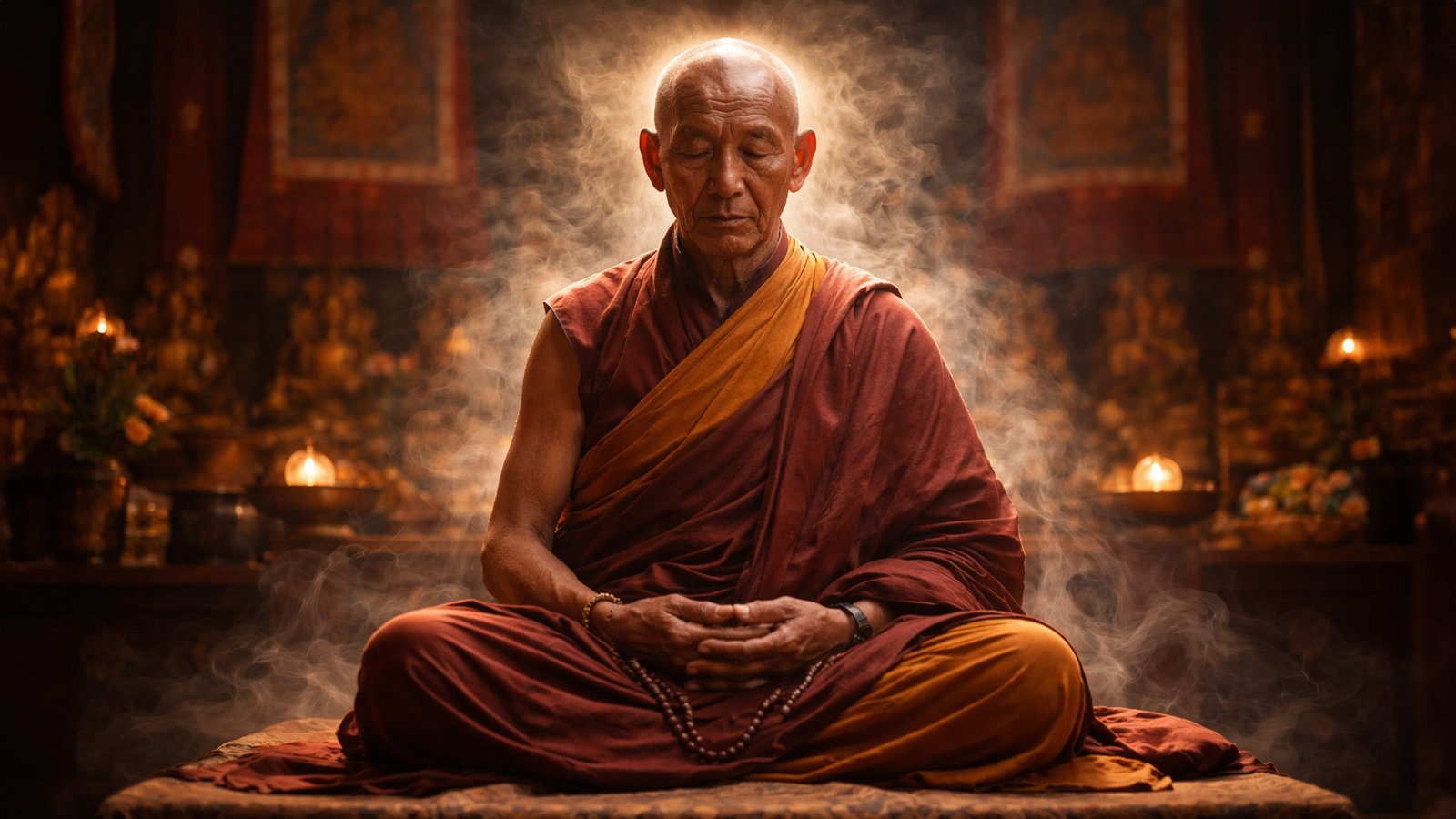
Somewhere in the mountains of Tibet, monks have been quietly defying the rules of death for centuries. Not in the dramatic, Hollywood-style way you might imagine. No rising from the grave, no creepy shuffling down corridors. What actually happens is stranger, subtler, and frankly more fascinating than anything a horror film could dream up.
The phenomenon carries the name tukdam. Pronounced roughly “took-dahm,” it translates rather poetically to “one absorbed in Buddha-mind.” In Tibetan Buddhism, death is not treated as a full stop. Rather, it is viewed as a transition, a doorway into something far more significant. Tukdam sits right at that doorway. Put simply, it is a postmortem meditative state. Essentially, the body of a highly realised practitioner shows almost no signs of decomposition for days, sometimes weeks, after clinical death has been declared.
To be completely clear about what that means: the heart has stopped. The breathing has ceased. By every Western medical standard, the person is dead. Clinically, undeniably, officially dead. And yet the body remains remarkably fresh. The skin stays supple and bright. The face retains a glow of vitality. Often, the practitioner remains seated upright in meditation posture. They look, for all the world, as though they have simply dozed off after a particularly long prayer session. Then there is the scent. Observers frequently report a pleasant, floral fragrance emanating from the body. That is, admittedly, the opposite of everything you would expect from a corpse. Surprisingly, this sweet smell has become one of the most discussed details in the scientific literature. Researchers are now planning to analyse the volatile organic compounds involved. In other words, even the way a tukdam body smells has sparked genuine scientific curiosity.
Tibetan Buddhists explain tukdam through the concept of the “Clear Light,” also called the “Ground Luminosity.” This concept sits at the heart of their understanding of consciousness. At the moment of death, layers of coarser awareness dissolve one by one. Beneath them lies an extraordinarily subtle form of consciousness. For most people, this subtle awareness flickers by so quickly that it goes completely unnoticed. However, a practitioner who has spent decades training their mind can recognise this light. Indeed, they can dwell within it.
Their consciousness remains active in a state of profound meditative absorption, even after the body has technically died. Consequently, the longer the practitioner’s spiritual realisation, the longer they can sustain the state. Buddhist tradition holds that tukdam is, in theory, available to anyone. In practice, though, only the most accomplished meditators manage it. Essentially, it is the spiritual equivalent of climbing Everest without oxygen — theoretically possible, but extraordinarily rare.
Here is the genuinely wild bit. Tukdam is not something you can simply stumble into on a weekend retreat. It requires an extraordinary level of spiritual mastery. That mastery is built through years of disciplined practice and moral living. Notably, it also demands a genuine surrender of ego — something that, admittedly, most of us struggle with on a good day. Practitioners who achieve it are considered to have lived remarkably ethical lives.
Furthermore, reaching tukdam is seen as a testament to having lived with genuine intention and compassion. Sacred as it is, the state carries real responsibilities for the wider community. Specifically, the body gets deliberately left undisturbed during tukdam. Everyone around honours the belief that consciousness remains present and active. Moving or interfering with the body could, according to tradition, disrupt the entire process. Consequently, cremation ceremonies get postponed until monks or spiritual leaders confirm that tukdam has concluded. It is, in short, death treated with a level of reverence that Western cultures rarely extend to the dying, let alone the dead.
Now, Western science has had quite a few things to say about all this. The story of how modern researchers got involved is rather entertaining. Back in 1995, neuroscientist Richard Davidson sat down with the Dalai Lama in Dharamsala, India. Davidson ranks among the world’s leading experts on meditation and the brain. Crucially, he had spent years studying how meditation reshapes the brain. The Dalai Lama brought up tukdam casually during their conversation. He described the passing of his former tutor, who had remained in the state for several days. Davidson went away with a burning question: could science actually study this? Thus began one of the most unusual scientific investigations in history.
The research now unfolds in Tibetan monastic communities in India. It is led by the Centre for Healthy Minds at the University of Wisconsin-Madison. Russian scientists have also joined the effort, bringing their own forensic expertise. Tibetan medical doctors collaborate closely with the team throughout. Their first peer-reviewed paper landed in 2021, marking a significant milestone. The researchers detected no measurable brain activity in thirteen deceased practitioners. The earliest recording, however, came twenty-six hours after death. That gap left rather a lot of room for doubt. Tibetan medical practitioners responded with some justification, and rightly so. Their tradition never claimed tukdam involved conventional brain activity. Instead, their focus falls squarely on the heart. Specifically, they look for warmth at the heart centre and signs that the “subtle mind” remains active there. The two sides, in other words, are not even measuring the same thing.
More recently, the team published new findings in Forensic Science International. They documented two cases in which postmortem decomposition slowed dramatically. One practitioner’s body remained remarkably preserved for thirty-seven days. Signs of decay finally appeared only then, and rapidly at that. The bodies appeared radiant throughout the entire period. Remarkably, no unpleasant odour surfaced for weeks. Scientists are now investigating whether changes to the oral microbiome might explain the pattern. Volatile organic compounds — the chemicals released by the body — fall under scrutiny too. Interestingly, researchers also noted that Tibetan monastic communities show lower rates of Alzheimer’s and dementia, which has sparked a separate but related line of inquiry. Furthermore, a forensic anthropologist not involved in the study remarked that tukdam has genuine potential to reshape our understanding of how decomposition works.
Of course, tukdam has attracted its fair share of sensationalism along the way. The most notorious example arrived in 2015. A mummified monk was discovered in Mongolia, sitting in lotus position. Headlines screamed that a two-hundred-year-old Buddhist master was “still alive and meditating.” Unsurprisingly, the story spread like wildfire. Experts, however, quickly poured cold water on the whole affair. The original claim came from a single art professor. He was most likely describing the symbolic significance of the monk’s posture, not making a medical diagnosis. Forensic examination confirmed the monk was very much dead. Mongolia’s extreme cold and traditional salt-packing practices had preserved the remains. Nevertheless, the episode became a masterclass in how ancient spiritual traditions get mangled by the internet. It also revealed, perhaps, how desperately people want death to have a loophole.
Yet tukdam refuses to disappear quietly. As recently as June 2025, Yongdzin Tenzin Namdak Rinpoche passed away at the age of one hundred. This revered teacher of the Tibetan Bön tradition remained in tukdam for eight days. Monks and followers around the world observed and honoured the state. In addition, the event reignited widespread interest in tukdam among both spiritual and scientific communities. Meanwhile, scientists press on with their careful, painstaking work. Taking tissue samples remains largely out of the question. Tibetan communities consider invasive procedures deeply inappropriate. They worry that disturbing the body could interfere with the sacred process of spiritual liberation. Moreover, the ethical dimensions of this research run far deeper than most scientific studies ever encounter. Ultimately, what matters most to the Tibetan side is not a lab result but the integrity of the dying practitioner’s journey.
What makes tukdam so enduringly compelling is the tension it creates. Western science demands measurable, repeatable evidence. Tibetan Buddhism operates from an entirely different set of assumptions about consciousness and the body. The two traditions are not, strictly speaking, looking at the same thing. Or at least, they are using profoundly different lenses. One scholar compared them to two field teams crossing the same landscape with completely different maps. Both teams are thorough. Similarly, both teams are sincere. Neither, however, can fully translate what the other has found.
Perhaps the most honest answer to the question “what is tukdam, really?” is simply this: nobody knows for certain. Science has documented the phenomenon with increasing rigour. Buddhist tradition has explained it beautifully within its own framework. The gap between those two accounts remains stubbornly, fascinatingly wide. And until someone figures out how to bridge it — assuming that is even possible — tukdam will keep sitting there, cross-legged and serene, quietly embarrassing both sides of the debate.