Tudor Court Paranoia of Poison
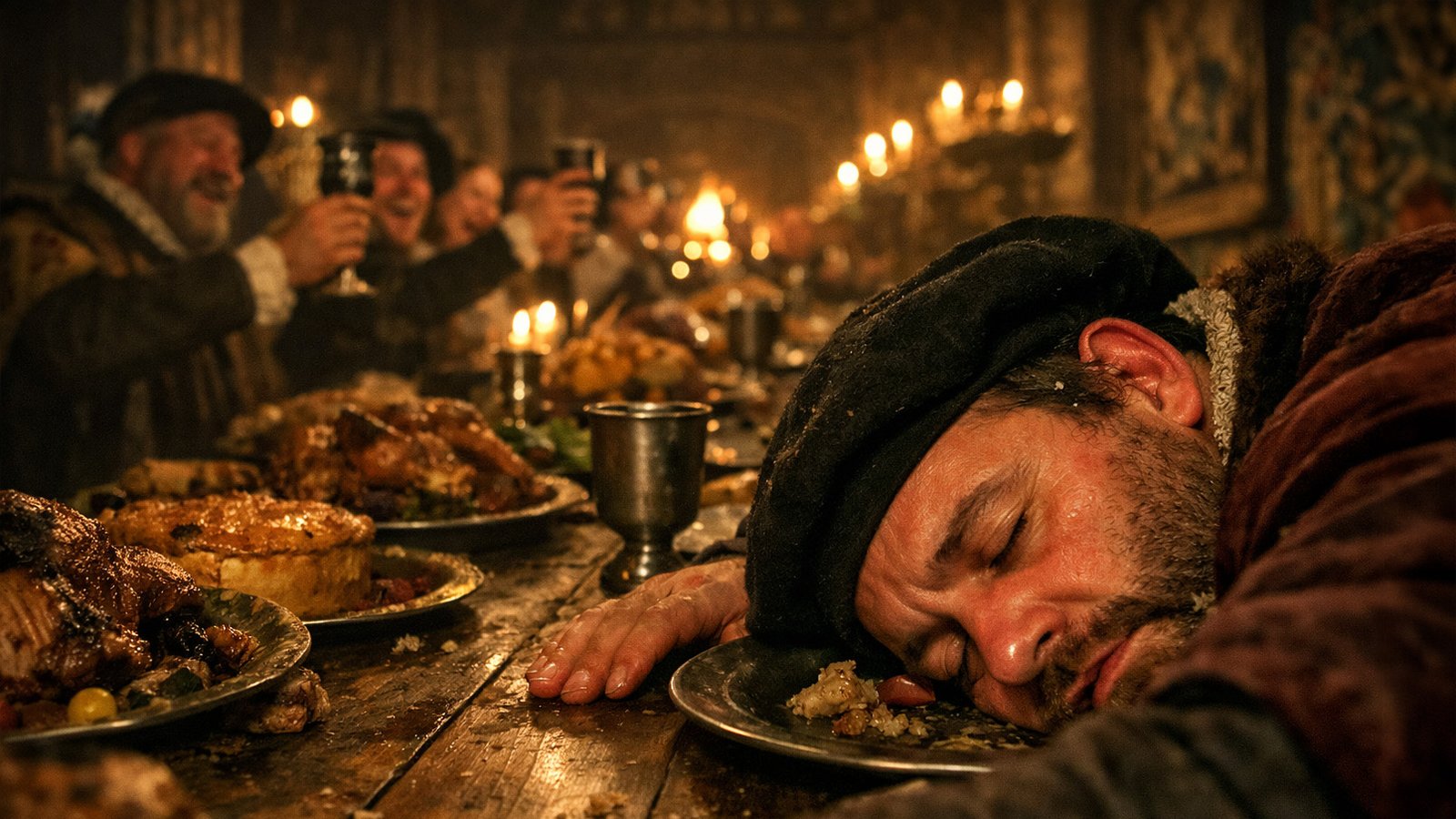
The Tudor court liked to present itself as confident, theatrical, and divinely ordained. Portraits showed calm faces, rich fabrics, and steady gazes. Ceremonies projected control. Yet behind the tapestries and ritualised smiles sat a quieter, more persistent emotion: fear. Specifically, fear of what might be hidden in a cup, a dish, or a medicine bottle. The Tudor court lived with the idea that power could end not by a sword, but by supper.
This anxiety was not theatrical paranoia. Instead, it shaped how the court functioned every day. It influenced who worked in kitchens, who touched the monarch’s body, and who rose or fell politically. Because poison worked invisibly, ordinary domestic spaces turned into political front lines. As a result, survival depended on routines that looked ceremonial but were fundamentally defensive.
Food sat at the centre of this concern. Eating was unavoidable, frequent, and communal. A monarch could postpone a journey or cancel an audience, but dinner arrived regardless. Consequently, the kitchen became one of the most sensitive spaces in the Tudor court. Hundreds of people handled royal food before it reached the table, and each hand introduced perceived risk.
To manage that risk, the court relied on accountability. Every stage of food preparation had named officials. Meat moved through a chain of responsibility: purchase, storage, preparation, cooking, transport, and service. At each point, someone could answer for failure. Therefore, fear remained contained within procedure rather than erupting into chaos.
Popular images of a lone royal food taster oversimplify the system. Instead, the Tudor court relied on ritualised testing known as assay. Officers inspected food, smelled it, and sometimes tasted it well before it reached the royal table. Drinks attracted particular suspicion. Since liquids carried dissolved substances easily, wine and medicinal drinks worried people more than solid food.
These measures did not eliminate danger. Rather, they organised anxiety. They created visibility and oversight. In a court obsessed with access, public preparation felt safer than private handling. Shared dishes carried less suspicion than personal treats. Even salt mattered, because poisoning it without notice proved difficult.
Meanwhile, the kitchen itself functioned as a political space. Senior kitchen posts brought status, wages, and patronage. Often, appointments reflected factional loyalty rather than culinary skill. When politics shifted, staff shifted too. As a result, kitchens felt less neutral and more entangled with power.
Large palaces intensified this tension. Vast kitchens fed thousands daily, which reduced the chance of secret tampering. At the same time, scale increased distance between monarch and worker. Trust became abstract. Consequently, procedures replaced personal familiarity. Systems mattered more than individuals.
Medicine provoked deeper unease. Food passed through many hands, but medicine reached the monarch directly. Treatments involved ingestion, purging, bleeding, or ointments applied in private rooms. Because these moments lacked witnesses, medical care felt both intimate and dangerous.
Tudor medicine followed humoral theory. Health depended on balance, while illness reflected imbalance. Treatments aimed to restore equilibrium. However, many remedies contained mercury, arsenic compounds, or powerful herbs. This overlap blurred the line between cure and poison.
Because of that ambiguity, illness raised questions immediately. Slow decline caused more suspicion than sudden collapse. Gradual weakness matched contemporary ideas of subtle poisoning. Therefore, even ordinary sickness triggered political anxiety.
Physicians guarded their reputations carefully. Apothecaries faced scrutiny over sourcing and preparation. Treatments were delayed, diluted, or refused altogether. In this environment, caution looked sensible rather than timid.
Servants completed the triangle of fear. They dressed the monarch, handled bedding, prepared baths, and delivered private items. Access made them indispensable. At the same time, access made them suspect. Loyalty mattered, yet loyalty remained impossible to prove absolutely.
Accordingly, the Tudor court monitored servants closely. Household ordinances regulated behaviour. Sleeping arrangements limited unsupervised access. When illness struck, questioning often focused on those nearest to the monarch. Even without evidence, suspicion ruined lives.
Factional politics intensified this atmosphere. The Tudor court thrived on competition shaped by religion, marriage, and succession. In such conditions, poisoning accusations proved useful. They explained inconvenient deaths. They justified purges. And they removed rivals without open violence.
Confirmed poisonings remained rare. Nevertheless, belief mattered more than frequency. People acted as though danger lurked everywhere because ignoring it felt reckless. As a result, fear shaped behaviour even in the absence of proof.
Foreign influence sharpened suspicion further. Continental courts carried reputations for sophisticated poisoning. Italian politics, in particular, loomed large in the Tudor imagination. Cultural exchange brought new medicines and luxuries. Simultaneously, it introduced unfamiliar risks.
For that reason, the Tudor court valued routine intensely. Ceremony reassured. Repetition reduced uncertainty. The same dishes, servants, and rituals created stability. By contrast, change invited questions and anxiety.
Over time, survival habits hardened into tradition. What began as precaution acquired symbolic meaning. Food testing looked ceremonial. Medical caution appeared excessive. Servant hierarchies seemed rigid. Yet fear remained the engine underneath.
Seen this way, Tudor behaviour looks defensive rather than cruel. Control over food, medicine, and access was not merely tyranny. It was an attempt to survive in a world where death arrived without explanation.
The paradox remains striking. The more elaborate the court became, the more vulnerable it felt. Wealth brought complexity. Complexity created imagined openings for threat. Consequently, fear normalised itself.
That fear endured through memory. Past scares, rumours, and betrayals reinforced vigilance. In time, suspicion passed for wisdom.
Politics at the Tudor court unfolded far beyond council chambers. It unfolded in kitchens, sickrooms, and servants’ corridors. Domestic routines carried political weight. Ordinary acts became matters of state.
Ultimately, the Tudor court survived by managing fear rather than eliminating it. Ritual, hierarchy, and suspicion formed a system that contained anxiety without resolving it. In doing so, the court revealed an enduring truth about power: the closer one stands to it, the more fragile it feels.