Thomas Edison and the lost war of currents
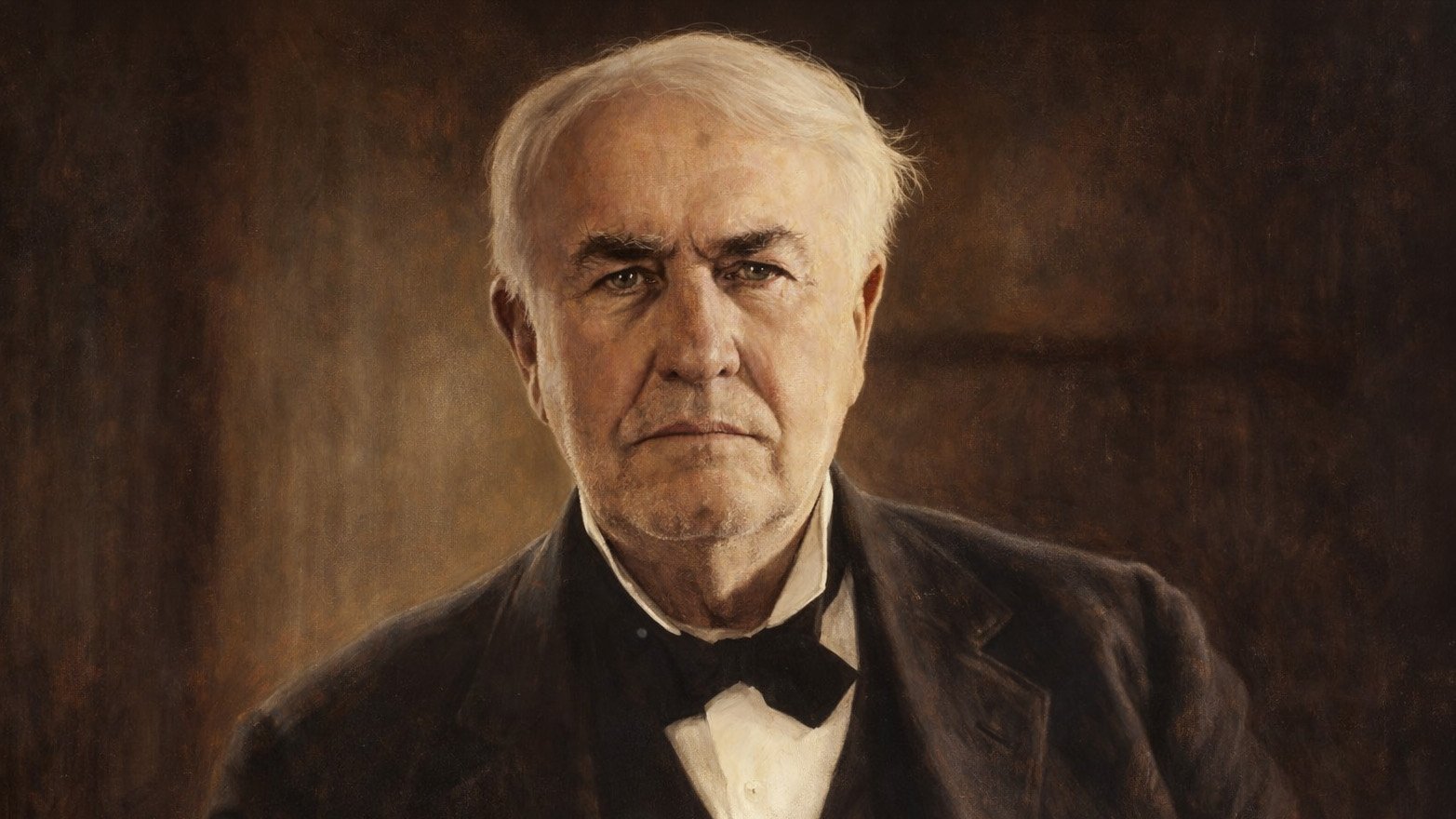
Let’s talk about Thomas Edison — the man who gave us the light bulb, the phonograph, and a spectacular, ego-fuelled meltdown that nearly derailed the entire electrification of the modern world. Behind the legend of America’s greatest inventor sits a far messier, far more entertaining story: the War of the Currents. And spoiler alert — he lost.
It’s the 1880s. Edison has already pulled off the impossible. He’s built Pearl Street Station in lower Manhattan in 1882, the world’s first commercial power plant, pumping direct current (DC) electricity into the buildings of New York City. Direct current is simple, steady, and — crucially — entirely his. He holds the patents. Royalties are rolling in. Life, for Thomas Edison, is very good indeed. Indeed, it seems nothing could touch him.
Then along comes a wiry Serbian immigrant with extraordinary hair and an even more extraordinary brain. Nikola Tesla, fresh off the boat and eager to make his mark, lands a job at Edison’s company. He promptly tells his new boss that the future of electricity lies not in DC, but in alternating current — AC. Tesla has spent years developing the technology. He has the maths, the vision, and a plan. Edison, to put it politely, is not interested. He dismisses AC as utterly impractical and, by most accounts, refuses to pay Tesla what he promised him for improving the DC generators. Tesla, understandably furious, quits. And so begins one of history’s most consequential career moves. And that, right there, is the moment Edison handed his rivals the knife.
Tesla goes on to patent his AC system and sells those patents to George Westinghouse — an industrialist with deep pockets, sharp instincts, and absolutely no patience for Edison’s nonsense. Westinghouse immediately begins rolling out AC electricity across America. Whereas Edison’s DC system needs a power station roughly every mile, AC can travel enormous distances along power lines without losing energy. To power a whole city on DC, you essentially need to carpet it in generators. Westinghouse, by contrast, can power entire cities from a single plant miles away. The difference, in practical terms, is enormous.
Edison knows his system is inferior. He also knows what that means for his fortune. So rather than admit defeat and adapt — which, let’s be honest, would have been the sensible thing — he does something far more interesting. He launches a propaganda campaign of quite breathtaking audacity. He starts electrocuting animals. Publicly. With AC.
Working alongside a rather enthusiastic electrical engineer named Harold Brown, Edison begins staging public demonstrations to prove that alternating current is lethal. Brown pays neighbourhood boys twenty-five cents each to round up stray dogs in New Jersey. Those dogs are then electrocuted with AC at Edison’s laboratory while the press watches. Calves, horses, and other unfortunate creatures follow in due course. Moreover, Edison coins a delightful new phrase for the proceedings: getting “Westinghoused.” He apparently hoped it would catch on as common slang. It didn’t, but you have to admire the commitment.
Still not satisfied, Edison secretly helps finance the development of America’s first electric chair — ensuring, naturally, that it runs on AC. His logic is exquisitely cynical: if AC becomes synonymous with state-sanctioned death, the public will surely never accept it in their homes. Furthermore, the first execution, of convicted murderer William Kemmler in 1890, goes catastrophically wrong. Technicians misjudge the voltage, the procedure has to be repeated, and the room fills with the smell of burning flesh. George Westinghouse, appalled, reportedly mutters that they would have done better with an axe. Edison, for his part, pretends the whole thing is nothing to do with him.
Then there is the myth of Topsy the elephant — possibly the most misunderstood footnote in the entire war. Popular internet legend has it that Edison personally electrocuted a circus elephant at Coney Island in 1903 as a final, desperate act of anti-AC propaganda. It makes for a cracking villain origin story. Unfortunately, it is largely rubbish.
By 1903, the War of the Currents had been over for a decade. Edison had long since lost control of his company, which had merged into General Electric in 1892. He wasn’t even at Coney Island that day. Topsy was put down — by park management, not Edison — because she had killed three people. His film company recorded it, which is probably why his name got attached to the whole affair. Circumstantial at best, mythological at worst. In fact, by the time Topsy died, Edison had long since sold his General Electric stock to chase an iron ore refining venture.
The actual turning point in the war came not from an elephant, but from a world fair. In 1893, Westinghouse won the contract to light the Chicago World’s Fair — the World’s Columbian Exposition — at a fraction of the price Edison’s team had quoted. Millions of visitors wandered, open-mouthed, through a city blazing with AC-powered electric light. Consequently, it became the most spectacular advertisement for alternating current that money couldn’t buy. Three years later, when the first AC generators at Niagara Falls began sending electricity twenty-six miles to Buffalo, New York, the game was well and truly up. Even General Electric — the company born from Edison’s empire — quietly switched to AC. Edison, meanwhile, eventually admitted he regretted not listening to Tesla at the very beginning. That is the sort of confession that probably keeps a man awake at night.
What makes the whole saga deliciously ironic is that Edison’s legacy is bulletproof despite losing the battle he fought dirtiest. Tesla, who actually won, died alone and penniless in a New York hotel room — having cheerfully torn up a contract that would have made him extraordinarily wealthy, just to save Westinghouse from bankruptcy. Tesla had the genius and the grace. Edison, on the other hand, had the publicity machine and the ego. History, being the chaotic thing it is, rewarded both of them — just not in the ways either expected.
As a final twist, the War of the Currents never quite ended. DC has staged a quiet comeback in recent decades, powering everything from your laptop battery to solar panels to electric vehicles. New York City’s last DC utility only shut down in 2007. Edison would probably take that as a moral victory. He’d be wrong, of course. Nevertheless, given everything we know about the man, that seems entirely on brand.
Post Comment
You must be logged in to post a comment.