The World’s Oldest Metro Station Has Seen It All
Prefer to listen? Enjoy the full story of Baker Street Station on Youtube
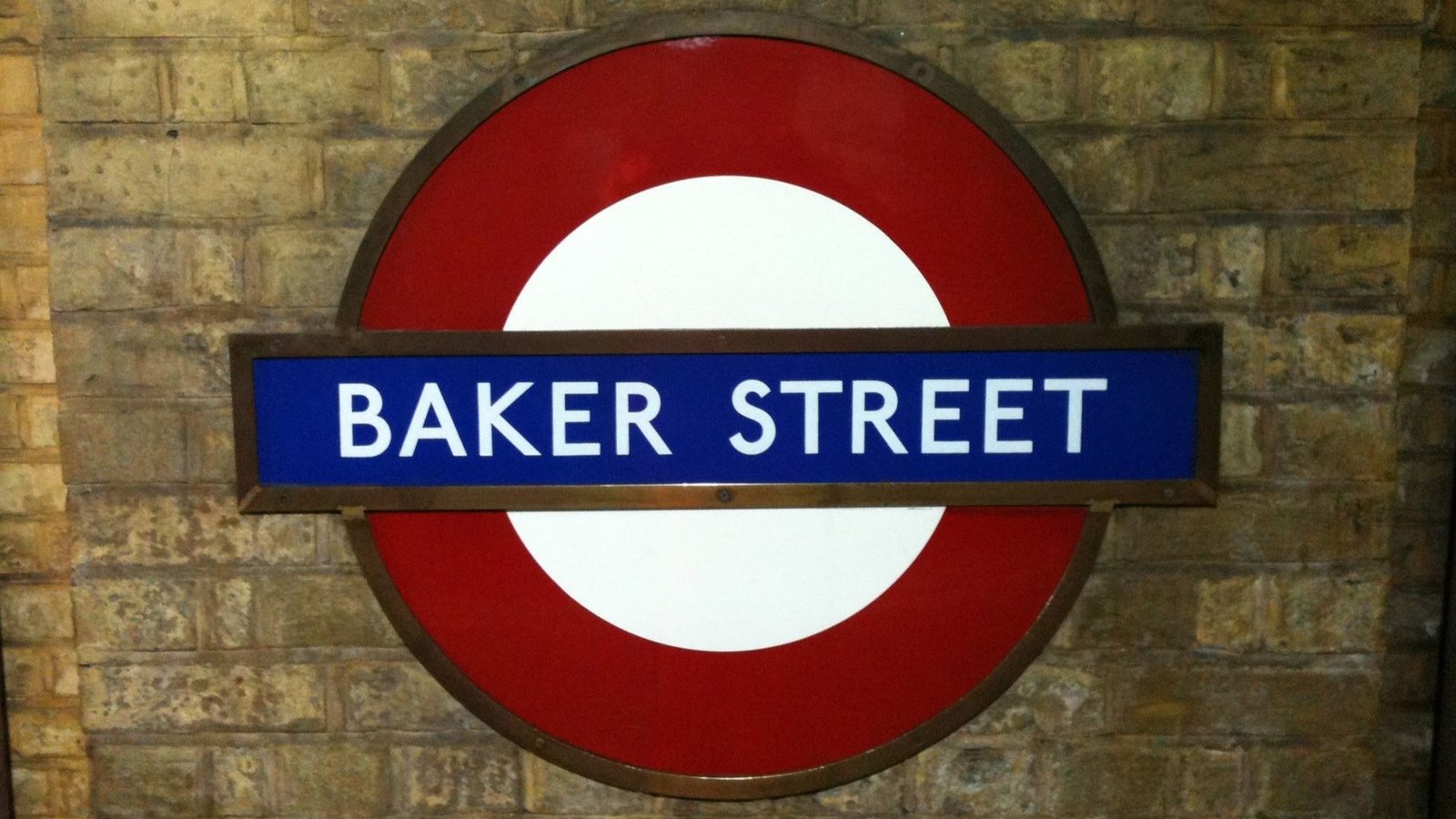
Baker Street Station smells faintly of history and brake dust. Stand still long enough on one of its old brick platforms and you’ll hear echoes of Victorian boots, steam whistles, and the collective astonishment of 19th‑century Londoners who first dared to travel beneath their own city. Opened on 10 January 1863, this unassuming corner of Marylebone Road became the heart of the world’s first underground railway: the Metropolitan Railway. In that moment, London became the birthplace of the modern metro, and Baker Street its oldest living witness.
The Metropolitan Railway was a triumph of boldness over common sense. Digging beneath London’s choking streets using the crude cut‑and‑cover method meant tearing up roads, displacing traffic, and praying the tunnels wouldn’t flood. Yet when the first trains rolled out, pulled by steam locomotives in gas‑lit carriages, crowds lined up to descend into the smoky underworld. Twenty‑six thousand passengers rode it on opening day. They complained about soot in their eyes, but they loved the speed — fifteen minutes from Paddington to Farringdon without a single horse in sight.
Baker Street, one of the original seven stations, became a gateway to this underground novelty. The engineers built it in yellow London stock brick, vaulting the roof into graceful arches that still stand today. Step onto the Circle or Hammersmith & City line platforms and you’re looking at the 1863 originals, soot stains and all. You can practically hear the hiss of steam and the click of brass buttons on frock coats. It feels like a time capsule that somehow kept its commuter schedule.
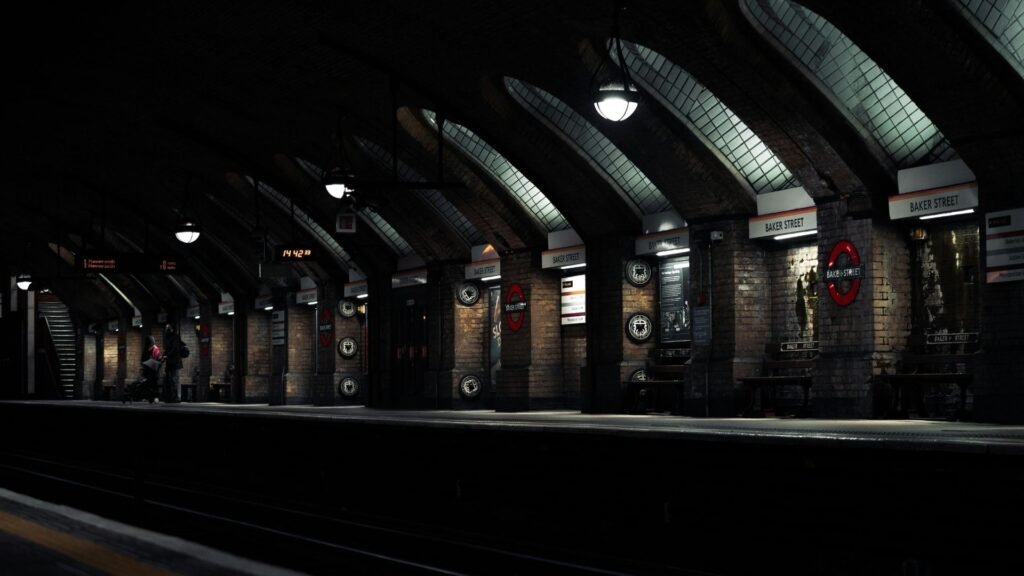
Photo by Tom Whyte
The early station was primitive by today’s standards. Ventilation meant holes in the road above, and passengers often emerged looking like chimney sweeps. Still, the system worked, and within a few years the line expanded both east and west. By 1868 Baker Street was no longer a mere stop — it was a junction, sprouting new branches towards Swiss Cottage and beyond. To keep up, engineers added more platforms, creating a complex warren of tunnels and staircases. Later, the deep‑level Bakerloo and Jubilee lines joined in, giving Baker Street an impressive total of ten platforms — a proper subterranean metropolis.
Above ground, the station was dressed for respectability. The Metropolitan Railway commissioned a grand new frontage between 1911 and 1913, designed by Charles W. Clark, the company’s in‑house architect. His work gave the station an Edwardian gravitas, topped later by Chiltern Court — a vast apartment block that still looms over the entrance. Its restaurant became the Metropolitan Bar, where commuters once toasted the future of transport over stout and shepherd’s pie.
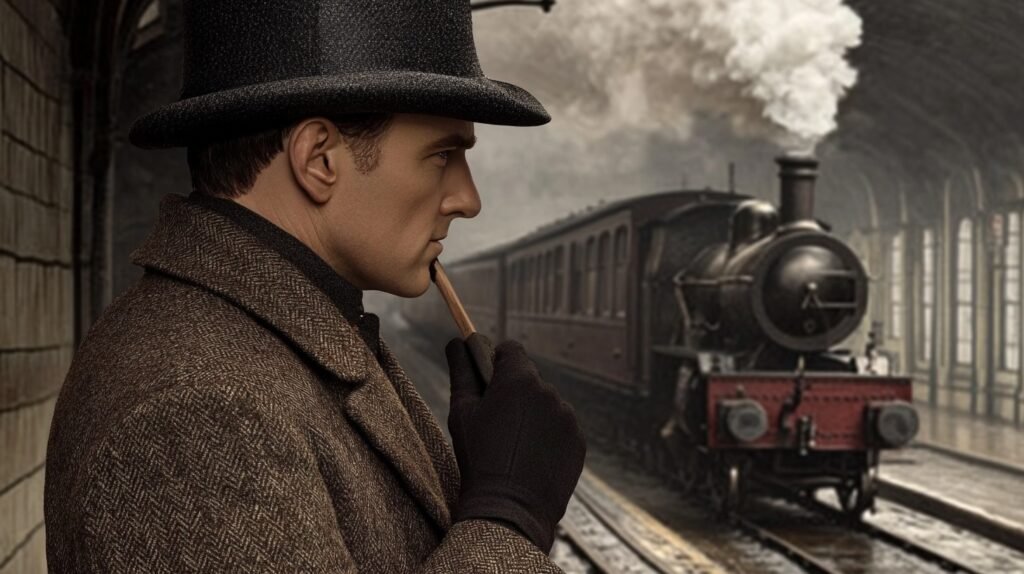
Then came Sherlock Holmes. Or rather, he had already been there all along, at 221B Baker Street, just a short stroll away — at least in the minds of readers. When Arthur Conan Doyle’s detective captured the public imagination, Baker Street Station found itself transformed from mere transit hub to literary shrine. Today, silhouettes of Holmes adorn the platform tiles, and a bronze statue of the detective keeps watch outside the station. Tourists snap selfies beside his pipe while commuters hurry past, unbothered by the world’s most famous fictional resident.
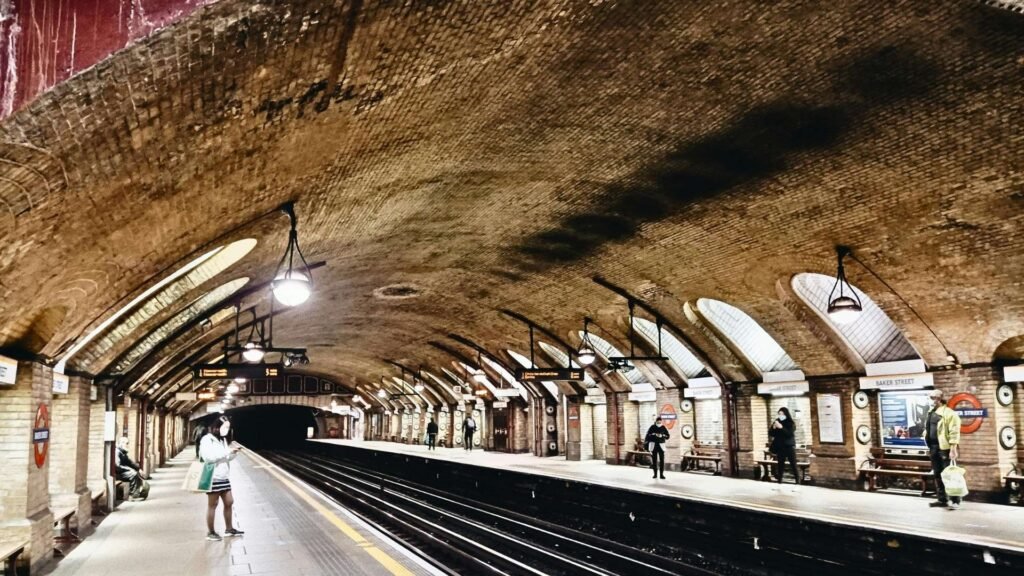
It’s a station of contrasts: the old sub‑surface platforms hum with heritage while the deeper tunnels flash with LED displays and Jubilee line trains. The Victorian brick arches sit a few metres above the sleek 1970s concrete, and between them runs a century of technological ambition. Electrification replaced steam in 1905, bringing cleaner air and faster trains, but not before decades of coughing passengers proved how desperately it was needed. You can almost imagine a Victorian commuter, top hat tilted, marvelling at today’s driverless escalators.
For architecture enthusiasts, Baker Street is a layered sandwich of London’s urban history. The oldest parts are Grade II* listed, a nod to their pioneering engineering and endurance. The original ticket hall, refurbished in the 1980s, preserved many period details — wrought‑iron railings, old signage, and even replicas of gas lamps. Each restoration seems to respect the ghosts that haunt its walls, never quite erasing their presence. Beneath the modern signage and CCTV cameras, the old bricks still breathe London soot.
What makes Baker Street so endlessly fascinating isn’t just its age, but its personality. Unlike newer, sterile stations, it has quirks: narrow tunnels that suddenly open into wide platforms, mismatched tiles from different eras, and the occasional waft of something unmistakably metallic mixed with nostalgia. It’s a living museum disguised as public transport. The walls have witnessed everything from wartime blackouts to Beatles‑era commuters. During the Second World War, like much of the Underground, its tunnels served as air‑raid shelters — a refuge where Londoners sang to drown out the Blitz above.
The station also mirrors the city’s evolution. When it opened, it represented a leap into the industrial unknown — humans going underground to escape their own congestion. Now it’s a symbol of continuity, a reminder that modern London still runs on Victorian foundations. Every Circle line train that rattles through those old arches is a nod to the engineers who first imagined a subterranean city before electricity, before motorcars, before anyone thought to call it a Tube.
For the traveller, Baker Street offers more than a commute. Step outside, and you’re in one of London’s most curious neighbourhoods — a blend of history, mystery, and genteel chaos. Madame Tussauds is a few steps away; Regent’s Park lies just beyond. But the station itself is the real attraction for anyone with a taste for time travel. Find platform 5, pause beneath the arched ceiling, and imagine the scene in 1863: steam swirling, lamps flickering, and the smell of damp brick mixed with coal smoke. The same air still circulates here, seasoned by 160 years of progress.
What’s remarkable is how the station never stopped adapting. The Jubilee Line’s arrival in 1979 brought modern escalators and a fresh subterranean level, yet engineers managed to weave it seamlessly into the historic structure. It’s like a palimpsest — every generation adding a layer without erasing the previous one. In an age obsessed with the new, Baker Street proves that endurance can be more impressive than novelty.
Few cities treasure their infrastructure like London does. Here, even a daily commute is an encounter with history. The tiles whisper stories if you listen — of engineers covered in soot, of soldiers sleeping on the platforms, of tourists searching for 221B. Somewhere between the 1860s and today, Baker Street stopped being just a station and became a character in its own right: stubborn, dignified, and slightly eccentric.
So next time you pass through, don’t rush. Look up at the brick vaults, those patient arches that have seen everything from steam to smartphones. You’re standing in the world’s oldest metro station still in use, the beating heart of a network that changed the way cities breathe. London wouldn’t be London without its Underground, and the Underground wouldn’t exist without Baker Street — that steadfast, slightly smoky reminder that progress sometimes starts beneath our feet.