The Strange Obelisks of Rome
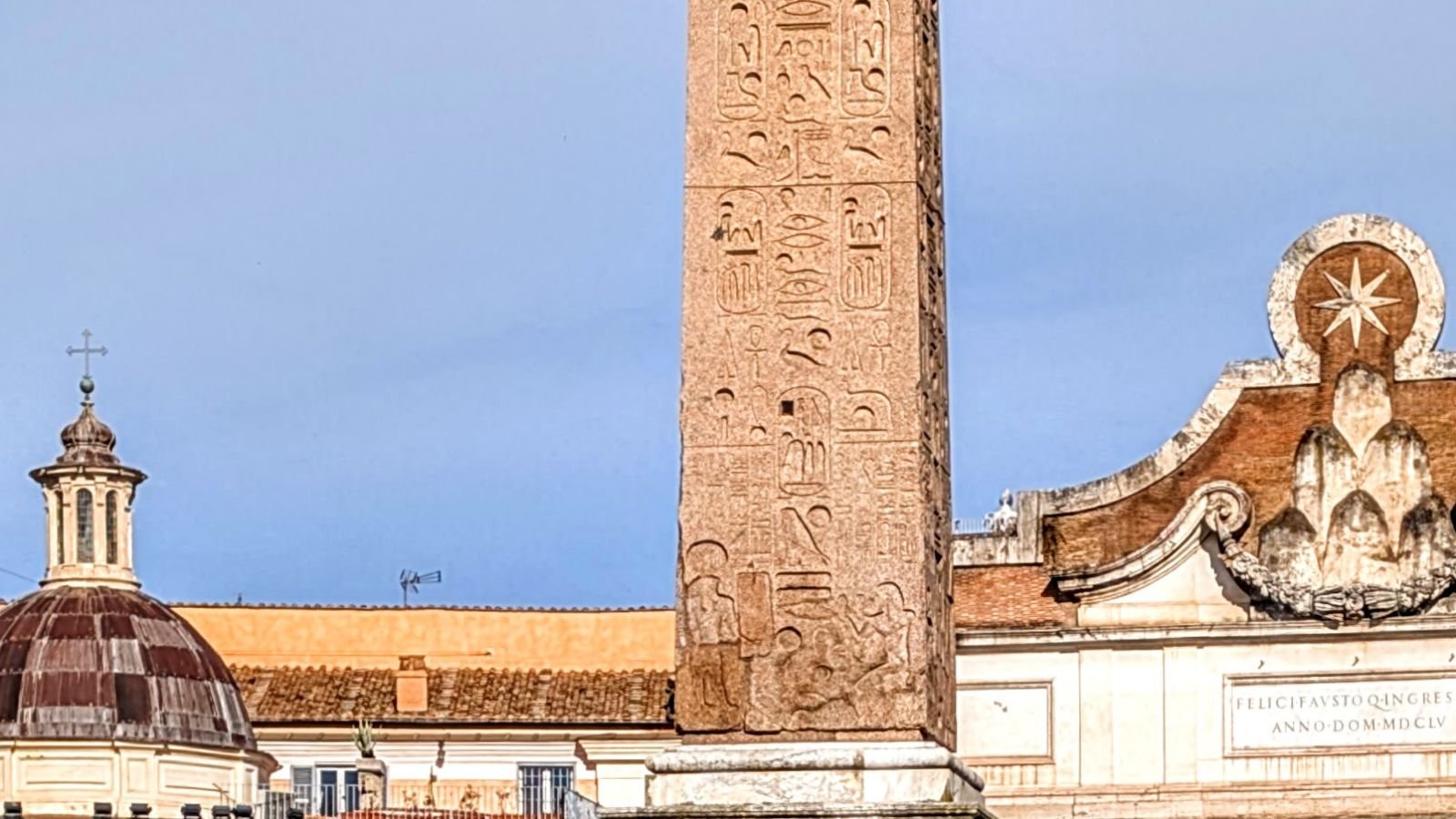
Rome does not whisper about power. Instead, it plants it in the ground in 300-tonne chunks of granite and builds traffic around it. You wander into a sunlit piazza with a gelato in hand, and there it stands: a needle of stone so old it watched pharaohs rise and fall before Latin found its confidence. The strange obelisks of Rome do not merely decorate the city. They supervise it.
At first glance, each one looks almost modest. A tall shaft. Four sides. A pointed tip. No swirling baroque theatrics, no marble saints flinging drapery into the air. Yet that understatement hides a journey that began long before Rome dreamt of empire.
Originally, most of these monoliths stood in Egypt. Workers carved them from single blocks of red granite in Aswan. They hacked them out with pounding stones under a punishing sun. Then they floated them down the Nile on barges. Finally, priests raised them at temple entrances in pairs, covering them in hieroglyphs that honoured Ra and praised the ruling pharaoh with admirable bluntness.
However, centuries later, Roman emperors looked at those monuments and saw something irresistible. Conquest tastes better when it leaves visible trophies. So when Augustus absorbed Egypt into the Roman world, he did not settle for grain and taxes. He wanted symbols. He wanted theatre. He wanted the sun itself, preferably carved in granite.
Specially engineered ships carried obelisks across the Mediterranean. Imagine the spectacle. A floating platform bore a single impossible stone. Sailors stood guard, aware that one mistake could sink the lot. Crowds gathered when the cargo reached Rome. Children pointed. Merchants grumbled about blocked streets. Meanwhile, the empire staged its latest announcement in stone.
Augustus placed one obelisk in the Circus Maximus. There, chariots thundered around it in clouds of dust. He set another in the Campus Martius as the pointer of a vast sundial. Time, he implied, now answered to Rome. Better still, it answered to him. On certain days, the shadow aligned with the Ara Pacis. Whether the alignment worked perfectly matters less than the message. Power thrives on spectacle, and spectacle thrives on confidence.
Later emperors joined this granite competition. Constantius II transported the colossal Lateran Obelisk to Rome in the fourth century. The shaft rises more than thirty metres before you count the base. It once stood at Karnak, steeped in the rituals of ancient Thebes. Now it towers beside the Basilica of St John Lateran. The stone bridges millennia without asking anyone’s permission.
Yet Rome never contents itself with simple relocation. The city prefers reinvention. A pagan monument arrives. Soon a Christian cross appears on top. Latin inscriptions wrap around Egyptian hieroglyphs like firm but polite commentary. Renaissance popes did not smash the obelisks. Instead, they baptised them. They rebranded solar symbols as markers of Christian triumph and planted them in carefully choreographed spaces.
Take the obelisk in St Peter’s Square. Caligula brought it to Rome in the first century and placed it in his circus. According to tradition, it witnessed the martyrdom of Saint Peter nearby. That association gave the stone a second life. In 1586, Pope Sixtus V ordered architect Domenico Fontana to move it to the centre of the newly shaped piazza.
The relocation required hundreds of workers and dozens of horses. Moreover, engineers built wooden towers and rigged elaborate pulley systems. Fontana banned shouting during the operation to avoid confusion. Silence, he believed, would prevent chaos. As ropes tightened and wood creaked, tension must have hummed through the crowd.
Then, so the story goes, a sailor cried out. He advised the team to wet the ropes so they would not snap under friction. Guards seized him for breaking orders. The pope, however, recognised the wisdom and rewarded him. Whether embroidered or exact, the tale fits Rome perfectly. Drama, risk, and a final flourish.
Today, the obelisk anchors the sweeping colonnades of St Peter’s Square. Pilgrims gather around it. Photographers circle it. Cardinals process past it in scarlet. Meanwhile, hieroglyphs continue their silent monologue about long-dead pharaohs. Few visitors can read them. Nevertheless, the inscriptions endure.
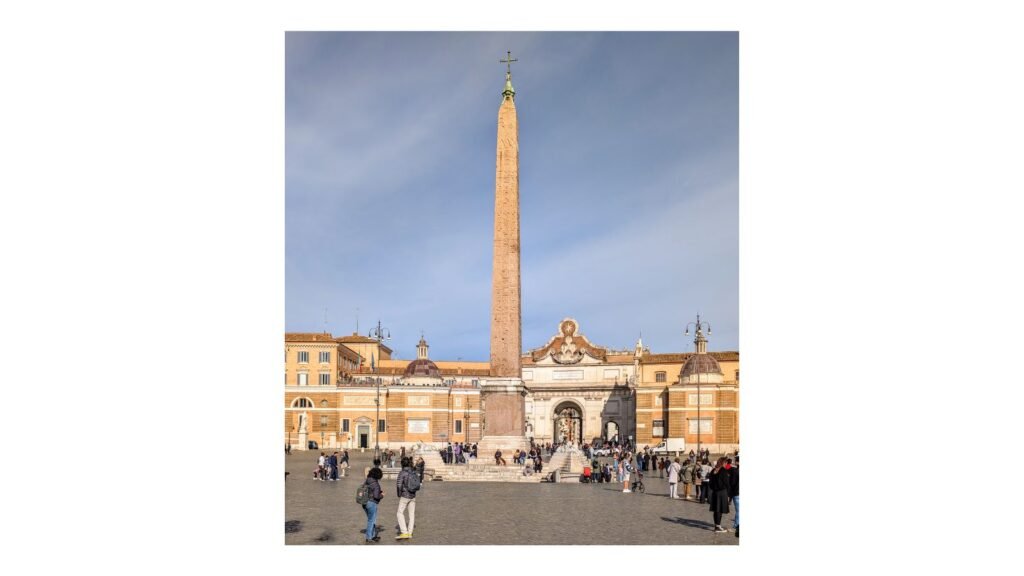
Elsewhere in the city, obelisks act as punctuation marks. Piazza del Popolo uses one to command the space between its twin churches. Piazza Navona crowns Bernini’s Fountain of the Four Rivers with another. Baroque exuberance collides with ancient austerity, yet the pairing works. Even the Spanish Steps claim a slender obelisk at the top. That one comes from Roman workshops rather than Egyptian quarries. Rome, after importing the originals, learned to copy the style with confidence.
Near the Pantheon, a smaller obelisk enjoys perhaps the most playful setting. In the seventeenth century, workers uncovered it broken and buried. Pope Alexander VII commissioned Bernini to provide a base. The sculptor responded with an elephant. Not a raging beast, but a charming one with a faintly mischievous air.
Consequently, the granite shaft rises from the elephant’s back as though wisdom requires sturdy support. A Latin inscription reinforces the idea. Some locals insist the elephant smirks at a nearby monastery. Whether true or not, the story adds flavour to the square.
Still, these monuments do more than decorate postcards. They shape Rome’s urban logic. Stand in any major piazza and notice how the eye gravitates towards the vertical line. The obelisk anchors space. It creates orientation. It offers a meeting point that never closes for lunch. City planners still rely on such focal markers. Rome achieved the effect centuries ago with borrowed Egyptian sunlight.
For nearly two thousand years, nobody in Rome could read the hieroglyphs. Scholars speculated about hidden meanings. Some imagined mystical secrets. Others treated the carvings as exotic ornament. Only after Champollion deciphered hieroglyphs in the nineteenth century did the inscriptions regain their voice. Suddenly, the stones spoke again. They revealed dedications to Amun-Ra and boasts about pharaonic victories.
Meanwhile, myths flourished. A bronze orb atop the Vatican obelisk allegedly contained Julius Caesar’s ashes. Workers opened it during the Renaissance and found nothing of the sort. Emptiness, however, rarely spoils a good story. Guides still recount the tale with a wink.
Transporting these monoliths required audacity. Engineers designed ships capable of bearing their weight. Labourers hauled them upright with capstans and ropes. Trumpet signals coordinated teams. A snapped rope could kill. A misjudged angle could shatter years of effort. Yet Rome persisted. Granite equalled prestige, and prestige justified risk.
Over time, some obelisks fell. Earthquakes toppled them. Buildings collapsed around them. Soil swallowed them whole. Centuries later, Renaissance popes rediscovered and resurrected them. Often they placed them in entirely new locations. The city treated them less like relics and more like reusable assets.
A square lacked drama. Therefore, planners planted an obelisk. A pilgrimage route needed emphasis. So they raised a granite marker. Rome understood that verticality commands attention. The message felt simple: look up.
However, the story does not end in the Renaissance. Modern Rome continues to orbit these ancient shafts. Cars circle them in busy roundabouts. Protesters rally near them. Couples lean against their bases while debating dinner plans. Granite outlasts ideology, yet it absorbs each new layer of life.
You might ask why Rome hosts more ancient obelisks than Egypt itself. The answer combines conquest, vanity, and spectacle. Egyptian temples lost their monoliths as Roman emperors claimed them. Later, neglect and reuse altered Egyptian landscapes. Meanwhile, Rome guarded its trophies as proof of imperial reach.
Ironically, the city that once conquered Egypt now preserves fragments of its monumental identity. History enjoys such reversals. Rome, after all, built its greatness on adaptation. It rarely invents from nothing. Instead, it absorbs and reframes.
Egyptian solar symbols became Roman political statements. Roman trophies later became Christian signposts. Ancient hieroglyphs now coexist with papal coats of arms. Each layer remains visible. Rather than erase the past, Rome stacks it.
Walk through the city at dusk and watch shadows stretch across cobblestones. The obelisks darken against a glowing sky. Street musicians pack up. Tourists drift away. Yet the granite remains, holding centuries in quiet balance.
On another morning, stand in Piazza Montecitorio near the Italian Parliament. The obelisk that once served as Augustus’s sundial pointer still marks the space. Lawmakers hurry past. Journalists cluster nearby. The ancient shaft measures distance, if not time. Empire has changed costumes. The stage props endure.
Strange, then, does not mean alien. Instead, it means layered. It suggests something slightly out of place yet entirely at home. Rome’s obelisks belong to Egypt by birth, to Rome by adoption, and to Christianity by reinterpretation. They form a granite chorus that refuses to sing a single tune.
Perhaps that explains their magnetism. They travelled across seas. They survived upheaval. They endured earthquakes and theological shifts. They watched chariot races and papal coronations. They witnessed martyrdoms and modern marathons.
Next time you find yourself in Rome, do not rush past the nearest obelisk on your way to espresso. Step back. Look up. Consider the quarry workers in Aswan. Think about Roman sailors straining at ropes. Picture Renaissance architects calculating angles without spreadsheets.
After all that effort and ambition, the result stands casually in a piazza where someone checks messages on a smartphone. Granite, it turns out, makes an excellent storyteller. Rome simply provides the stage.