The Revolutionary Brew of the Boston Tea Party
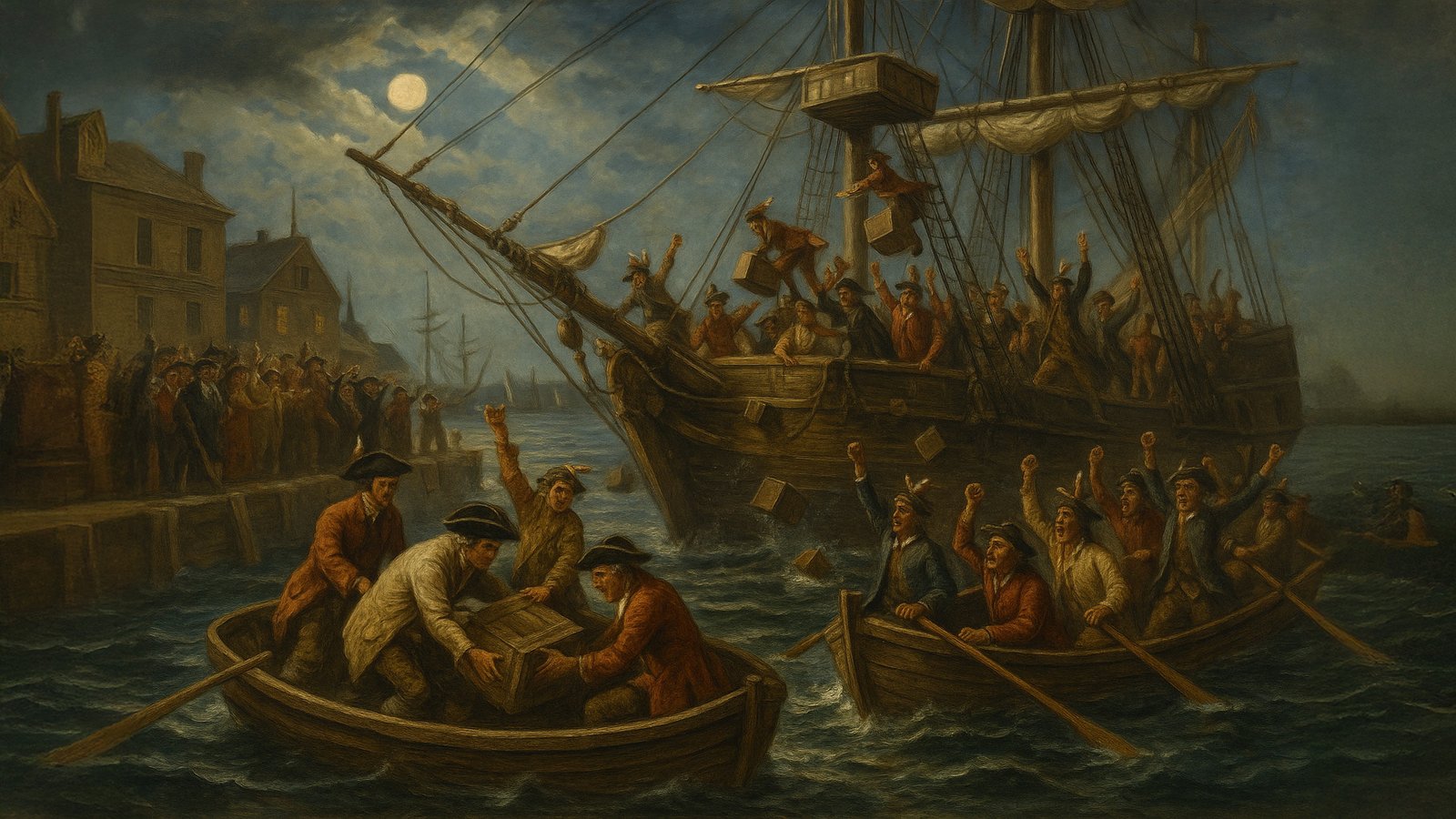
Boston carries a special sort of swagger whenever the Boston Tea Party comes up, as if the whole city still remembers the night locals turned a quiet harbour into the world’s most famous oversized teacup. The episode grew from daily irritation into an act that reshaped imperial politics, but it began with something deceptively simple: colonists tired of being told what to drink, what to pay and how cheerfully they should accept it. By the time the Boston Tea Party unfolded on 16 December 1773, patience had thinned so dramatically you could see daylight through it.
The Sons of Liberty, the increasingly restless network of agitators, had watched resentment over British policy bubble for years. Boston felt perpetually on edge. Crowds grumbled about the Stamp Act, simmered over the Townshend Duties and replayed the Boston Massacre until it hardened into political legend. Customs officers strutted about as if they owned the place, and soldiers lodged themselves in civilian spaces with a confidence that made tempers twitch. Anyone with a pulse sensed that something dramatic hovered in the air.
The Tea Act of 1773 ignited what remained of calm. Parliament believed it had found a clever way to prove its authority: make tea cheaper. People love bargains, London reasoned, so colonists would surely accept the tax buried inside the newly discounted leaves. Except colonial pride recoiled. The Boston Tea Party didn’t come from a hatred of tea; it came from the insult of manipulation. The Act also handed the East India Company a sweet monopoly. Local merchants smelled the hostility instantly because nothing sours patriotism faster than someone interfering with profit.
The East India Company, that sprawling empire-within-an-empire, staggered under financial trouble and needed a rescue package. The Tea Act served as its lifeline, letting shipments go directly to colonial ports. Middlemen who’d made their fortunes off smuggled Dutch tea glared at the legislation as if it were personally out to ruin them. Ideals and wallets merged so smoothly that even participants might have struggled to tell where principle ended and practicality began. The Boston Tea Party became a tidy rallying point for anyone who disliked taxes, monopolies, imperial arrogance or, frankly, being told what to do.
On the cold evening of 16 December, Old South Meeting House overflowed with people who had run out of patience. Voices climbed, tempers sharpened and arguments clattered across the hall like dropped tankards. When news arrived that Governor Hutchinson refused to let the tea ships leave the harbour, the mood changed. Samuel Adams supposedly declared that the meeting could do nothing more to save the country. He might as well have rung a bell. People surged outside with new determination stitched into their strides.
Disguises appeared, though calling them disguises feels generous. A smear of paint, a few feathers, ripped clothing and a vague nod toward Mohawk symbolism turned participants into a makeshift theatre troupe. The gesture carried layers. It helped obscure identities but also expressed a budding sense of cultural distance from Britain. Historians now critique this appropriation with good reason, but on that night it broadcast defiance and separation. The Boston Tea Party unfolded as a blend of rebellion and performance.
Down at Griffin’s Wharf, three ships waited: the Dartmouth, the Eleanor and the Beaver. Their holds groaned under hundreds of chests filled with Bohea, Congou, Souchong and Hyson tea from Fujian province. The harbour glimmered faintly, just enough for the men to see the scale of what they were about to dump. Yet the Boston Tea Party lacked the chaos British authorities later described. Participants boarded quietly, smashed the chests with brisk efficiency, and poured roughly 45 tonnes of tea into the cold water. They swept the decks afterwards, determined that no stray leaf would remain. Nothing else was damaged. It was targeted destruction with surprisingly neat manners.
Some of that tea still exists, trapped in harbour sediments until dredging work brought it up centuries later. Museums display fragments sealed in glass, proof that even ruined tea can ascend to historical glory. It’s strange to imagine those damp leaves drifting through the water while the empire they symbolised tried to puzzle out how a colony had dared such rhetoric made physical.
News reached London before the last leaves had sunk. The reaction came crisp and furious. The Coercive Acts of 1774 — rechristened the Intolerable Acts by colonists — attempted to crush Boston into submission. The harbour closed until someone paid for the destroyed tea. Town meetings found themselves restricted. Royal officials gained the luxury of trials held elsewhere. Soldiers acquired fresh authority to settle themselves in private homes. Britain treated the Boston Tea Party as a tantrum requiring strict discipline. The colonies treated Britain’s response as an overreach demanding resistance.
Ironically, the backlash united the colonies far more effectively than the Boston Tea Party itself. Some colonists had initially muttered that the destruction felt excessive. Revolutionary theatre doesn’t please everyone. But once Britain tightened the screws, sympathy for Boston spread quickly. Representatives gathered in the First Continental Congress, and the idea of a joint revolutionary identity began to take shape, even if no one yet dared to imagine how far it would ultimately go.
The spirit of the Boston Tea Party spilled outward. Philadelphia blocked tea ships entirely. New York sent vessels packing as well. Charleston stored its tea in damp warehouses where it quietly devalued. Annapolis went full drama and burned the entire ship Peggy Stewart. By then, tea had stopped being a beverage and become a political symbol people tossed, hid or incinerated to signal loyalty.
But tidy myths don’t fully capture the Boston Tea Party. Smuggling interests played a part. Class tensions shaped participation. Wealthy merchants framed the rhetoric, while dock workers provided the muscle. Everyday frustrations mingled with grand political ideals. The event wasn’t a unified moral chorus; it was a rowdy symphony of overlapping motives. Yet that doesn’t diminish its significance. Rather, it makes the Boston Tea Party more recognisably human.
Women stayed off the ships but proved essential to the movement. The Daughters of Liberty championed boycotts, brewed liberty tea from herbs and ensured that resistance seeped into daily life. Revolutions require infrastructure, and they built it quietly, one cup at a time.
As decades passed, the Boston Tea Party’s edges softened. Retellings polished the rough details and sculpted the event into patriotic legend. Children learned a version where colonists stood united and noble, their disguises tidy and intentions pure. Reality had been far messier, but national memory prefers a narrative that fits neatly into textbooks.
Still, the Boston Tea Party remains one of history’s most striking examples of political theatre. Modern Boston reenacts the event every year with gusto, complete with costumed volunteers and replica tea chests hurled into the water. Visitors queue at the Boston Tea Party Ships & Museum for the chance to act out the rebellion and feel momentarily like participants in the birth of a nation. Historians widen the frame, tracing the event through global trade, imperial policy, racial symbolism and corporate power.
The longer one studies that December night, the more extraordinary it seems. Ordinary people walked onto three ships, lifted their hatchets and tipped an empire’s arrogance into the sea. They didn’t know they were nudging the world toward a revolution that would redraw maps, transform politics and spark centuries of debate. They simply knew they would not accept tea that carried the weight of a tax they had no voice in creating.
The harbour has changed since then. Ice froze and thawed, tides shifted, ships came and went, and skyscrapers rose along the shoreline. But the story of the Boston Tea Party endures. It ripples outward in every retelling, a reminder that political change often begins with small acts of refusal — sometimes even with the quiet splash of tea hitting dark water.