The Queen Who Almost Ruled Britain
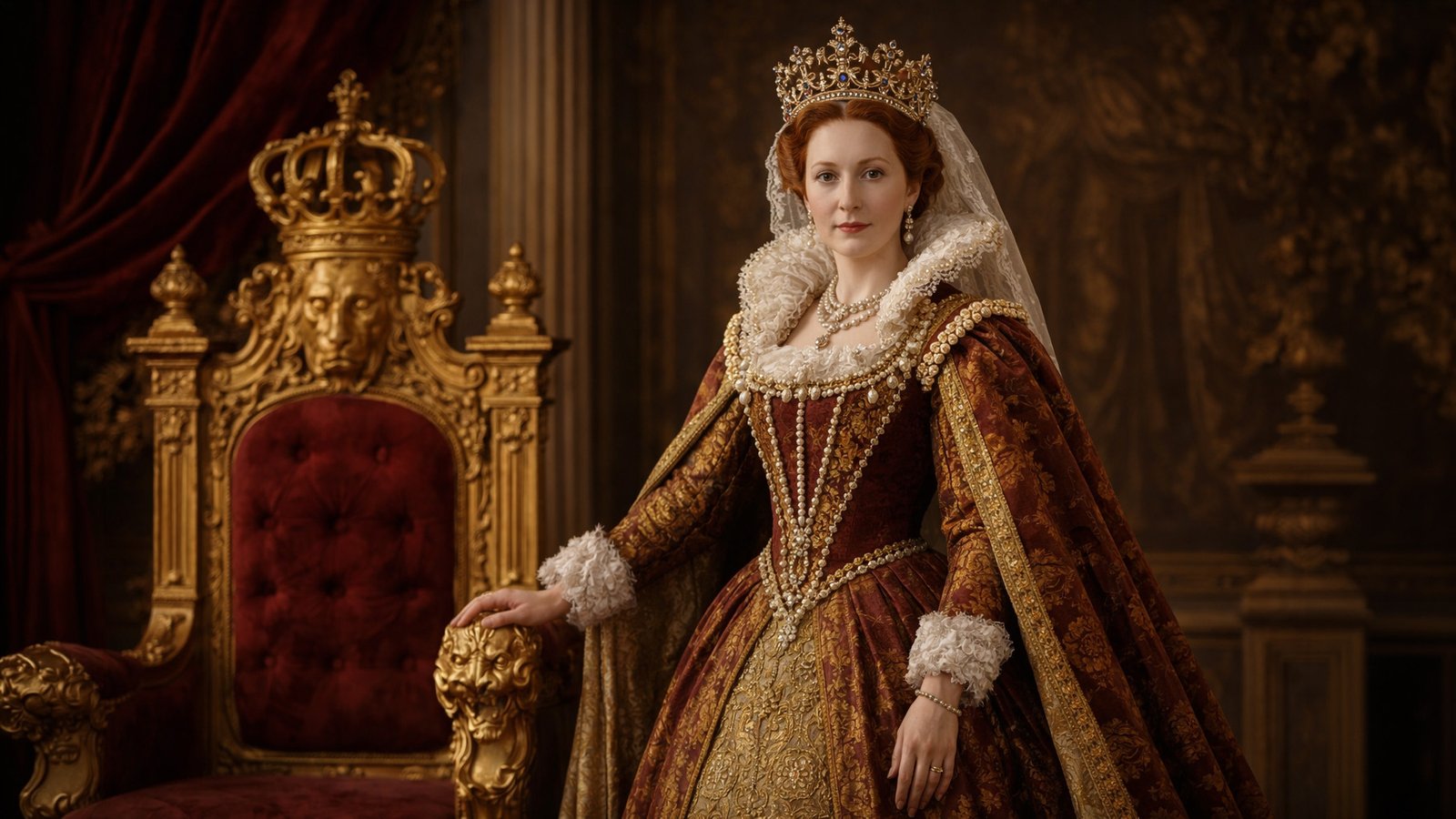
The sixteenth century loved dangerous possibilities, and few looked more dramatic than the idea of Mary Stuart wearing the English crown. Her claim never belonged to fantasy. Instead, it hovered over Elizabethan England like a persistent shadow. Catholic Europe watched carefully, English Catholics whispered hopefully, and diplomats quietly sketched scenarios in which the Scottish queen might step across the border and inherit a kingdom that officially rejected her religion.
Mary’s claim rested on blood rather than ambition. Her grandmother Margaret Tudor was the sister of Henry VIII, which placed Mary firmly inside the Tudor family tree. Many Catholics therefore considered Elizabeth illegitimate because Henry VIII’s marriage to Anne Boleyn had broken with Rome. Under that interpretation, Mary Stuart appeared less like a rival and more like the rightful heir waiting politely across the border.
Consequently the debate in London rarely sounded abstract. Ministers asked practical questions instead. When might Mary become queen? Under what circumstances would England accept her? Most nervously of all, who might help her claim the throne first?
Elizabeth understood the danger immediately. From the moment Mary returned to Scotland in 1561, English advisers treated her less like a neighbouring monarch and more like a political time bomb. Yet the situation remained complicated. Mary was family, she was royal, and executing a fellow queen felt alarmingly radical even for Tudor politics.
Meanwhile Mary herself never behaved like a passive claimant. She possessed charm, education, and a remarkable talent for attracting powerful allies. Raised in France from childhood, she spoke French more comfortably than Scots and moved through European courts with effortless confidence.
Her early life already carried the scent of continental power. At sixteen she married Francis II of France, briefly becoming queen consort of one of Europe’s most influential kingdoms. Although Francis died young, the marriage left Mary deeply connected to French politics and Catholic diplomacy. As a result any future English crown on her head would have pulled England closer to France almost automatically.
That possibility unsettled Elizabeth’s government. England had spent decades trying to avoid domination by either France or Spain. A queen with strong French loyalties therefore looked strategically dangerous. Even worse, Catholic Europe viewed Mary as a potential instrument for reversing the English Reformation.
Nevertheless several realistic roads might have carried Mary to the English throne.
Patience offered the simplest path. Elizabeth never married and produced no children. Eventually England needed an heir. Mary Stuart stood close enough in the Tudor bloodline to appear as the natural successor if politics remained calm. Had Elizabeth allowed Mary to live quietly in Scotland or England, the crown might have passed to her peacefully.
However peace rarely defined Tudor politics. Religious tension simmered constantly beneath the surface. England’s official Protestant identity satisfied neither extreme. Many Protestants feared Catholic restoration, while many Catholics considered Elizabeth’s church settlement illegitimate.
As a result rebellion always lingered in the background. The Northern Rebellion of 1569 demonstrated how quickly events might shift. Catholic nobles in northern England rose against Elizabeth and hoped to place Mary on the throne. Their uprising collapsed quickly. Yet the episode proved that Mary’s supporters possessed both organisation and ambition.
Foreign assistance might easily have transformed that rebellion from a regional disturbance into a national crisis. Spain watched England cautiously under Philip II. France maintained its own interest in weakening Elizabeth’s government. If either power had committed troops, the political map of Britain might have changed overnight.
Unfortunately Mary complicated her own chances through a series of disastrous personal decisions. Scotland already struggled with religious division between Protestant reformers and traditional Catholic elites. Instead of calming the situation, Mary’s reign often intensified the drama.
The murder of her second husband Henry Stuart, Lord Darnley, in 1567 shocked Europe. Darnley’s residence exploded in Edinburgh under mysterious circumstances. Although the exact conspiracy remains debated, suspicion quickly drifted toward James Hepburn, Earl of Bothwell.
Events soon turned even stranger. Within months Mary married Bothwell, the very nobleman widely suspected of organising Darnley’s death. Scottish nobles reacted with fury. They rebelled against her authority, defeated her forces, and forced her abdication in favour of her infant son James.
That moment altered British history dramatically. Instead of ruling Scotland confidently while waiting for Elizabeth’s throne, Mary became a fugitive queen searching for protection. She fled south into England in 1568 expecting Elizabeth’s support.
Elizabeth faced an extraordinary dilemma. Offering hospitality seemed natural between queens. However Mary’s presence inside England instantly energised Catholic conspiracies. Every rumour, every whispered plot, and every coded letter suddenly revolved around the same possibility: replace Elizabeth with Mary Stuart.
Consequently Elizabeth’s government confined Mary rather than freeing her. The arrangement resembled polite imprisonment. Guards accompanied her constantly, although she lived in castles and manor houses rather than prison cells. She hunted, wrote letters, and maintained a small court while England’s ministers monitored every conversation.
Nevertheless plots multiplied around her captivity. The Ridolfi Plot in 1571 imagined Spanish troops landing in England while Catholic nobles proclaimed Mary queen. Later the Throckmorton Plot revived similar ambitions with French assistance. Each conspiracy reinforced Elizabeth’s suspicion that Mary represented a permanent threat.
Meanwhile Europe itself burned with religious conflict. France endured brutal wars between Catholics and Huguenots. The Spanish Netherlands revolted against Spanish rule. Across the continent rulers feared that religious disputes might ignite wider political chaos.
Consequently Mary’s claim formed part of a much larger European struggle between Protestant and Catholic power. If she gained the English throne, England might have rejoined the Catholic sphere of influence stretching from Spain to Italy and across large parts of Central Europe.
However England under Elizabeth had already begun shaping a different identity. Protestant reform stabilised gradually after earlier turmoil under Henry VIII and Mary I. London merchants expanded overseas trade. Sailors pushed exploration across the Atlantic. Writers and playwrights flourished in a cultural environment that celebrated growing national confidence.
For that reason a Catholic queen in London might have redirected that cultural momentum. Patronage networks would likely have shifted toward Catholic nobles and continental artists. Religious policy might have softened toward Rome or even restored certain Catholic institutions. Churches might have regained images, rituals, and ceremonies that Protestant reformers had removed.
Even so Mary herself probably would not have governed as harshly as Mary I of England. Her personality showed more flexibility. She enjoyed diplomacy and understood the dangers of provoking Protestant resistance too aggressively. Therefore she might have attempted a cautious Catholic restoration rather than an immediate religious revolution.
Still such moderation would not have guaranteed stability. English Protestants had grown powerful by the 1580s. Parliament contained many figures committed to defending the Protestant settlement. Even a careful Catholic queen therefore might have faced parliamentary resistance, local unrest, and possible rebellion.
Foreign policy might have shifted even more dramatically. Under Elizabeth, England gradually moved toward rivalry with Spain, especially in maritime trade and colonial competition. Privateers such as Francis Drake attacked Spanish shipping across the Atlantic.
Mary’s diplomatic instincts leaned toward continental alliances rather than maritime confrontation. Her French upbringing and Catholic sympathies could have encouraged closer cooperation with France or Spain. England therefore might have avoided the dramatic naval showdown later remembered as the Spanish Armada of 1588.
Without that conflict England’s naval mythology might look completely different today. Instead of heroic tales about Protestant England defeating Catholic Spain, historians might describe a cautious Catholic monarchy balancing between European powers.
Scotland would also have remained central to Mary’s story. Her son James VI already ruled there after her forced abdication. If Mary later gained the English crown, Britain might have experienced an earlier form of dynastic union under mother and son.
Such an arrangement would have created fascinating political tensions. James had been raised as a Protestant monarch in Scotland. Mary remained personally Catholic. The royal family itself therefore would have embodied the religious divisions shaping Britain.
Yet the partnership might also have stabilised the island. Mary ruling England while James governed Scotland could have created a cooperative dynastic system decades before the historical union of the crowns in 1603.
Eventually James would almost certainly have inherited England after Mary’s death. Britain therefore might still have ended with a Protestant monarch, only after a Catholic interlude. History in that case might have resembled a religious pendulum swinging once again across the British Isles.
The greatest uncertainty concerns political stability. Mary possessed charisma and intelligence, but her record in Scotland suggested difficulty managing powerful nobles. England’s aristocracy remained equally ambitious and suspicious of royal authority.
Her reign therefore might have unfolded through constant negotiation between crown, parliament, and religious factions. Some historians imagine a period of fragile compromise rather than decisive transformation.
One event ultimately prevented the experiment entirely. In 1586 English agents uncovered the Babington Plot, a conspiracy proposing the assassination of Elizabeth and the installation of Mary as queen. Letters written in coded correspondence appeared to show Mary supporting the plan.
Elizabeth’s ministers seized their opportunity. They presented the letters as proof that Mary had authorised treason against the English crown. Parliament demanded decisive action. After years of hesitation, Elizabeth finally signed the warrant ordering Mary’s execution.
Mary Stuart died in 1587 at Fotheringhay Castle. Witnesses later described the scene in dramatic detail: the red petticoat beneath her black gown, the calm dignity of her final speech, and the heavy axe that required two blows to complete its grim work.
With that execution the most intriguing alternative in British history vanished in a single winter morning. Mary never tested what kind of queen she might have been in England. Elizabeth continued ruling for another sixteen years before the crown finally passed to Mary’s son James.
Even so the possibility continues to fascinate historians. A Catholic England under Mary Stuart might have reshaped European alliances, religious politics, and cultural identity. Maritime expansion might have slowed. Continental diplomacy might have strengthened. Protestant dominance might have faced a serious challenge.
Yet history often turns on personality as much as policy. Mary’s charm attracted allies easily, but her judgement sometimes betrayed her ambitions. The England she ruled therefore might have experienced both brilliance and instability.
For that reason Mary Stuart remains one of history’s most tantalising almost‑monarchs. She stood within reach of England’s throne for nearly two decades. Europe watched closely. Plots formed repeatedly. Armies occasionally prepared.
Still the crown never reached her head. Instead her son eventually united England and Scotland peacefully in 1603, creating the Stuart dynasty that shaped Britain for the next century. The question of what might have happened under Queen Mary of England therefore remains one of the most intriguing unanswered questions of Tudor history.
Post Comment
You must be logged in to post a comment.