The Okapi: Half Giraffe, Half Myth
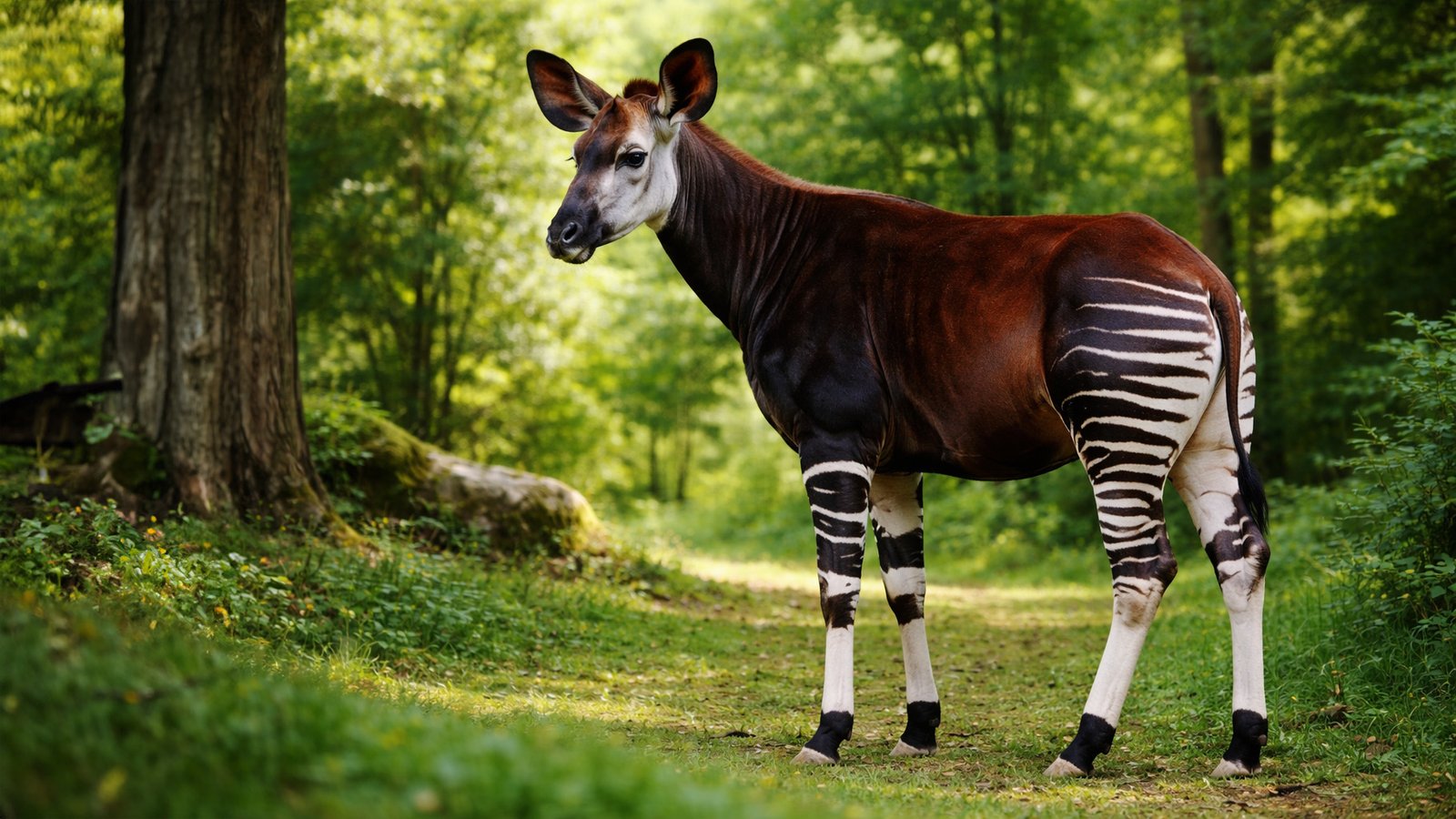
The okapi looks like an animal invented to test whether humans actually understand evolution or merely recognise familiar shapes. At first glance, it appears assembled rather than born. At the same time, the face whispers giraffe, while the legs shout zebra. The body, however, sits quietly in between, pretending not to notice the argument. That impression is not a modern internet joke. In fact, it is exactly how scientists, explorers, and museum curators reacted when the animal finally forced its way into Western science at the start of the twentieth century.
For centuries, the okapi lived comfortably beyond European certainty, deep in the rainforests of central Africa. Local communities, meanwhile, knew it well. They hunted it, named it, and folded it into their understanding of the forest. Outsiders, however, struggled to believe in it at all. Reports described an animal with stripes, cloven hooves, a long tongue, and giraffe-like features, yet living in dense jungle rather than open plains. To Victorian ears, this sounded less like zoology and more like a campfire story.
The setting mattered enormously. The Ituri Forest, in what is now the Democratic Republic of the Congo, is not a landscape that rewards casual observation. Visibility collapses after a few metres. Sound travels oddly. Movement dissolves into layers of green. As a result, animals adapted to this environment survive by not being seen. The okapi perfected that strategy long before anyone tried to sketch it.
Early European explorers heard about the animal indirectly, often from guides who described it with visible frustration at being doubted. Some called it a forest horse. Others compared it to a donkey with stripes. A few, however, leaned into the mystery and let the word unicorn slip into their reports, which did nothing to help credibility. By the late nineteenth century, the okapi existed in European minds as a rumour with hooves.
When physical evidence finally arrived, it did not resolve the problem. Instead, it made it worse. Strips of skin reached museums first. The bold black-and-white pattern on the legs looked undeniably zebra-like. Naturally, zoologists assumed the rest of the animal would confirm that conclusion. Then skull fragments followed, and the assumptions collapsed. The teeth did not belong to a horse. The skull proportions hinted at something closer to a giraffe. Consequently, the pieces refused to assemble into a familiar animal.
At the time, classification leaned heavily on visual analogy. Animals were grouped by what they resembled and where they lived. The okapi violated both principles at once. Giraffes belonged to open landscapes and extreme height. Stripes suggested speed, herds, and plains. Forest animals, by contrast, were expected to be uniformly coloured and compact. The okapi ignored every one of those expectations.
In 1901, the animal finally received a formal scientific description. Even then, acceptance arrived cautiously. Some researchers proposed it as a strange antelope. Others treated it as a relic species, a leftover from a forgotten lineage. The idea that it was a close relative of the giraffe felt counterintuitive and, to some, almost offensive to tidy evolutionary diagrams.
The irony is that the okapi’s anatomy makes perfect sense once the forest replaces the savannah as the reference point. Its neck is long, but not excessively so. In dense vegetation, height becomes a liability rather than an advantage. Instead, the okapi browses selectively, using reach rather than elevation. Its body remains muscular and compact, allowing quiet movement through undergrowth. Its gait, therefore, favours control over speed.
The tongue tells a clearer story. Like its taller cousin, the okapi has an extraordinarily long, prehensile tongue, dark in colour and remarkably dexterous. It strips leaves, manipulates branches, and even cleans the animal’s own ears. For that reason alone, this feature links it unmistakably to giraffes, regardless of how misleading the rest of the body appears.
The stripes, meanwhile, are not decorative confusion. In the filtered light of the rainforest, high-contrast patterns break up outlines and disrupt depth perception. To a predator, the okapi’s legs do not form a continuous shape. To a calf, however, the stripes act as visual anchors, making it easier to follow an adult through dense vegetation. In other words, what looks theatrical to humans functions as camouflage and communication at the same time.
The okapi’s behaviour reinforced its reputation as something half-imagined. It is solitary, territorial, and largely silent. Individuals maintain overlapping ranges, marking paths with scent glands rather than sound. Encounters between adults tend to be brief and understated. As a result, there are no dramatic displays and no loud calls echoing through the forest. Even researchers working with tracking technology report long periods without direct sightings.
That elusiveness fed the myth long after the species entered textbooks. Museum visitors stared at early mounts with suspicion. Zoo audiences assumed the animal was exaggerated or mislabelled. Photographs were accused of manipulation decades before digital editing existed. In short, the okapi did not look real, which turned out to be a social problem rather than a biological one.
Genetics eventually ended the debate with blunt efficiency. DNA analysis placed the okapi firmly alongside giraffes, confirming what skeletal anatomy had already suggested. The giraffid family, therefore, turned out to be more diverse than nineteenth-century zoology had allowed. The problem had never been the animal. Instead, it was the framework used to interpret it.
This moment offers a quiet lesson in how science progresses. Classification systems feel authoritative until something refuses to cooperate. The okapi exposed the limits of assumption-based taxonomy. In doing so, it demonstrated that habitat does not dictate lineage, and that appearance can mislead even experienced observers.
The animal also arrived at a cultural moment primed for misunderstanding. Colonial exploration blurred into spectacle. Exoticism sold newspapers and lecture tickets. Consequently, a creature that sounded unbelievable was often presented as such. The okapi became exotic not because it was rare to local people, but because it arrived filtered through disbelief.
Today, the okapi remains vulnerable, though no longer mythical. Habitat loss, mining, and political instability threaten the forests it depends on. Conservation efforts, however, face logistical and ethical challenges, particularly in regions where human survival pressures are immediate and intense. Protecting an animal that prefers invisibility complicates everything.
In zoos, the okapi still unsettles expectations. Visitors pause longer than they planned. Children ask whether it is real. Adults read the signage twice. Even now, the animal resists quick categorisation and refuses to become background fauna.
That resistance explains its enduring appeal. The okapi feels like a reminder from evolution that coherence is optional. Nature does not aim to reassure observers. Instead, it solves problems locally and improvisationally, without regard for how tidy the result appears to outsiders.
The okapi did not confuse scientists because it was strange. Rather, it confused them because it exposed habits of thinking that relied too heavily on visual shortcuts. Once those shortcuts failed, the animal slipped neatly into place, exactly where it had always been.
Half giraffe and half myth is not an insult. It is a description of perspective. Strip away the assumptions, and the myth dissolves. What remains is a forest browser perfectly adapted to its world, quietly ignoring the fact that humans took so long to believe in it at all.