The Long Road to Mechanical Washing
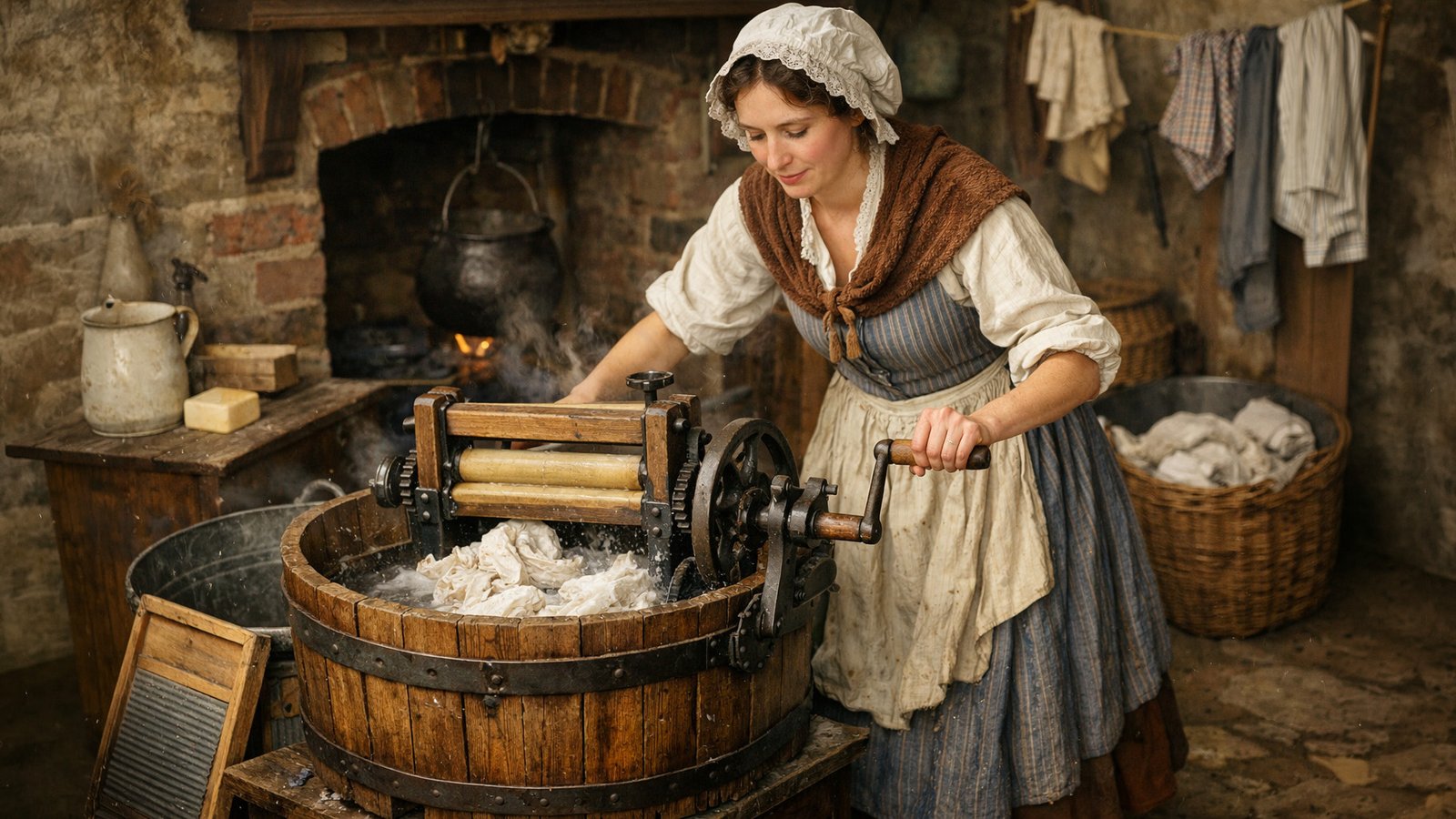
Washday ranked among the loudest, wettest, and most exhausting household rituals. It soaked kitchens, filled yards with steam, and left backs aching for days. Even so, people clung to hand washing far longer than modern logic suggests. The washing machine never burst into homes as a triumph of progress. Instead, it arrived slowly and cautiously, shaped by decades of mistrust, disappointment, and quiet resistance.
For centuries, households did not treat laundry as a problem waiting for invention. They treated it as a system. Everyone knew when washday came around. Families heated water once, usually in large iron pots that took hours to boil. Soap remained rough, homemade, and unpredictable. Clothes had to survive punishment, so people made them from thick linen, heavy cotton, and resilient wool. Neighbours often helped one another, while children fetched water, stirred tubs, and turned wringers. The work hurt, yet familiarity created confidence.
When mechanical washing devices appeared in the eighteenth and early nineteenth centuries, they failed to signal liberation. Instead, they introduced uncertainty. Inventors produced hand-cranked boxes fitted with paddles, plungers, or rocking frames. These devices promised to save muscle, yet they created fresh worries. Seams tore. Buttons snapped. Long garments tangled into damp knots that took longer to fix than scrubbing ever had. In households that owned only a few sets of clothes, damage mattered more than speed. A ruined shirt meant real financial loss.
Judgement therefore sat at the heart of laundry. Some stains needed soaking, while others required pressure. Wool demanded gentleness, whereas cotton tolerated abuse. Hands could feel resistance and adjust instantly. Early machines could not. They repeated the same motion relentlessly, whether the fabric needed it or not. Many women, who carried responsibility for laundry, doubted that a machine could truly understand dirt. Experience, not sentiment, shaped that scepticism.
Nineteenth-century advice manuals echoed this caution. Writers framed mechanical washers as helpful aids rather than full replacements and urged readers to watch them closely. They recommended frequent stops and warned against using them on delicate garments. In practice, machines demanded attention instead of removing labour. As a result, tools that required supervision lost their appeal quickly.
Soap chemistry lagged behind mechanical ambition. Early soaps varied wildly in strength and composition. Some left residue, while others stiffened fabric or yellowed whites. Human hands compensated by rinsing longer or scrubbing more lightly. Machines offered no such flexibility. Until manufacturers produced consistent soap, enclosed mechanical washing often delivered worse results than manual methods. The machine arrived before its supporting chemistry.
Water created an even larger barrier. A washing machine without plentiful hot water amounts to little more than an awkward barrel. Before indoor plumbing, people carried every bucket and heated every litre. Fires needed tending, and temperatures demanded constant attention. Adding a machine on top of that infrastructure rarely removed effort. In some homes, it increased it. Cranking a washer while hauling boiling water felt like progress only on paper.
Class dynamics slowed adoption further. Manufacturers marketed early washing machines mainly to middle-class households. Working-class families rarely had spare money, floor space, or stable surfaces for bulky equipment. Wealthier households, meanwhile, often employed servants or sent laundry to professional laundresses. Consequently, the people most burdened by washing gained the least access to machines. Those who could afford them rarely needed them urgently. This imbalance proved stubborn.
Gender tensions also shaped reception. Men designed, patented, and promoted most early washing machines. Women judged them. Advertisements promised liberation from drudgery, yet women’s magazines and household columns remained sceptical. Reviews listed leaks, rust, broken gears, and endless adjustments. The tone seldom sounded angry. Instead, it sounded tired. This still does not do what you claim.
Noise added another layer of unease. Early machines clattered and thumped, while water splashed across floors. Exposed belts and gears posed obvious risks. Hair and fingers caught easily. Records from the early twentieth century document injuries from electric washers, at a time when safety standards were still forming. In households already managing fire, steam, and heavy lifting, another hazard hardly felt like progress.
Electricity did not erase suspicion overnight. Many suppliers rented early electric washers rather than selling them outright. Ownership implied commitment, and commitment required trust. Households tried machines tentatively, returned them, and tried again years later as designs improved. Adoption zigzagged instead of moving forward smoothly.
Habit exerted quiet power. Washday remained washday long after machines appeared. Monday stayed Monday. Routines survived even as labour changed. In many homes, machines handled heavy items, while hands continued to wash delicate pieces for decades. Progress layered itself onto tradition rather than sweeping it aside.
Moral judgement also entered the picture. Critics sometimes framed mechanical washing as laziness. Household manuals warned readers against dependence on contrivances. Society still treated labour, especially women’s labour, as character-building. Clean clothes achieved through visible effort carried moral weight. Automation disrupted that logic, and disruption rarely goes unchallenged.
Mechanical washing only took hold once several systems aligned. Indoor plumbing spread. Electricity stabilised. Detergents became gentler and predictable. Designers enclosed moving parts, improved safety, and reduced size. Once machines genuinely reduced effort rather than rearranging it, trust followed. This alignment appeared unevenly, often between the 1920s and 1950s, depending on region and income.
By then, resistance faded through accumulation of experience rather than sudden conversion. Machines stopped tearing clothes. They stopped flooding kitchens. They stopped demanding constant supervision. Over time, they earned their place.
Looking back, the delay reads less like stubbornness and more like caution. Laundry sat at the centre of daily life, touching money, time, health, and dignity. People did not reject mechanical washing out of ignorance. They rejected it until it worked properly. In that sense, the long road to mechanical washing reflects not a failure of imagination, but a quiet triumph of collective scepticism.