The Khmissa and the Quiet Art of Keeping Trouble Out
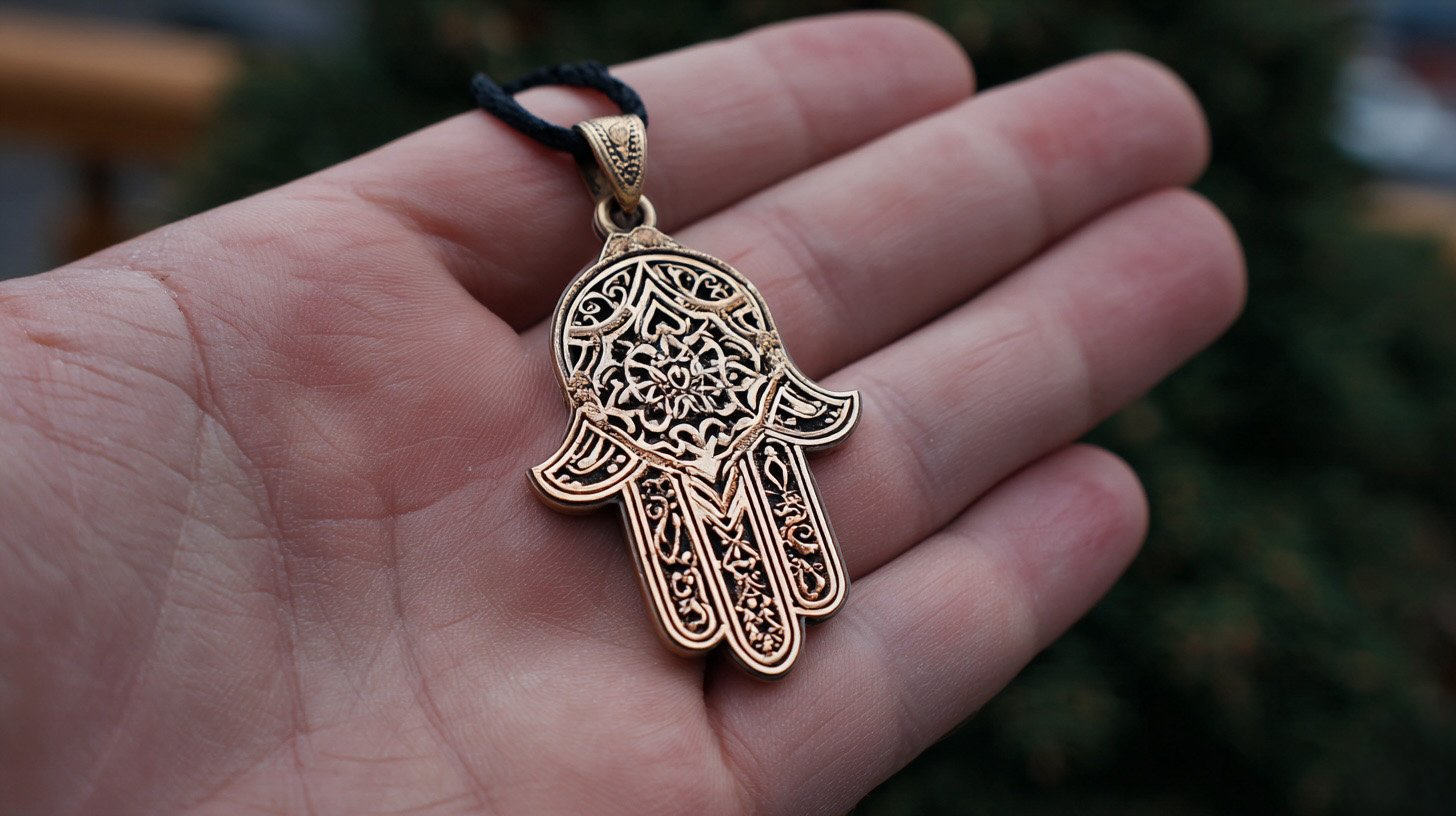
You notice the khmissa long before anyone explains it. It hangs quietly on a door in Fez, swings from a taxi mirror in Casablanca, sits engraved on a silver bracelet in a souk, or appears woven into a rug that has survived three generations and at least one very opinionated grandmother. Nobody points at it. Rarely does anyone announce it. Instead, it simply exists, like background music you only register once it stops.
The word comes from Arabic khamsa, meaning five, but that tidy linguistic explanation barely scratches the surface. In practice, the khmissa does not behave like a word. Rather, it behaves like a habit. People keep it around not because they constantly think about it, but because removing it would feel vaguely irresponsible, much like leaving the house without locking the door.
Long before Islam or Judaism gave the hand their own stories, the open palm already travelled the Mediterranean as a warning sign. Across Phoenician, Carthaginian, and other trading cultures, hands, eyes, and geometric marks signalled protection and boundaries. The logic stayed visual rather than theological. An open hand says stop. It also says enough, and quietly adds that whatever you are bringing with you does not pass.
That ancient visual grammar explains why the khmissa feels so durable. Over time, religions layered meanings on top of it, yet they never replaced the core idea. In Islamic tradition, the hand became associated with Fatima, the Prophet Muhammad’s daughter, admired for restraint, patience, and endurance. Jewish North African communities linked it to Miriam, sister of Moses, often pairing the hand with blessings or fish symbols. Both narratives arrived late to a symbol that already knew how to survive.
Everyday Maghrebi life treats the khmissa with casual seriousness. People who laugh at superstition still hang one near the front door. Those who insist they are rational still slip one onto a baby’s bracelet. This is not contradiction. It is cultural muscle memory at work. Much like knocking on wood or saying mashallah after a compliment, the gesture happens automatically because generations before already tested the alternative.
The evil eye sits at the centre of this story, although it rarely looks dramatic. In North Africa, envy is treated as a normal social force rather than a moral failure. At times, a stranger admires your child too intensely. Elsewhere, praise for a new house lingers a bit too freely. On another day, someone notices your good fortune while carrying the weight of their own bad luck. Trouble emerges not from malice, but from imbalance, and the khmissa exists to steady the moment before it tips.
Design choices quietly reinforce this logic. The hand almost never looks anatomically correct. Many khmissas feature two thumbs, creating perfect symmetry. By avoiding realism, the object stays symbolic rather than representational. It is not your hand or mine, but the idea of a hand. Often an eye appears in the centre, not to contradict the goal of blocking the evil eye, but to confront it directly. You look, I look back, and nothing slips through unnoticed.
Colour matters more than decoration. Blue dominates for both practical and symbolic reasons. Historically, blue pigments resisted fading in sun-heavy climates. Culturally, blue connects to water, sky, and calm across the Mediterranean. Silver appears more often than gold because it was affordable, durable, and associated with purity rather than display. The khmissa was never meant to show off wealth. Its job was to survive daily life.
Gender quietly shapes how the symbol travels. Women carry the khmissa more visibly, not because men reject it, but because women traditionally guarded domestic space and transitions. Birth, marriage, illness, and mourning passed through their hands. Bridal khmissas protected not only the bride, but the future household she represented. Baby khmissas signalled value more than fragility. You protect what matters.
Inside Moroccan homes, the khmissa often blends seamlessly into Amazigh visual language. It appears alongside lozenges, zigzags, and fertility motifs that predate Arabic script altogether. In rural areas, people may not even name it. Recognition comes instinctively, the way you recognise a familiar face without recalling where you first met. The symbol belongs to the place rather than to any explanation.
A layer of social politeness also sits inside the khmissa. It allows people to acknowledge risk without assigning blame. When something goes wrong, no neighbour gets accused of envy and no one blames themselves for carelessness. Instead, people accept that things happen. The hand was there. It did what it could. Life remains unpredictable.
Modernity complicated this arrangement without breaking it. As North African communities moved, their symbols travelled with them. The khmissa appeared in Paris flats, London kitchens, and New York jewellery boxes. Eventually, it crossed into fashion and interior design, rebranded as bohemian, spiritual, or vaguely Mediterranean. Context thinned along the way. Patterns survived.
This global popularity sparked mild controversy. Some see cultural flattening, a meaningful object reduced to décor. Others shrug and point out that symbols have always travelled. The khmissa itself borrowed freely long before anyone worried about authenticity. What matters locally is not whether outsiders understand it perfectly, but whether it still works where it counts.
Interestingly, the khmissa rarely provokes strict religious debate on the ground. Scholars may argue about orthodoxy, but everyday practice remains pragmatic. People combine prayer with protection, belief with habit. The hand does not replace faith. Instead, it accompanies it, like a quiet friend who does not interrupt.
There is something profoundly unambitious about the khmissa. It does not promise wealth, success, or transformation. What it offers is modest protection against imbalance. It does not guarantee happiness. It reduces risk. In an uncertain world, that restraint feels surprisingly modern.
Remove every khmissa from a city and nothing dramatic would happen. Doors would still open. Children would still grow. Life would continue. Even so, many people would feel slightly exposed, as if a familiar layer had gone missing. That reaction explains the symbol better than any myth.
The khmissa endures because it understands scale. It does not fight destiny. Instead, it addresses everyday friction. It lives comfortably between belief and habit, design and meaning, seriousness and irony. You can admire it aesthetically, question it intellectually, or ignore it completely. It will still hang there, palm open, quietly suggesting that some things are worth guarding, even when you are not entirely sure why.
In a world obsessed with optimisation and certainty, the khmissa offers something humbler. A pause. A boundary. A raised hand that says enough uncertainty has passed through today, and the rest can wait.