The Hippocratic Oath: Why Doctors Still Swear a 2,400-Year-Old Promise
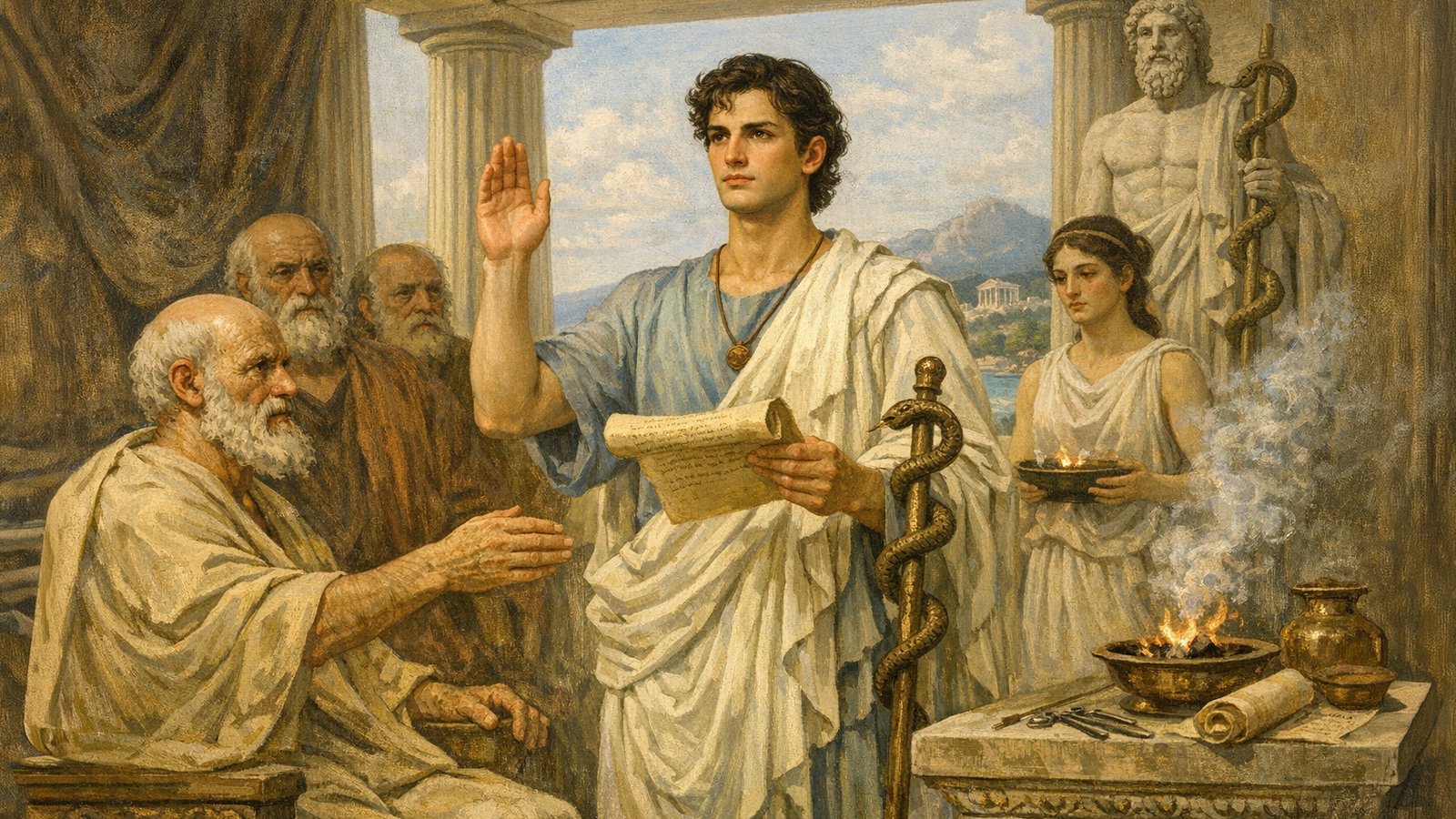
Picture a young physician in ancient Greece standing before teachers, colleagues, and perhaps a few curious onlookers. Instead of receiving a diploma, the doctor swears an oath to the gods. Apollo, Asclepius, Hygieia, Panacea. The promise sounds solemn, almost religious. Yet the real purpose is practical. Medicine, even then, was dangerous in the wrong hands. Patients trusted strangers with their bodies, their secrets, and often their lives. The oath existed to reassure society that doctors belonged to a profession with rules.
Historians believe the oath appeared sometime between the fifth and third centuries BCE. Tradition links it to Hippocrates of Kos, the physician often called the father of medicine. However, scholars now suspect it may have been written by later members of the Hippocratic school rather than by Hippocrates himself. Either way, the text became one of the earliest surviving statements about professional ethics in Western medicine.
At the beginning, the oath establishes something that feels surprisingly modern: medicine as a community. A new doctor promises to treat their teacher like a parent and to support them financially if needed. In return, the teacher shares medical knowledge freely. Education becomes a moral duty rather than a commercial transaction. The oath also insists that students teach the next generation. Knowledge, therefore, must circulate inside the profession rather than disappear with one doctor’s death.
Then the document moves to the core promise: help the sick and avoid causing harm. The exact phrase “first, do no harm” does not appear in the original wording, although the spirit clearly runs through it. A physician pledges to prescribe treatments that benefit patients according to their judgement and ability, while avoiding anything that could injure them. In a world without licensing boards, malpractice insurance, or regulatory agencies, this promise served as a primitive safety mechanism.
Several clauses in the ancient oath sound startling to modern ears. One line forbids doctors from giving a patient a deadly drug, even if the patient requests it. Another prohibits providing a substance intended to cause abortion. The oath also states that physicians should not perform surgical procedures for bladder stones, leaving that task to specialists. Surgery in antiquity often involved itinerant craftsmen with different training, and the oath attempted to keep general physicians within their competence.
Equally important is confidentiality. The physician promises never to reveal what they see or hear while treating patients. Illness exposes deeply private details about people’s lives. The oath recognises that without secrecy, patients might hide information or avoid treatment altogether. Even today, the idea that medical conversations remain private remains one of the most enduring elements of the ancient pledge.
Yet the oath was never a universal rulebook. Ancient Greek medicine contained many competing traditions, and not all doctors followed the Hippocratic school. Some historians even argue that the oath represented a minority ethical position rather than a universal one. Meanwhile, the text contains instructions that clearly did not match everyday medical practice of the time. Other Hippocratic writings discuss surgical procedures that the oath itself forbids. The contradiction suggests the oath functioned more like an idealistic manifesto than a practical handbook.
Over the centuries, the oath travelled far beyond Greece. Medieval European universities copied it into medical curricula. Later, Renaissance physicians printed it alongside other classical medical texts. However, the wording gradually changed. Translators modified phrases, inserted interpretations, and occasionally adjusted moral positions. As a result, the version many people quote today often differs from the earliest Greek wording.
Modern medicine eventually faced a dilemma. The original oath reflected a world without antibiotics, genetics, organ transplants, or intensive care. New ethical questions appeared: assisted dying, reproductive medicine, experimental treatments, public health policy. The ancient document offered little guidance for these problems. Doctors still valued its symbolism, but they needed a more detailed framework.
In 1948 the World Medical Association introduced the Declaration of Geneva, sometimes described as the modern successor to the Hippocratic Oath. This new pledge removed references to Greek gods and replaced them with commitments to humanity. Physicians promised to serve patients regardless of nationality, religion, or social status. The declaration also emphasised respect for human rights and medical neutrality during war. Not surprisingly, the shadow of the Second World War shaped much of its language.
Medical schools soon began adopting modified oaths. Some institutions kept fragments of the original text while rewriting controversial sections. Others allowed students to compose their own modern pledges. By the late twentieth century, very few schools still used the classical oath in its ancient form. Instead, most ceremonies feature customised versions reflecting contemporary ethical priorities.
Curiously, this constant rewriting does not weaken the tradition. If anything, it shows how seriously the profession takes the ritual. Each generation of doctors revisits the oath and asks the same question: what does responsible medicine mean now? The answers shift with society’s expectations and scientific progress.
Still, the ancient oath retains a peculiar power. Even people who know little about medical history recognise its name. The phrase “Hippocratic oath” has become shorthand for professional integrity. Politicians invoke it during debates about healthcare. Journalists cite it when discussing controversial treatments. Patients often assume their doctors have sworn it, even if the actual ceremony used a different text.
Perhaps the real legacy of the oath lies not in its precise wording but in its ambition. It was one of the first attempts to define medicine as a moral profession rather than merely a technical skill. A healer could not simply know how to treat disease. They also had to promise restraint, honesty, and loyalty to the patient.
More than two thousand years later, hospitals look very different from the temples and homes where Greek physicians once worked. Machines hum, screens glow, and treatment involves teams rather than solitary practitioners. Nevertheless, the central dilemma remains strangely familiar. People still place extraordinary trust in doctors. And society still expects medicine to honour that trust with a code of ethics worthy of the responsibility.
Post Comment
You must be logged in to post a comment.